
Table of Contents
Rama is a timeless name steeped in spiritual and cultural heritage, primarily known from Hindu tradition. Originating from Sanskrit, it carries the beautiful meaning of ‘pleasing’ or ‘delightful,’ while also representing one of the most revered figures in Hinduism. This name has transcended centuries through epics like the Ramayana, symbolizing ideals of righteousness and devotion. Whether chosen for its melodic sound or profound significance, Rama remains a powerful choice for parents worldwide.
Meaning of Rama
The name Rama derives from the Sanskrit root √ram, which means ‘to delight, to please, or to rejoice.’ In its adjectival form, राम (rāma) translates to ‘pleasing, charming, or delightful,’ reflecting a positive and agreeable essence. Linguistically, it is a well-documented term in ancient Indian texts, including the Vedas and classical literature. Its most prominent usage, however, is in the Hindu epic Ramayana, where Rama is the seventh avatar of the god Vishnu, embodying dharma (righteousness) and ideal human virtues. This dual meaning—both literal and mythological—gives the name deep layers of significance in Indian cultures.
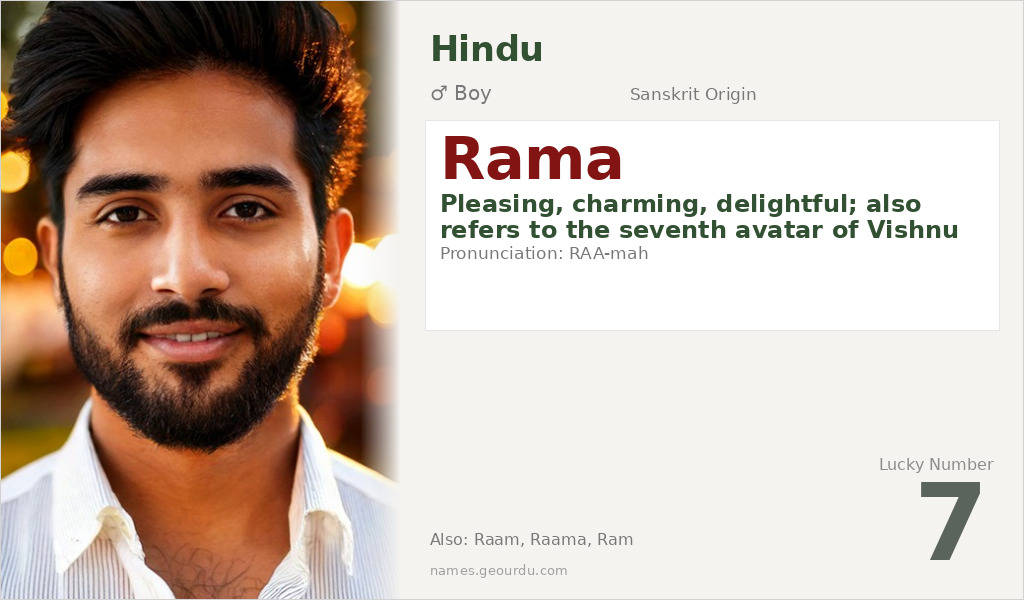
| 📛 Name | Rama |
| 💎 Meaning | Pleasing, charming, delightful; also refers to the seventh avatar of Vishnu in Hinduism |
| 👤 Gender | Boy |
| 🕌 Religion | Hindu |
| 🌍 Origin | Sanskrit |
| 🗣 Pronunciation | RAA-mah |
| ✍️ Urdu | رام |
| ✍️ Arabic | راما |
| 🔢 Numerology | 7 |
| ✨ Spellings | Raam, Raama, Ram |
Origin & Cultural Significance
Rama has its origins in Sanskrit, the classical language of ancient India, and is deeply embedded in Hindu religious texts. It gained widespread recognition through the Ramayana, composed by the sage Valmiki, which narrates the life and adventures of Prince Rama of Ayodhya. Over millennia, the name has spread across South and Southeast Asia, influencing languages like Hindi, Bengali, Tamil, Thai (as in the Thai royal title ‘Rama’), and even appearing in Indonesian and Filipino cultures due to historical Hindu-Buddhist influences. While primarily associated with Hinduism, the name is also used in Jain and Buddhist traditions, though with varying narratives.
Personality Traits
Inspired by the legendary figure, those named Rama are often associated with traits like integrity, compassion, and leadership. They may be seen as dependable and morally grounded, with a natural ability to inspire others. The name’s meaning of ‘pleasing’ also suggests a person who is agreeable, charming, and brings joy to their surroundings, balancing strength with gentleness.
Similar Names
If you like Rama, consider: Krishna, Arjun, Vishnu, Lakshman, Hanuman
Famous People Named Rama
- Rama — Seventh avatar of Vishnu in Hindu mythology, central figure of the Ramayana
- Rama IX (Bhumibol Adulyadej) — Former King of Thailand, whose regnal name includes Rama
Frequently Asked Questions About Rama
What does Rama mean?
Rama means 'pleasing, charming, or delightful' in Sanskrit. It also refers to the seventh avatar of the god Vishnu in Hinduism, a central figure in the epic Ramayana.
Is Rama a boy or girl name?
Rama is traditionally a boy's name in Hindu and Indian contexts, though variations like 'Ramaa' (with a long 'a') can be feminine in some usages.
What is the origin of Rama?
Rama originates from Sanskrit, an ancient Indian language, and is deeply rooted in Hindu religious and cultural traditions, particularly through the Ramayana epic.





