
Table of Contents
Ramanuja is a profound Sanskrit name with rich religious and cultural significance in Hinduism. Literally meaning ‘Rama’s younger brother,’ it directly references Lakshmana from the epic Ramayana. The name gained particular prominence through the 11th-century philosopher Ramanuja, founder of Sri Vaishnavism. Today, it remains a meaningful choice for boys in Hindu families, embodying devotion and spiritual heritage.
Meaning of Ramanuja
Ramanuja is a classical Sanskrit compound name with precise etymological roots. It combines ‘Rama’ (राम), referring to Lord Rama, the seventh avatar of Vishnu, and ‘Anuja’ (अनुज), meaning ‘younger brother’ or ‘born after.’ The complete name therefore translates to ‘Rama’s younger brother,’ specifically denoting Lakshmana in Hindu mythology. This linguistic construction follows standard Sanskrit compounding rules where the first element modifies the second. The name’s meaning is well-documented in Sanskrit literature and religious texts, particularly in reference to Lakshmana’s role as Rama’s devoted sibling in the Ramayana. Beyond the literal meaning, the name carries connotations of loyalty, service, and familial devotion.
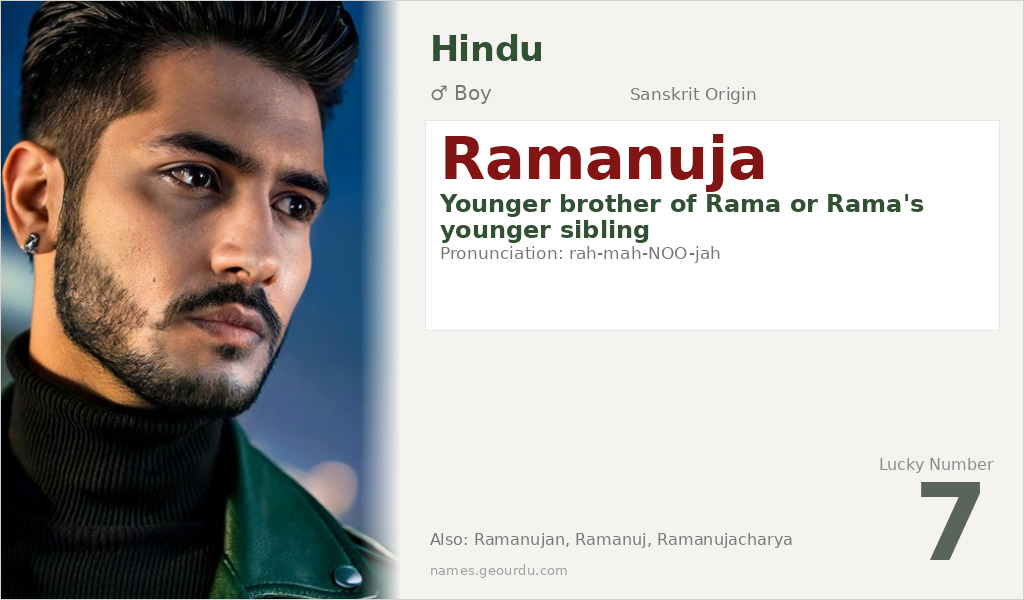
| 📛 Name | Ramanuja |
| 💎 Meaning | Younger brother of Rama or Rama's younger sibling |
| 👤 Gender | Boy |
| 🕌 Religion | Hindu |
| 🌍 Origin | Sanskrit |
| 🗣 Pronunciation | rah-mah-NOO-jah |
| ✍️ Urdu | رامانوج |
| ✍️ Arabic | رامانوجا |
| 🔢 Numerology | 7 |
| ✨ Spellings | Ramanujan, Ramanuj, Ramanujacharya |
Origin & Cultural Significance
Ramanuja originates from classical Sanskrit, the ancient liturgical language of Hinduism. Its primary cultural context is Hindu mythology, specifically the Ramayana where Lakshmana is Rama’s younger brother. The name gained significant historical importance through Ramanuja (1017–1137 CE), the influential philosopher who established the Sri Vaishnavism tradition and Vishishtadvaita (qualified non-dualism) school of Vedanta. This historical figure’s prominence elevated the name’s status in South Indian Hindu communities. While the name remains most common among Hindus, particularly in Tamil Nadu, Karnataka, and Andhra Pradesh, its usage has spread through the global Hindu diaspora. The name represents both mythological devotion and philosophical tradition in Hindu culture.
Personality Traits
Those named Ramanuja often embody qualities associated with both the mythological Lakshmana and the historical philosopher. They tend to be deeply spiritual, intellectually curious, and devoted to their principles and relationships. Many display natural leadership in philosophical or religious contexts, combined with humility and service-oriented attitudes. The name suggests someone who values tradition while potentially contributing new insights to spiritual or academic discussions.
Similar Names
If you like Ramanuja, consider: Lakshmana, Bharata, Shatrughna, Rama, Krishna, Vishnu, Anuja, Ramachandra, Ramakrishna, Raghav
Famous People Named Ramanuja
- Ramanuja (1017–1137 CE) — 11th-century Hindu philosopher, theologian, and social reformer who founded the Sri Vaishnavism tradition and Vishishtadvaita Vedanta school
- Srinivasa Ramanujan (1887–1920) — Renowned Indian mathematician whose name contains the same root elements, though with different meaning and composition
Frequently Asked Questions About Ramanuja
What does Ramanuja mean?
Ramanuja means 'Rama's younger brother' in Sanskrit, specifically referring to Lakshmana from the Hindu epic Ramayana. The name combines 'Rama' (Lord Rama) and 'Anuja' (younger brother).
Is Ramanuja a boy or girl name?
Ramanuja is exclusively a boy's name in Hindu tradition. It has masculine grammatical construction in Sanskrit and refers to male figures (Lakshmana and the philosopher Ramanuja).
What is the origin of Ramanuja?
Ramanuja originates from Sanskrit, the classical language of Hinduism. It has roots in Hindu mythology (referring to Lakshmana) and gained prominence through the 11th-century philosopher Ramanuja who founded Sri Vaishnavism.





