
Table of Contents
Ranganath is a powerful and culturally rich Sanskrit name that carries profound religious significance in Hinduism. Primarily used as an epithet for Lord Vishnu, this name combines two meaningful elements that reflect divine protection and cosmic performance. Popular among Hindu families, especially in South India, Ranganath connects bearers to one of India’s most important temple traditions. The name evokes images of vibrant spirituality and divine guardianship.
Meaning of Ranganath
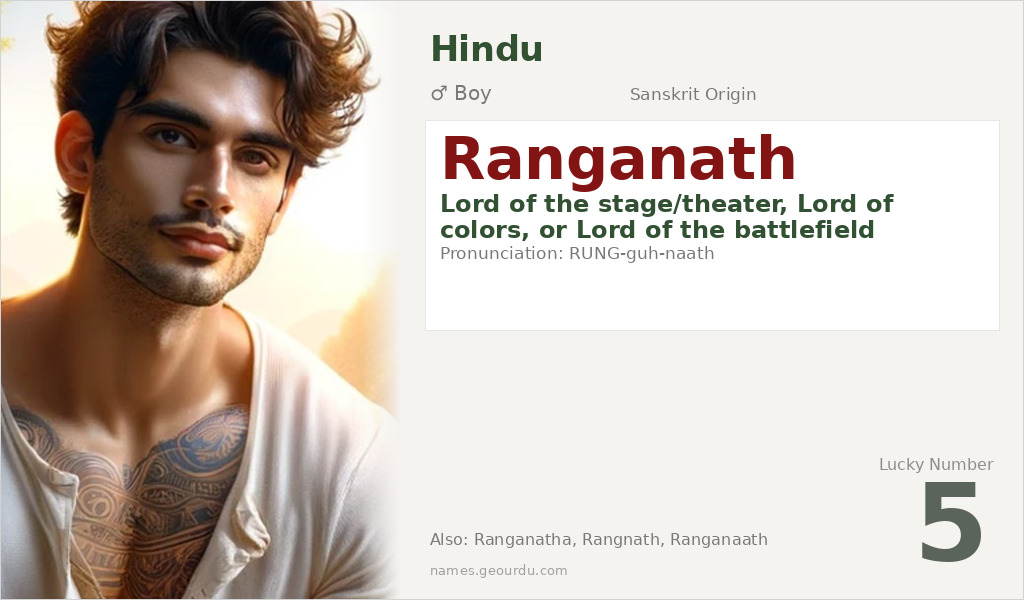
Ranganath is a compound Sanskrit name with precise etymological roots. The first component ‘Ranga’ (रङ्ग) has multiple related meanings including ‘stage’, ‘theater’, ‘arena’, ‘battlefield’, and ‘color’—all conveying a sense of space where action or performance occurs. The second component ‘Nath’ (नाथ) means ‘lord’, ‘master’, ‘protector’, or ‘refuge’. Together, they create meanings like ‘Lord of the Stage’ (referring to Vishnu’s cosmic play), ‘Lord of Colors’ (reflecting his vibrant nature), or ‘Lord of the Battlefield’ (as protector). This name appears in ancient Hindu scriptures and temple inscriptions, particularly associated with the Srirangam Vishnu temple in Tamil Nadu, one of the eight self-manifested shrines in Vaishnavism.
| 📛 Name | Ranganath |
| 💎 Meaning | Lord of the stage/theater, Lord of colors, or Lord of the battlefield |
| 👤 Gender | Boy |
| 🕌 Religion | Hindu |
| 🌍 Origin | Sanskrit |
| 🗣 Pronunciation | RUNG-guh-naath |
| ✍️ Urdu | رنگ ناتھ |
| ✍️ Arabic | رانجاناث |
| 🔢 Numerology | 5 |
| ✨ Spellings | Ranganatha, Rangnath, Ranganaath |
Origin & Cultural Significance
Ranganath originates from classical Sanskrit and holds special significance in Hindu Vaishnavite tradition. The name gained prominence through the Srirangam temple in Tamil Nadu, dedicated to ‘Sri Ranganatha Swamy’—a reclining form of Vishnu on the serpent Adishesha. This temple, dating back to the early centuries CE, became one of the most important pilgrimage sites in South India. The name spread through devotional literature, temple traditions, and as a given name for boys in Hindu families, particularly among Tamil, Kannada, and Telugu communities. It represents both a specific deity form and a broader concept of Vishnu as the lord of the cosmic theater where divine drama unfolds.
Personality Traits
Those named Ranganath often exhibit leadership qualities combined with artistic sensibility. They tend to be protective of their loved ones while enjoying expressive, creative pursuits. The name’s association with performance and color suggests individuals who are dynamic, engaging, and capable of commanding attention in social or professional settings. Their inherent sense of duty often makes them reliable and responsible in their relationships and commitments.
Similar Names
If you like Ranganath, consider: Rangaraj, Rangadhar, Rangapati, Vishnu, Narayana
Famous People Named Ranganath
- Sri Ranganatha Swamy — The presiding deity of Srirangam temple, one of the most important Vaishnavite shrines in India
- Ranganath Misra — Former Chief Justice of India (1990-1991) and human rights advocate
Frequently Asked Questions About Ranganath
What does Ranganath mean?
Ranganath means 'Lord of the stage/theater', 'Lord of colors', or 'Lord of the battlefield' in Sanskrit. It's a compound name combining 'Ranga' (stage/color) and 'Nath' (lord/protector).
Is Ranganath a boy or girl name?
Ranganath is exclusively a boy's name in Hindu naming tradition. It's used as both a given name and an epithet for the male deity Lord Vishnu.
What is the origin of Ranganath?
Ranganath originates from Sanskrit and holds special significance in Hindu Vaishnavism, particularly associated with the Srirangam temple tradition in Tamil Nadu, South India.





