Table of Contents
Rasamanjari is a beautiful and meaningful Sanskrit name for girls that carries deep literary and aesthetic significance. Derived from classical Indian poetic tradition, this name evokes imagery of emotional richness and artistic expression. With roots in Sanskrit literature and philosophy, Rasamanjari represents the beautiful arrangement of human emotions and experiences. This name continues to be cherished in Hindu families for its cultural depth and melodic sound.
Meaning of Rasamanjari
Rasamanjari is a compound Sanskrit name with profound literary significance. The first component ‘rasa’ (रस) has multiple layers of meaning in Sanskrit — originally meaning ‘juice’ or ‘essence,’ it evolved to signify ’emotion,’ ‘aesthetic experience,’ and specifically in literary theory, the nine fundamental emotions or sentiments in poetry and drama. The second component ‘manjari’ (मञ्जरी) means ‘a cluster,’ ‘garland,’ ‘bouquet,’ or ‘collection.’ Thus, Rasamanjari literally translates to ‘a garland of emotions’ or ‘a collection of poetic sentiments.’ In classical Sanskrit literature, the term appears in titles of poetic works and commentaries on rasa theory, making it a name deeply embedded in India’s literary heritage.
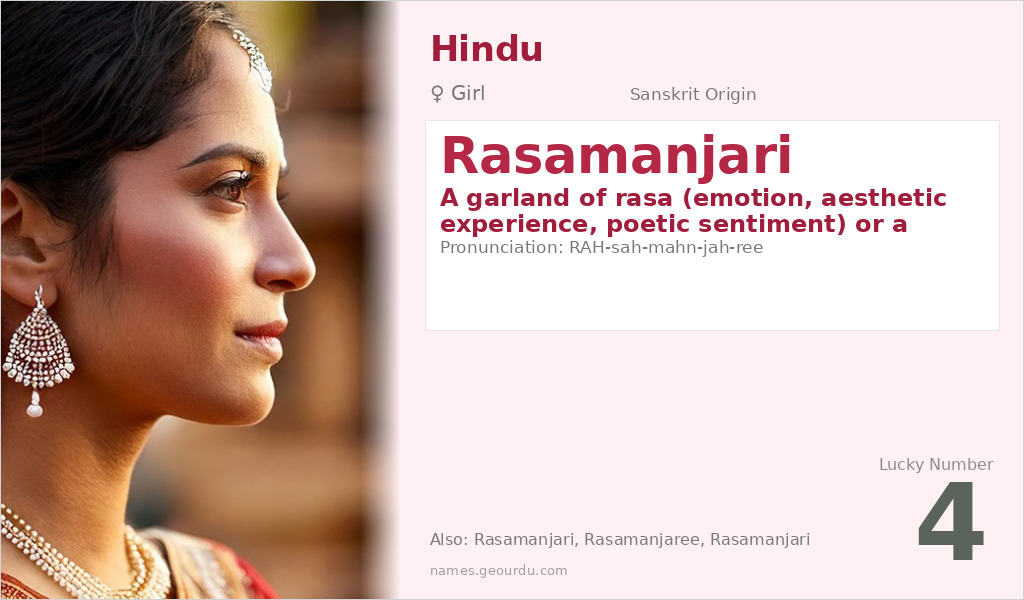
| 📛 Name | Rasamanjari |
| 💎 Meaning | A garland of rasa (emotion, aesthetic experience, poetic sentiment) or a collection of emotional/poetic compositions |
| 👤 Gender | Girl |
| 🕌 Religion | Hindu |
| 🌍 Origin | Sanskrit |
| 🗣 Pronunciation | RAH-sah-mahn-jah-ree |
| ✍️ Urdu | رسامنجری |
| ✍️ Arabic | راسامانجاري |
| 🔢 Numerology | 4 |
| ✨ Spellings | Rasamanjari, Rasamanjaree, Rasamanjari, Rasamanjari |
Origin & Cultural Significance
Rasamanjari originates from classical Sanskrit, the ancient liturgical language of Hinduism, Buddhism, and Jainism. The name emerges from India’s rich literary tradition, particularly the theory of rasa (aesthetic experience) developed in works like Bharata’s Natya Shastra. Historically, ‘Rasamanjari’ has been used as both a personal name and a title for poetic anthologies and commentaries. The most famous literary work with this title is Bhanudatta’s ‘Rasamanjari,’ a 15th-century Sanskrit text on erotic poetry. The name reflects the sophisticated aesthetic philosophy that has influenced Indian arts for centuries and continues to be used primarily within Hindu communities.
Personality Traits
Those named Rasamanjari often embody the artistic and emotional qualities suggested by their name’s meaning. They tend to be creative individuals with a strong appreciation for beauty, art, and literature. Their emotional intelligence and sensitivity make them perceptive and empathetic in personal relationships. Like a carefully arranged garland of flowers, they often bring harmony and aesthetic pleasure to their surroundings through their creative expressions and interpersonal connections.
Similar Names
If you like Rasamanjari, consider: Rasika, Manjari, Rasamrita, Rasavati, Manjusha
Famous People Named Rasamanjari
- Rasamanjari — A 15th-century Sanskrit poetess and author of erotic poetry
- Rasamanjari — Title of several classical Sanskrit poetic works and commentaries on rasa theory
Frequently Asked Questions About Rasamanjari
What does Rasamanjari mean?
Rasamanjari means 'a garland of emotions' or 'a collection of poetic sentiments' in Sanskrit. It combines 'rasa' (emotion, aesthetic experience) and 'manjari' (garland, collection).
Is Rasamanjari a boy or girl name?
Rasamanjari is exclusively a girl's name in Hindu naming tradition. The feminine ending '-i' and its association with poetic beauty and emotion align with traditional feminine naming patterns in Sanskrit.
What is the origin of Rasamanjari?
Rasamanjari originates from classical Sanskrit, the ancient language of India. It comes from India's literary tradition and specifically references the theory of rasa (aesthetic emotions) in poetry and drama.