
Table of Contents
Rishikesh is a profound and spiritual name deeply rooted in Hindu tradition, often chosen for boys to invoke divine qualities. Derived from Sanskrit, it combines ‘ṛṣi’ (sage) and ‘īśa’ (lord), symbolizing mastery over the senses and spiritual wisdom. This name is not only popular in India but also carries the legacy of the sacred city of Rishikesh, a hub for yoga and meditation. Embracing this name connects a child to a rich heritage of enlightenment and devotion.
Meaning of Rishikesh
Rishikesh is a Sanskrit compound name with a clear and well-documented etymology. It is formed from ‘ṛṣi’ (ऋषि), meaning ‘sage’, ‘seer’, or ‘wise one’, and ‘īśa’ (ईश), meaning ‘lord’, ‘master’, or ‘ruler’. Thus, Rishikesh translates to ‘Lord of the sages’ or ‘Lord of the senses’, highlighting a connection to spiritual authority and control. In Hindu mythology, it is an epithet for Lord Vishnu, emphasizing his role as the supreme guide for ascetics and seekers. The name also relates to the concept of ‘Hrishikesha’, another name for Vishnu meaning ‘lord of the senses’, found in texts like the Bhagavad Gita. Linguistically, it showcases the classical Sanskrit tradition of combining meaningful roots to create names with deep philosophical implications.
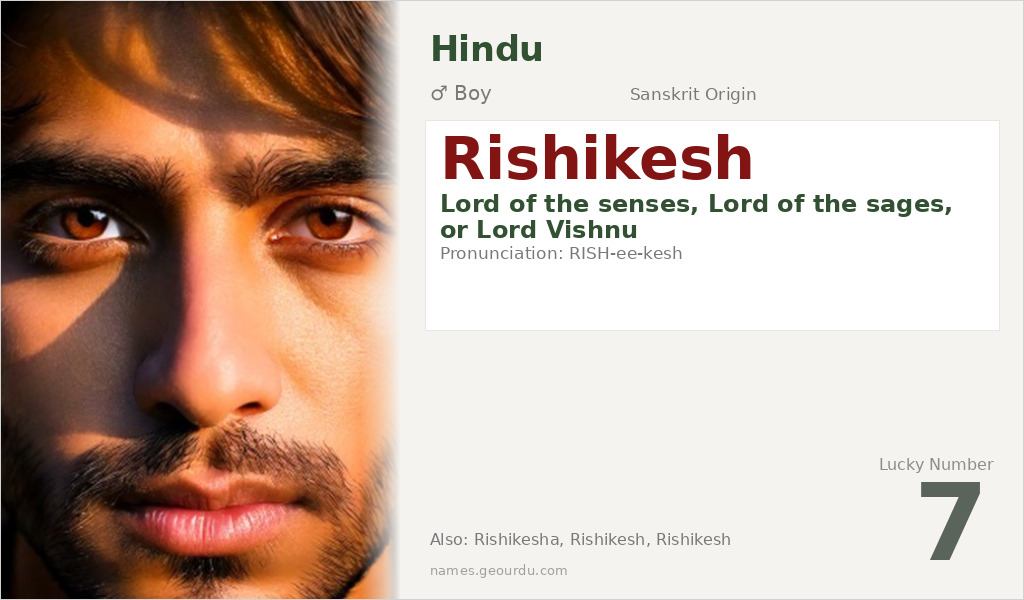
| 📛 Name | Rishikesh |
| 💎 Meaning | Lord of the senses, Lord of the sages, or Lord Vishnu |
| 👤 Gender | Boy |
| 🕌 Religion | Hindu |
| 🌍 Origin | Sanskrit |
| 🗣 Pronunciation | RISH-ee-kesh |
| ✍️ Urdu | رشی کش |
| ✍️ Arabic | ريشيكيش |
| 🔢 Numerology | 7 |
| ✨ Spellings | Rishikesha, Rishikesh, Rishikesh |
Origin & Cultural Significance
Originating from Sanskrit, an ancient Indo-Aryan language, Rishikesh has been used for centuries within Hindu culture, particularly in India and among Hindu communities worldwide. It is closely tied to the holy city of Rishikesh in Uttarakhand, India, which is named after Lord Vishnu in this form and is renowned as a center for spirituality and yoga. The name appears in Hindu scriptures and epics, reflecting its religious significance as a title for deities and enlightened beings. Over time, it has remained a popular choice for boys, symbolizing virtues like wisdom, leadership, and devotion. Its usage extends beyond personal names to place names and spiritual contexts, underscoring its enduring cultural impact.
Personality Traits
Those named Rishikesh are often perceived as calm, thoughtful, and spiritually inclined, drawing from the name’s association with sages and lordship. They may exhibit traits of introspection, discipline, and a natural ability to guide others, mirroring the qualities of a wise leader. This name inspires a life focused on inner growth, knowledge, and harmony, making it suitable for individuals who value tradition and enlightenment.
Similar Names
If you like Rishikesh, consider: Vishnu, Krishna, Rishi, Ishwar, Hrishikesh
Famous People Named Rishikesh
- Rishikesh — A holy city in India, named after Lord Vishnu, known as the 'Yoga Capital of the World'
- Rishikesh — Various Indian spiritual leaders and scholars bearing this name
Frequently Asked Questions About Rishikesh
What does Rishikesh mean?
Rishikesh means 'Lord of the senses', 'Lord of the sages', or 'Lord Vishnu', derived from the Sanskrit words 'ṛṣi' (sage) and 'īśa' (lord).
Is Rishikesh a boy or girl name?
Rishikesh is traditionally a boy's name in Hindu culture, reflecting masculine divine qualities and historical usage for males.
What is the origin of Rishikesh?
Rishikesh originates from Sanskrit, an ancient Indian language, and is deeply rooted in Hindu religion and mythology, often associated with Lord Vishnu and the holy city of Rishikesh.





