
Table of Contents
Ritish is a distinctive Hindu boy name with deep roots in Sanskrit tradition. Meaning ‘lord’, ‘master’, or ‘ruler’, this name carries connotations of authority and leadership that have made it popular in Hindu communities. With its strong phonetic presence and meaningful etymology, Ritish represents both cultural heritage and aspirational qualities for a child. This comprehensive guide explores everything from its linguistic origins to modern usage.
Meaning of Ritish
Ritish derives from the Sanskrit word ‘Riti’ (रिति), which fundamentally means ‘lord’, ‘master’, ‘ruler’, or ‘king’. The name is formed by adding the suffix ‘-ish’, which in Sanskrit can denote possession or lordship, similar to how ‘-esh’ functions in names like Mahesh (great lord). This etymology connects Ritish to the broader Sanskrit vocabulary of sovereignty and authority, including related terms like Raja (king) and Rajesh (lord of kings). The name appears in classical Sanskrit literature and Hindu texts, often associated with figures of importance or divinity. Unlike some claims, it does not specifically mean ‘Lord of Love’—that interpretation appears to be a modern misattribution without linguistic basis in the original Sanskrit.
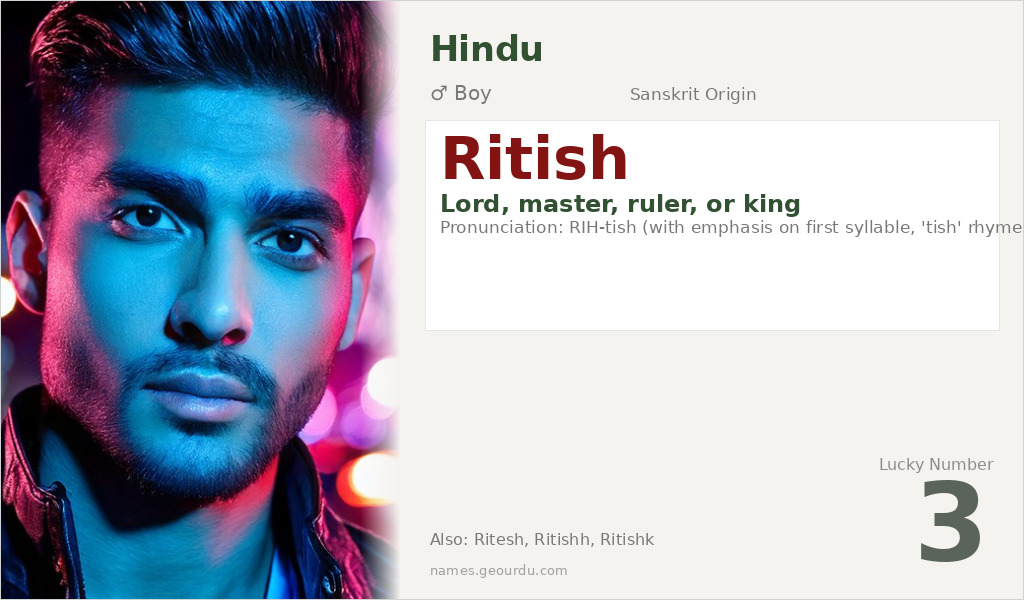
| 📛 Name | Ritish |
| 💎 Meaning | Lord, master, ruler, or king |
| 👤 Gender | Boy |
| 🕌 Religion | Hindu |
| 🌍 Origin | Sanskrit |
| 🗣 Pronunciation | RIH-tish (with emphasis on first syllable, 'tish' rhymes with 'wish') |
| ✍️ Urdu | رتش |
| ✍️ Arabic | ريتيش |
| 🔢 Numerology | 3 |
| ✨ Spellings | Ritesh, Ritishh, Ritishk, Ritishka |
Origin & Cultural Significance
Ritish originates from Sanskrit, the classical language of ancient India and the primary liturgical language of Hinduism. As a Sanskrit-derived name, it belongs to the Indo-European language family and shares roots with other Sanskrit names common in Hindu communities across India and the diaspora. The name reflects traditional Hindu values that emphasize leadership, duty, and righteous authority (dharma). While most commonly used in Hindu families, the name’s Sanskrit origin means it could theoretically be adopted by anyone appreciating its linguistic and cultural heritage. Its usage spans various regions of India, particularly in states with strong Sanskrit traditions like Maharashtra, Gujarat, and parts of North India.
Personality Traits
The meaning of Ritish as ‘lord’ or ‘ruler’ often influences perceptions of personality traits associated with the name. Those named Ritish are frequently seen as natural leaders with strong organizational skills and decisive natures. They may exhibit confidence in their abilities and approach challenges with determination and strategic thinking. While these associations are cultural rather than deterministic, many parents choose this name hoping to instill qualities of responsibility, authority, and capability in their child.
Similar Names
If you like Ritish, consider: Ritesh, Ritvik, Ritam, Ritendra, Ritoban
Famous People Named Ritish
- Ritish Deshmukh — Indian film producer and director known for Hindi cinema
- Ritish Venkataramani — Indian-American scientist and researcher in computational biology
Frequently Asked Questions About Ritish
What does Ritish mean?
Ritish means 'Lord', 'Master', 'Ruler', or 'King' in Sanskrit. It derives from the Sanskrit word 'Riti' with the suffix '-ish' denoting lordship.
Is Ritish a boy or girl name?
Ritish is exclusively a boy name in Hindu naming tradition. The masculine form and meaning relate to male authority figures in Sanskrit culture.
What is the origin of Ritish?
Ritish originates from Sanskrit, the classical language of ancient India and primary language of Hindu scriptures. It's an Indo-European language with deep cultural significance in Hindu communities.





