
Table of Contents
Rudra is a powerful Sanskrit name with deep roots in ancient Indian spirituality and mythology. Originally appearing in the Rigveda as a deity of storms and hunting, this name evolved to become one of the primary epithets of Lord Shiva in Hinduism. Carrying meanings like ‘The Roarer’ or ‘The Howler,’ Rudra represents both the terrifying and protective aspects of the divine. Today, it remains a popular choice for boys in Hindu families, symbolizing strength and transformation.
Meaning of Rudra
The name Rudra derives from the Sanskrit root ‘rud,’ which means ‘to cry, howl, or roar.’ This etymological foundation gives Rudra its primary meaning of ‘The Roarer’ or ‘The Howler.’ In Vedic literature, particularly the Rigveda, Rudra appears as a deity associated with storms, wind, hunting, and medicine—often described as fierce, roaring, and capable of both causing and curing diseases. In post-Vedic Hinduism, Rudra became identified with Shiva, specifically representing Shiva’s terrifying aspect as the destroyer within the Trimurti. The name thus carries dual significance: its literal meaning referring to roaring sounds (like storms), and its theological meaning as a manifestation of divine power that destroys to enable regeneration.
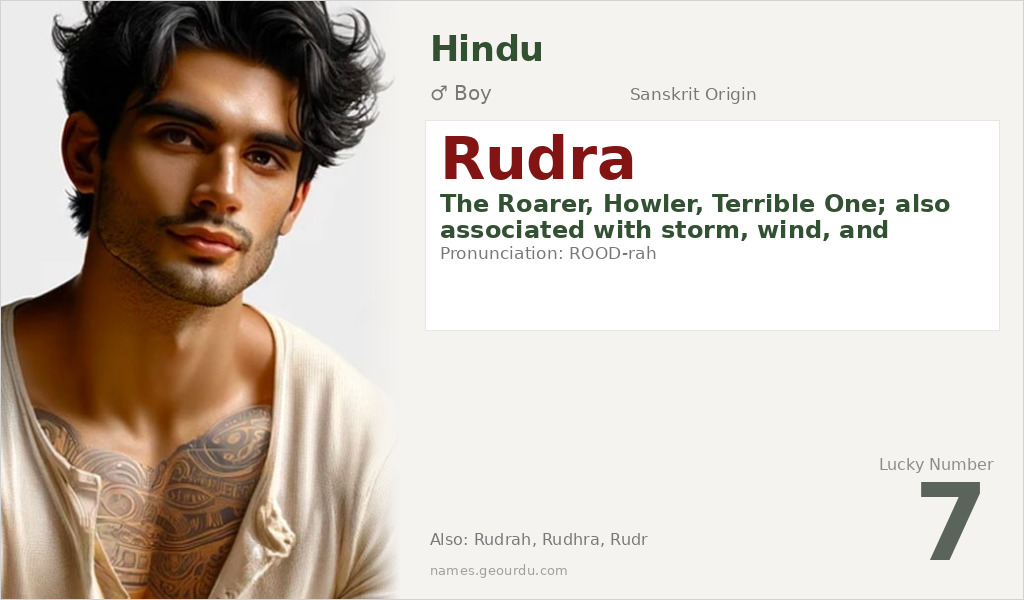
| 📛 Name | Rudra |
| 💎 Meaning | The Roarer, Howler, Terrible One; also associated with storm, wind, and hunting in Vedic context; later identified with Shiva in Hinduism |
| 👤 Gender | Boy |
| 🕌 Religion | Hindu |
| 🌍 Origin | Sanskrit |
| 🗣 Pronunciation | ROOD-rah |
| ✍️ Urdu | رُدر |
| ✍️ Arabic | رودرا |
| 🔢 Numerology | 7 |
| ✨ Spellings | Rudrah, Rudhra, Rudr |
Origin & Cultural Significance
Rudra originates from ancient Sanskrit texts, first appearing in the Rigveda (circa 1500–1200 BCE) as an important Vedic deity. In these early hymns, Rudra is portrayed as a complex figure—both feared and revered—associated with storms, winds, hunting, and healing. The name’s cultural evolution is significant: from a distinct Vedic god to becoming synonymous with Shiva in later Hindu traditions. This transition occurred gradually through texts like the Yajurveda and Puranas, where Rudra’s attributes were absorbed into Shiva’s characterization. The name remains particularly significant in Shaivism, where Rudra represents one of Shiva’s eleven forms (Rudras). While primarily used in Hindu communities, the name has gained some cross-cultural recognition through Indian diaspora communities worldwide.
Personality Traits
Those named Rudra are often associated with intensity, power, and transformative energy. The name suggests a personality that can weather life’s challenges with resilience, much like the storm god it references. Individuals with this name may exhibit strong protective instincts and natural leadership qualities, though they might also display a fierce determination when pursuing important goals. The connection to Shiva adds layers of spiritual depth, suggesting someone who understands the necessity of destruction for renewal and growth.
Similar Names
If you like Rudra, consider: Shiva, Mahadeva, Bhairava, Nataraja, Tryambaka
Famous People Named Rudra
- Rudra Pratap Singh — Indian cricketer
- Rudra — Indian death metal band formed in 1992
Frequently Asked Questions About Rudra
What does Rudra mean?
Rudra means 'The Roarer' or 'Howler' in Sanskrit, derived from the root 'rud' meaning to cry or howl. In Vedic context, it refers to the storm god, while in Hinduism it's a name for Shiva.
Is Rudra a boy or girl name?
Rudra is exclusively a boy's name in Hindu tradition, as it refers to male deities (the Vedic god Rudra and later Shiva). There are no recorded feminine usages in historical or contemporary contexts.
What is the origin of Rudra?
Rudra originates from Sanskrit, first appearing in the Rigveda (circa 1500–1200 BCE) as a Vedic deity of storms and hunting. It evolved within Hinduism to become one of Shiva's primary names.





