Table of Contents
Rukhmani is a beautiful Sanskrit name with deep roots in Hindu mythology and tradition. Most famously associated with Lord Krishna’s principal consort, this name carries centuries of cultural significance and spiritual meaning. For parents seeking a name with classical heritage and divine connections, Rukhmani offers both historical depth and contemporary elegance. Its melodic sound and rich background make it a meaningful choice for girls across Hindu communities.
Meaning of Rukhmani
The name Rukhmani derives from the Sanskrit word ‘rukma,’ meaning ‘gold,’ ‘shining,’ or ‘radiant,’ combined with the suffix ‘-ni’ that indicates possession or quality. Thus, the name literally translates to ‘adorned with gold’ or ‘jewel-like,’ reflecting beauty and preciousness. In Hindu scriptures, particularly the Mahabharata and Bhagavata Purana, Rukhmani (more commonly spelled Rukmini) is the princess of Vidarbha who becomes Lord Krishna’s first wife through divine love. The name symbolizes not just physical beauty but also spiritual grace, devotion, and royal dignity. Across various Indian languages, the name maintains its core meaning while adapting to regional pronunciations and spellings.
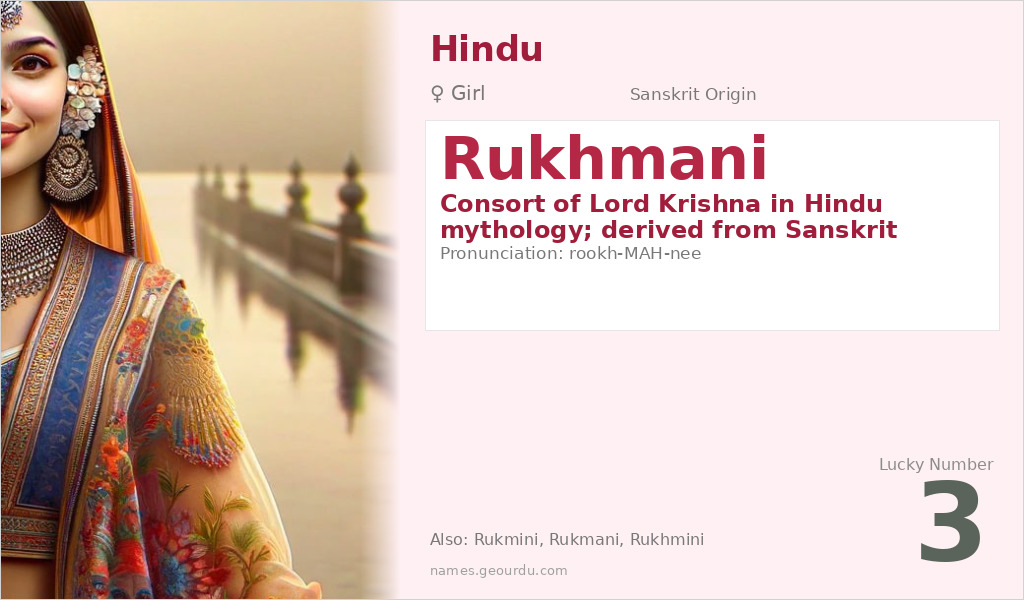
| 📛 Name | Rukhmani |
| 💎 Meaning | Consort of Lord Krishna in Hindu mythology; derived from Sanskrit meaning 'adorned with gems' or 'jewel-like' |
| 👤 Gender | Girl |
| 🕌 Religion | Hindu |
| 🌍 Origin | Sanskrit |
| 🗣 Pronunciation | rookh-MAH-nee |
| ✍️ Urdu | رخمینی |
| ✍️ Arabic | روخميني |
| 🔢 Numerology | 3 |
| ✨ Spellings | Rukmini, Rukmani, Rukhmini, Rukmanee |
Origin & Cultural Significance
Rukhmani originates from classical Sanskrit literature and Hindu mythology dating back over two millennia. The name first appears in the Mahabharata (circa 400 BCE-400 CE) and is elaborated in the Bhagavata Purana (circa 8th-10th century CE), where Rukhmani’s story is celebrated as one of divine love and devotion. As a historical name, it has been used primarily in Hindu communities across India, particularly in Maharashtra, Gujarat, and South India where the Rukhmani-Krishna tradition is especially revered. The name spread through religious texts, devotional poetry, and cultural traditions, maintaining its association with the mythological figure while becoming a popular given name. In modern times, variations like Rukmini remain common, preserving the name’s ancient roots while adapting to contemporary usage.
Personality Traits
Those named Rukhmani often embody qualities associated with their mythological namesake: grace, devotion, and inner strength. They tend to be spiritually inclined, artistic, and value deep, meaningful relationships. With natural leadership abilities and a compassionate nature, Rukhmanis often excel in creative fields or roles that require emotional intelligence. Their name’s connection to radiance and preciousness frequently manifests as a charismatic presence and appreciation for beauty in all forms.
Similar Names
If you like Rukhmani, consider: Radha, Sita, Draupadi, Subhadra, Satya
Famous People Named Rukhmani
- Rukmini Devi Arundale — Indian classical dancer, choreographer and theosophist who revived Bharatanatyam
- Rukmini Bhaya Nair — Indian poet, linguist and writer, professor at Indian Institute of Technology Delhi
Frequently Asked Questions About Rukhmani
What does Rukhmani mean?
Rukhmani means 'adorned with gems' or 'jewel-like' in Sanskrit, referring to radiance and preciousness. In Hindu mythology, it specifically names Lord Krishna's principal consort.
Is Rukhmani a boy or girl name?
Rukhmani is exclusively a girl's name in Hindu tradition, named after the female mythological figure who was Krishna's wife.
What is the origin of Rukhmani?
Rukhmani originates from Sanskrit and Hindu mythology, first appearing in ancient texts like the Mahabharata as the name of Krishna's consort.