Table of Contents
Rupamanjari is a beautiful and poetic Sanskrit name that has graced Hindu culture for centuries. Meaning ‘a garland of beautiful forms’ or ‘one whose beauty resembles a bouquet of blossoms’, this name carries deep aesthetic and cultural significance. Primarily used for girls, Rupamanjari reflects the rich tradition of compound names in Sanskrit literature. Let’s explore the fascinating etymology, cultural context, and modern relevance of this elegant name.
Meaning of Rupamanjari
Rupamanjari derives from two classical Sanskrit words: ‘Rupa’ (रूप) and ‘Manjari’ (मञ्जरी). ‘Rupa’ is a fundamental term in Sanskrit aesthetics, meaning form, beauty, appearance, or shape, and appears in philosophical texts discussing the nature of reality and perception. ‘Manjari’ specifically refers to a cluster of flowers, tender shoots, or a garland, often used poetically to describe something delicate and beautiful. When combined, Rupamanjari creates a vivid image of beauty arranged or collected like a floral garland. This compound construction is characteristic of Sanskrit naming traditions, where elements are combined to create nuanced, poetic meanings. The name appears in various Hindu literary works and is associated with feminine grace and aesthetic perfection.
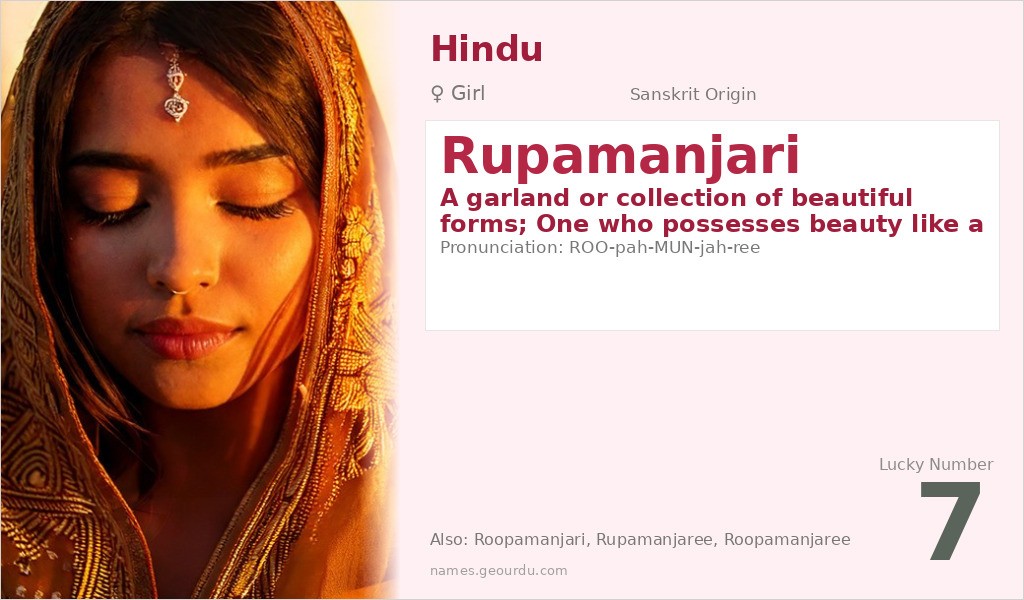
| 📛 Name | Rupamanjari |
| 💎 Meaning | A garland or collection of beautiful forms; One who possesses beauty like a garland of flowers |
| 👤 Gender | Girl |
| 🕌 Religion | Hindu |
| 🌍 Origin | Sanskrit |
| 🗣 Pronunciation | ROO-pah-MUN-jah-ree |
| ✍️ Urdu | روپامنجری |
| ✍️ Arabic | روبامانجاري |
| 🔢 Numerology | 7 |
| ✨ Spellings | Roopamanjari, Rupamanjaree, Roopamanjaree |
Origin & Cultural Significance
Rupamanjari originates from classical Sanskrit, the ancient liturgical language of Hinduism that has influenced numerous South Asian languages. As a compound name, it follows the sophisticated naming conventions of Sanskrit literature, where meaningful elements are combined to create names with layered significance. In Hindu culture, names containing ‘Rupa’ often relate to the concept of divine beauty and form, while ‘Manjari’ connects to natural beauty and growth. The name has been used historically in Indian subcontinent regions where Sanskrit-derived languages are spoken, particularly among Hindu communities. While not among the most common names today, it maintains cultural resonance through classical references and occasional contemporary usage, especially in artistic and literary circles.
Personality Traits
Those named Rupamanjari are often associated with artistic sensibility and aesthetic appreciation. The name’s meaning suggests someone who notices and creates beauty in their surroundings, potentially excelling in creative fields. They may possess a gentle, harmonious nature that seeks balance in relationships and environments. The floral imagery in the name’s etymology hints at qualities of growth, delicacy, and natural grace that might characterize individuals bearing this name.
Similar Names
If you like Rupamanjari, consider: Rupal, Rupashi, Manjari, Ruprekha, Rupinder
Famous People Named Rupamanjari
- Rupamanjari Gupta — Indian classical vocalist and musicologist
- Rupamanjari De — Bengali poet and writer from the 19th century
Frequently Asked Questions About Rupamanjari
What does Rupamanjari mean?
Rupamanjari means 'a garland of beautiful forms' or 'one whose beauty is like a collection of blossoms'. It is a compound Sanskrit name combining 'Rupa' (beauty/form) and 'Manjari' (flower cluster/garland).
Is Rupamanjari a boy or girl name?
Rupamanjari is exclusively a girl's name in Hindu naming tradition. The feminine ending and meaning related to beauty make it gender-specific to females in all cultural contexts where it is used.
What is the origin of Rupamanjari?
Rupamanjari originates from classical Sanskrit, the ancient language of Hindu scriptures and literature. It follows traditional Sanskrit compound naming conventions and has been used in Hindu communities across the Indian subcontinent for centuries.