
Table of Contents
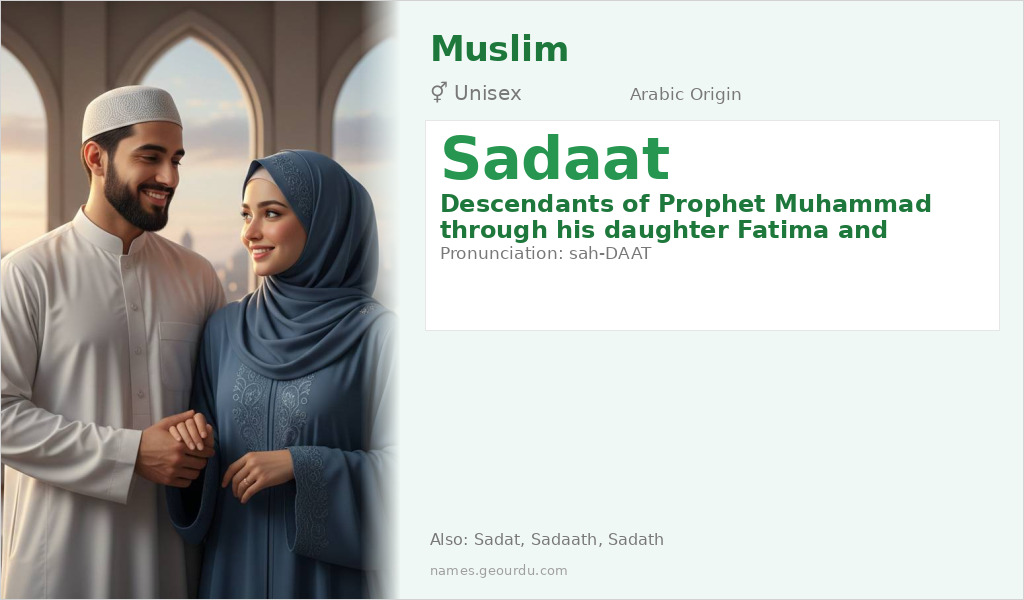
Sadaat is a significant Arabic honorific title with deep roots in Islamic history and tradition. Unlike conventional personal names, it serves as a collective designation for the descendants of Prophet Muhammad through his daughter Fatima and son-in-law Ali. This title carries immense respect and recognition in Muslim communities worldwide, particularly in South Asia where it’s commonly used as a surname. Understanding Sadaat requires exploring its linguistic origins and historical context within Islamic genealogy.
Meaning of Sadaat
Sadaat (سادات) derives from the Arabic root S-Y-D (س-ي-د), meaning ‘to master’ or ‘to lead.’ It’s the plural form of Sayyid (سيد), which translates to ‘master,’ ‘lord,’ or ‘chief.’ In Islamic context, Sadaat specifically refers to the collective descendants of Prophet Muhammad through the lineage of his daughter Fatima and her husband Ali ibn Abi Talib. The term encompasses both major branches: Sayyids (descendants of Hasan ibn Ali) and Sharifs (descendants of Husayn ibn Ali). This isn’t merely a name but a title of honor that acknowledges noble lineage, with documented usage dating back to early Islamic history. The singular ‘Sayyid’ and plural ‘Sadaat’ appear in historical texts, genealogical records, and contemporary usage across Arabic, Persian, Urdu, and other Muslim languages.
| 📛 Name | Sadaat |
| 💎 Meaning | Descendants of Prophet Muhammad through his daughter Fatima and son-in-law Ali; specifically refers to Sayyids (descendants of Hasan) and Sharifs (descendants of Husayn) |
| 👤 Gender | Unisex |
| 🕌 Religion | Muslim |
| 🌍 Origin | Arabic |
| 🗣 Pronunciation | sah-DAAT |
| ✍️ Urdu | سادات |
| ✍️ Arabic | سادات |
| 🔢 Numerology | |
| ✨ Spellings | Sadat, Sadaath, Sadath |
Origin & Cultural Significance
Sadaat originates from classical Arabic and Islamic tradition, emerging as an honorific title for Prophet Muhammad’s descendants. This practice developed during the early Islamic centuries as a way to recognize and respect the Ahl al-Bayt (People of the House). The title spread throughout the Muslim world, with particular prominence in South Asia where it became incorporated into naming conventions as surnames or titles. In countries like Pakistan, India, and Bangladesh, ‘Sadaat’ often appears as part of complete names (e.g., as a middle or last name) rather than as a first name. The term maintains religious and social significance across Sunni and Shia communities, though its usage and recognition may vary regionally.
Personality Traits
Since Sadaat is an honorific title rather than a personal given name, it doesn’t carry specific personality attributes in the way conventional names might. However, those who bear this title traditionally inherit expectations of moral leadership, religious knowledge, and community respect. In many Muslim societies, individuals recognized as Sadaat are often looked to for guidance and are expected to uphold the values associated with their noble lineage. The title itself conveys dignity, heritage, and connection to Islamic history rather than predicting individual character traits.
Similar Names
If you like Sadaat, consider: Sayyid, Sharif, Fatima, Ali, Hasan, Husayn
Famous People Named Sadaat
- Anwar Sadat — Former President of Egypt (1918-1981), Nobel Peace Prize laureate
- Junaid Jamshed — Pakistani singer-turned-preacher (1964-2016) who used 'Junaid Jamshed Sadat' as his full name
Frequently Asked Questions About Sadaat
What does Sadaat mean?
Sadaat is an Arabic honorific title meaning 'descendants of Prophet Muhammad' through his daughter Fatima and son-in-law Ali. It's the plural form of Sayyid and refers specifically to the noble lineage encompassing both Hasanid and Husaynid branches.
Is Sadaat a boy or girl name?
Sadaat is neither exclusively a boy nor girl name—it's an honorific title/surname used for descendants of Prophet Muhammad regardless of gender. While more commonly associated with male lineage in historical contexts, it applies to all descendants and is considered unisex in contemporary usage.
What is the origin of Sadaat?
Sadaat originates from classical Arabic and Islamic tradition. It comes from the root S-Y-D meaning 'master' and developed as a title for Prophet Muhammad's descendants through Fatima and Ali. The term has been used for centuries across Arabic, Persian, and South Asian Muslim communities.