
Table of Contents
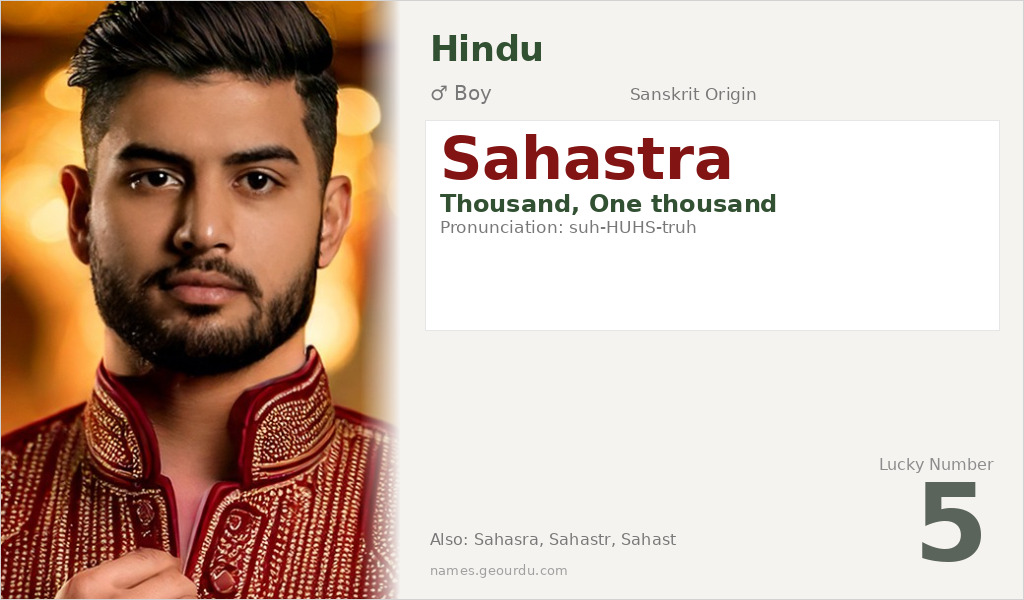
Sahastra is a distinctive and meaningful name of Sanskrit origin, primarily used for boys in Hindu communities. Rooted in ancient Indian traditions, this name carries the powerful symbolism of ‘thousand’, representing abundance, multiplicity, and infinite potential. Whether you’re drawn to its numerical significance or its cultural depth, Sahastra offers a unique choice for parents seeking a name with historical resonance and positive connotations. In this guide, we explore everything from its etymology and pronunciation to its modern usage and personality associations.
Meaning of Sahastra
Sahastra derives directly from the Sanskrit word ‘sahasra’ (सहस्र), which translates to ‘thousand’ or ‘one thousand’. This term is deeply embedded in Sanskrit literature, appearing in foundational texts like the Rigveda, where it often symbolizes vastness, completeness, or an immeasurable quantity. Linguistically, ‘sahasra’ is related to other Indo-European words for thousand, such as the Greek ‘chilioi’ and Latin ‘mille’, though its specific form is unique to Sanskrit and its descendant languages. In Hindu philosophy and mythology, the concept of a thousand is frequently used to denote perfection or infinity, as seen in terms like ‘sahasrara’ (thousand-petaled lotus) in yoga. Thus, the name Sahastra not only has a clear literal meaning but also carries rich symbolic weight in cultural and spiritual contexts.
| 📛 Name | Sahastra |
| 💎 Meaning | Thousand, One thousand |
| 👤 Gender | Boy |
| 🕌 Religion | Hindu |
| 🌍 Origin | Sanskrit |
| 🗣 Pronunciation | suh-HUHS-truh |
| ✍️ Urdu | سہسترا |
| ✍️ Arabic | ساهسترا |
| 🔢 Numerology | 5 |
| ✨ Spellings | Sahasra, Sahastr, Sahast, Sahas |
Origin & Cultural Significance
Sahastra originates from Sanskrit, one of the oldest languages in the Indo-European family and a primary liturgical language of Hinduism. Its usage as a personal name is most common in India and among Hindu communities worldwide, reflecting the enduring influence of Sanskrit on Indian naming traditions. Historically, numerical names like Sahastra have been used in Hindu culture to convey auspiciousness or specific qualities, often inspired by mythological figures or philosophical concepts. For example, the legendary king Sahastra Bahu, known for his thousand arms, exemplifies the name’s association with power and multiplicity. While not as widespread as some other Sanskrit names, Sahastra remains a meaningful choice for parents valuing linguistic heritage and symbolic depth, particularly in regions with strong Sanskrit scholarly traditions.
Personality Traits
People named Sahastra are often perceived as multi-faceted and capable, mirroring the name’s meaning of ‘thousand’. They may exhibit traits such as adaptability, intelligence, and a knack for managing diverse responsibilities with ease. Their analytical nature helps them break down complex problems, while their visionary side allows them to pursue grand goals. In social settings, they tend to be generous and inclusive, valuing connections that enrich their lives. Overall, the name suggests a personality that thrives on variety and excellence, aiming to achieve abundance in all endeavors.
Similar Names
If you like Sahastra, consider: Sahas, Sahil, Sahaj, Sahitya, Sahadev
Famous People Named Sahastra
- Sahastra Bahu — a legendary king in Hindu mythology, known for his thousand arms
- Sahastra Singh — a modern Indian author and scholar specializing in Sanskrit literature
Frequently Asked Questions About Sahastra
What does Sahastra mean?
Sahastra means 'Thousand' or 'One thousand', derived from the Sanskrit word 'sahasra'.
Is Sahastra a boy or girl name?
Sahastra is traditionally a boy's name in Hindu naming conventions, though names can sometimes be adapted across genders in modern usage.
What is the origin of Sahastra?
Sahastra originates from Sanskrit, an ancient Indian language, and is primarily used in Hindu cultural contexts.





