
Table of Contents
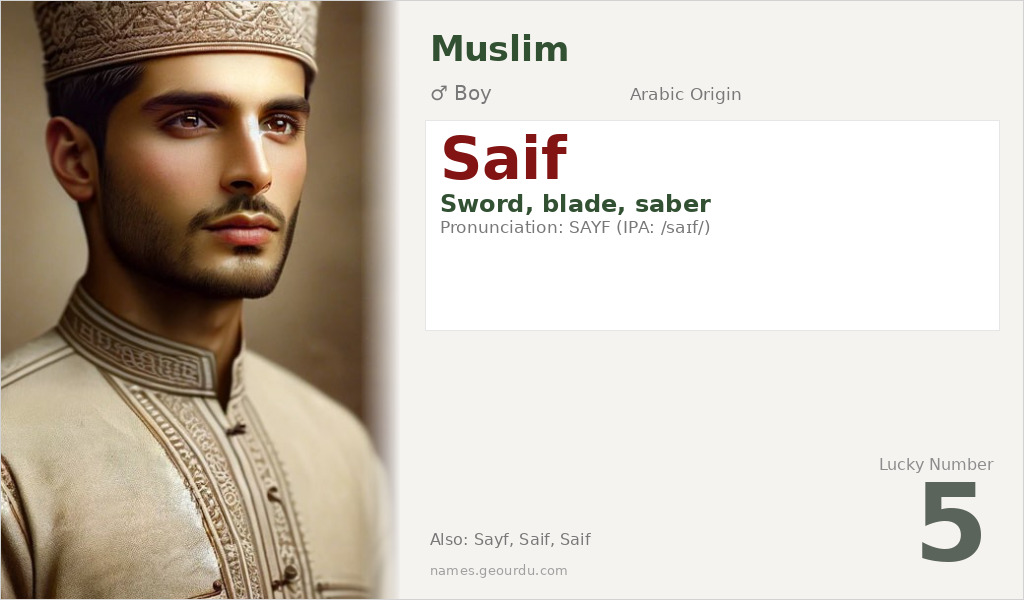
Saif is a timeless Arabic name that carries the powerful meaning of ‘sword’ or ‘blade.’ Primarily used for boys in Muslim communities worldwide, this name evokes imagery of strength, valor, and protection. Its deep roots in Arabic language and history make it a popular choice for parents seeking a name with cultural resonance and historical significance. In this guide, we explore the true meaning, origin, and proper usage of the name Saif.
Meaning of Saif
The name Saif (سَيْف) originates from the Arabic triliteral root S-Y-F (س-ي-ف), which is exclusively associated with swords, blades, and cutting weapons. In Classical Arabic, ‘saif’ refers specifically to a straight, double-edged sword, distinguishing it from other blade types. This root appears in various derived forms, such as ‘sayyaf’ (swordsmith) and ‘masyaf’ (place of swords). Historically, the name was borne by notable figures like Saif ibn Dhi Yazan, a pre-Islamic Himyarite king, and has been used metaphorically in Islamic contexts to denote defenders of faith. The meaning is well-documented in Arabic lexicons like Lisan al-Arab and modern dictionaries, with no verified alternative meanings in other languages like Persian, Pashto, or Sindhi—though it is borrowed into those languages.
| 📛 Name | Saif |
| 💎 Meaning | Sword, blade, saber |
| 👤 Gender | Boy |
| 🕌 Religion | Muslim |
| 🌍 Origin | Arabic |
| 🗣 Pronunciation | SAYF (IPA: /saɪf/) |
| ✍️ Urdu | سیف |
| ✍️ Arabic | سَيْف |
| 🔢 Numerology | 5 |
| ✨ Spellings | Sayf, Saif, Saif, Saif |
Origin & Cultural Significance
Saif is an Arabic name with origins dating back to pre-Islamic Arabia, where it was used in poetry and tribal contexts. It gained prominence in Islamic history through companions of the Prophet Muhammad and later Muslim rulers and warriors, symbolizing martial prowess and justice. The name spread across the Muslim world via Arabic influence, entering languages like Urdu, Persian, and Turkish as a loanword. While commonly used in South Asia, the Middle East, and North Africa, it remains distinctly Arabic in etymology and cultural association. Unlike some names that adapt across regions, Saif retains its original meaning without significant variation in Muslim-majority cultures.
Personality Traits
Traditionally, names like Saif are thought to influence personality traits, with Saif often associated with strength, courage, and leadership. Those named Saif may be seen as protective figures who value honesty and directness. In cultural narratives, the name inspires qualities of resilience and determination, reflecting the symbolic power of a sword in Arabic heritage.
Similar Names
If you like Saif, consider: Saifullah (Sword of God), Saif al-Islam (Sword of Islam), Saifuddin (Sword of Faith), Yusuf (Joseph), Khalid (Eternal)
Famous People Named Saif
- Saif al-Islam Gaddafi — Libyan political figure, son of Muammar Gaddafi
- Saif Ali Khan — Indian actor and producer from the Pataudi royal family
Frequently Asked Questions About Saif
What does Saif mean?
Saif means 'sword,' 'blade,' or 'saber' in Arabic, derived from the root S-Y-F (س-ي-ف) related to cutting weapons.
Is Saif a boy or girl name?
Saif is exclusively a boy's name in Arabic and Muslim naming traditions, with no historical usage as a feminine name.
What is the origin of Saif?
Saif originates from the Arabic language, with documented use since pre-Islamic times and continued prominence in Islamic history and culture.





