
Table of Contents
Saifulazman is a distinguished Arabic name with a powerful meaning that resonates through Islamic history and culture. As a compound name combining ‘sword’ and ‘time’, it carries connotations of protection, leadership, and historical significance. This name is particularly popular in Muslim communities across South Asia, the Middle East, and Southeast Asia. Understanding its linguistic roots reveals why it remains a meaningful choice for parents seeking a name with both strength and depth.
Meaning of Saifulazman
Saifulazman derives from classical Arabic, where ‘Saif’ (سيف) means ‘sword’ and ‘Azman’ (أزمان) is the plural of ‘Zaman’ (زمان), meaning ‘time, era, or epoch’. The name follows the Arabic grammatical construction called ‘Idafa’ (إضافة), where two nouns are connected to show possession or relationship, literally translating to ‘Sword of Times’. This is idiomatically understood as ‘Sword of the Era’ or ‘Sword of Time’, suggesting someone who is a defender or prominent warrior of their historical period. The ‘sword’ element appears in many Arabic names (like Saifullah, Saifuddin) symbolizing strength, justice, and protection. The ‘time’ element adds a dimension of historical consciousness and temporal significance, making the name particularly meaningful in Islamic contexts where historical continuity and defense of faith are valued.
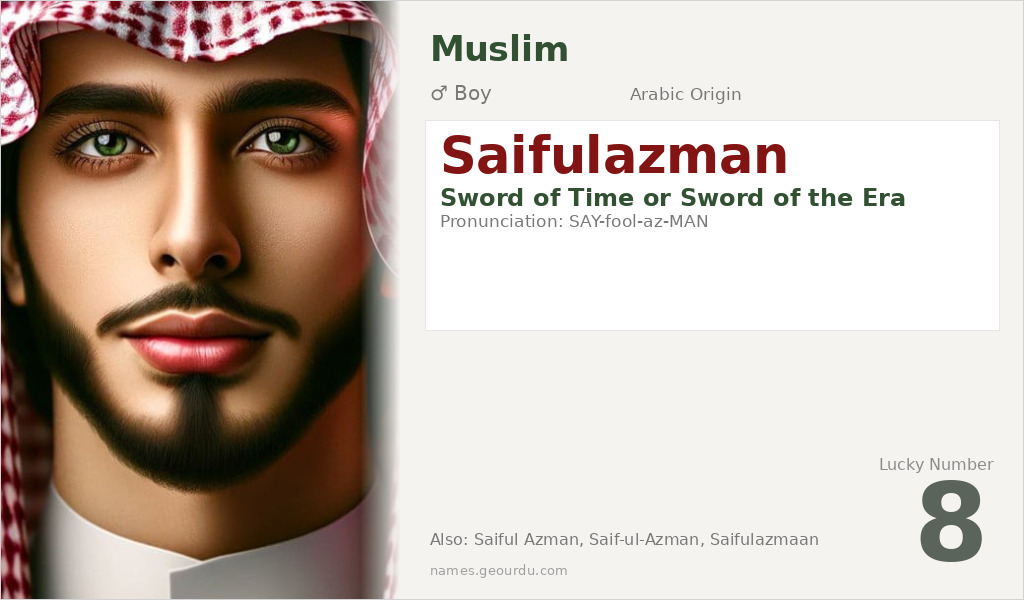
| 📛 Name | Saifulazman |
| 💎 Meaning | Sword of Time or Sword of the Era |
| 👤 Gender | Boy |
| 🕌 Religion | Muslim |
| 🌍 Origin | Arabic |
| 🗣 Pronunciation | SAY-fool-az-MAN |
| ✍️ Urdu | سیف الازمان |
| ✍️ Arabic | سيف الأزمان |
| 🔢 Numerology | 8 |
| ✨ Spellings | Saiful Azman, Saif-ul-Azman, Saifulazmaan, Saiful Azmaan |
Origin & Cultural Significance
Saifulazman originates from Arabic linguistic and cultural traditions, specifically within Islamic naming conventions. The practice of combining ‘Saif’ with other elements became popular during the Islamic Golden Age, reflecting values of courage, protection, and faith. While the name is Arabic in origin, it has been adopted and adapted in various Muslim cultures including those in South Asia (Pakistan, India, Bangladesh), the Middle East, and Southeast Asia (Malaysia, Indonesia). The name follows a pattern seen in other Arabic compound names where weapons (like sword) are combined with abstract concepts or divine attributes. Unlike some regional names that might have tribal or local origins, Saifulazman maintains its classical Arabic structure across different regions where it is used.
Personality Traits
The name Saifulazman suggests personality traits associated with strength, protection, and historical awareness. The ‘sword’ component implies qualities like decisiveness, courage, and leadership—someone who can defend principles and take action when needed. The ‘time/era’ element suggests consciousness of tradition, context, and historical significance, potentially indicating a person who values heritage and understands their role within larger temporal frameworks. Together, these elements paint a picture of someone who is both action-oriented and thoughtful about their place in history and community.
Similar Names
If you like Saifulazman, consider: Saifullah, Saifuddin, Saiful Islam, Saiful Malik, Saiful Haq
Famous People Named Saifulazman
- Saiful Azman — Malaysian military officer and former Chief of the Royal Malaysian Air Force
- Saiful Azman Abu Hassan — Malaysian footballer who played for Kelantan FA
Frequently Asked Questions About Saifulazman
What does Saifulazman mean?
Saifulazman means 'Sword of Time' or 'Sword of the Era' in Arabic. It combines 'Saif' (sword) and 'Azman' (times/eras), following classical Arabic naming patterns.
Is Saifulazman a boy or girl name?
Saifulazman is exclusively a boy's name in all cultures where it is used. Arabic compound names with 'Saif' (sword) are traditionally masculine, reflecting warrior and protector connotations.
What is the origin of Saifulazman?
Saifulazman originates from classical Arabic language and Islamic naming traditions. It follows the Arabic grammatical construction called Idafa, combining two nouns to show relationship, and has been used in Muslim communities for centuries.





