
Table of Contents
Salaar is a powerful masculine name with deep historical roots in Persian culture that has spread across South Asia and the Middle East. Meaning ‘leader’ or ‘commander’, this name carries connotations of authority, strength, and governance. While particularly popular in Muslim communities, it transcends religious boundaries in regions where Persian linguistic influence is strong. The name’s enduring appeal lies in its straightforward meaning and noble associations.
Meaning of Salaar
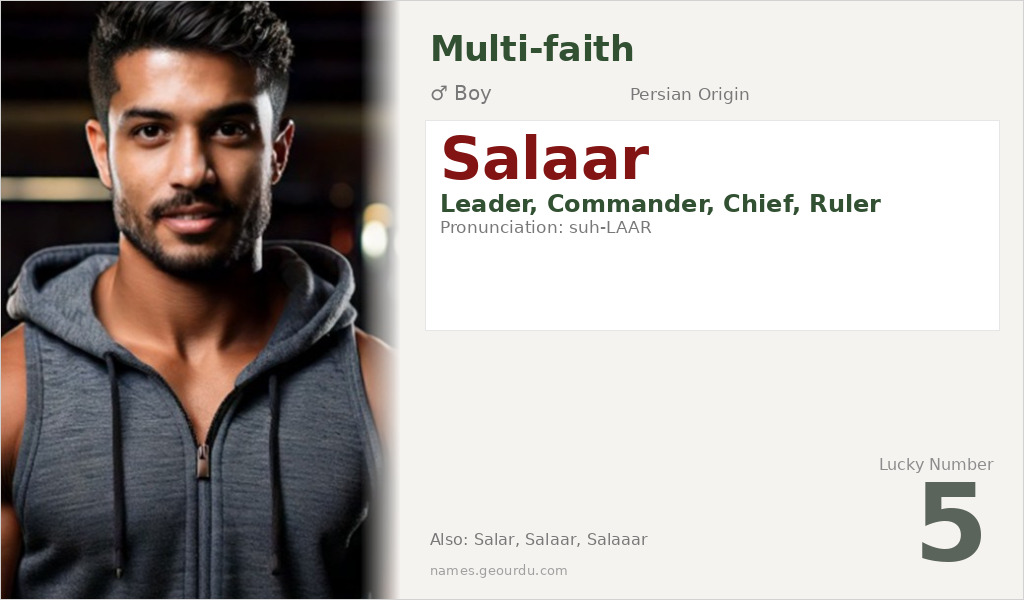
Salaar originates from the Persian word ‘سَلَار’ (salār), which directly translates to ‘leader’, ‘commander’, ‘chief’, or ‘ruler’. The term has been used in Persian literature for centuries to denote military commanders and those in positions of authority. Through Persian cultural influence during the Mughal Empire, the word entered various South Asian languages including Urdu, Punjabi, and Pashto, where it maintains the same core meaning. In contemporary usage, Salaar as a given name preserves these leadership connotations while sometimes being adapted with additional vowels in different regions. The name’s etymology is well-documented in Persian dictionaries and historical texts.
| 📛 Name | Salaar |
| 💎 Meaning | Leader, Commander, Chief, Ruler |
| 👤 Gender | Boy |
| 🕌 Religion | Multi-faith |
| 🌍 Origin | Persian |
| 🗣 Pronunciation | suh-LAAR |
| ✍️ Urdu | سالار |
| ✍️ Arabic | سالار |
| 🔢 Numerology | 5 |
| ✨ Spellings | Salar, Salaar, Salaaar |
Origin & Cultural Significance
Salaar has its origins in Persian language and culture, dating back to pre-Islamic Persia where military and administrative titles were commonly used as personal names. The name spread throughout the Persianate world, including modern-day Iran, Afghanistan, Pakistan, and parts of India, particularly during the Mughal era when Persian was the court language. While the name is popular among Muslims in South Asia, it is not exclusively Islamic and appears across different religious communities in regions with Persian linguistic heritage. Historical figures like Salar Jung, the Prime Minister of Hyderabad, helped popularize the name in the Indian subcontinent. Today, Salaar remains a respected name choice for boys in many cultures valuing leadership qualities.
Personality Traits
Those named Salaar are often perceived as natural leaders with strong personalities. They typically exhibit confidence, determination, and strategic thinking abilities that help them navigate complex situations. The name’s meaning tends to influence both self-perception and societal expectations, with Salaars often developing organizational skills and a sense of responsibility. While individual personalities vary, the name carries cultural associations with authority and capability that can shape how bearers approach challenges and relationships.
Similar Names
If you like Salaar, consider: Sardar, Salman, Sultan, Amir, Malik
Famous People Named Salaar
- Salar Jung I — 19th century Prime Minister of Hyderabad State in India
- Salar de Uyuni — World's largest salt flat in Bolivia (geographical feature sharing the name)
Frequently Asked Questions About Salaar
What does Salaar mean?
Salaar means 'Leader', 'Commander', 'Chief', or 'Ruler' in Persian. The name comes from the Persian word 'سَلَار' (salār) and has been used historically for military and administrative leaders.
Is Salaar a boy or girl name?
Salaar is exclusively a masculine name. In all cultures where it is used, including Persian, Urdu, and Pashto-speaking regions, it is given to boys due to its meaning of 'leader' or 'commander'.
What is the origin of Salaar?
Salaar originates from the Persian language and culture. It spread throughout South Asia and the Middle East through Persian linguistic influence, particularly during the Mughal era when Persian was a prominent court language.





