
Table of Contents
Saladin is a name that echoes through history, carrying the weight of legendary leadership and religious devotion. While many recognize it from the famous 12th-century Muslim commander who recaptured Jerusalem, the name itself has deep linguistic and cultural roots. Derived from the Arabic صلاح الدين (Salah ad-Din), it represents one of the most significant compound names in Islamic tradition. Today, Saladin continues to be used across cultures, symbolizing righteousness, faith, and historical legacy.
Meaning of Saladin
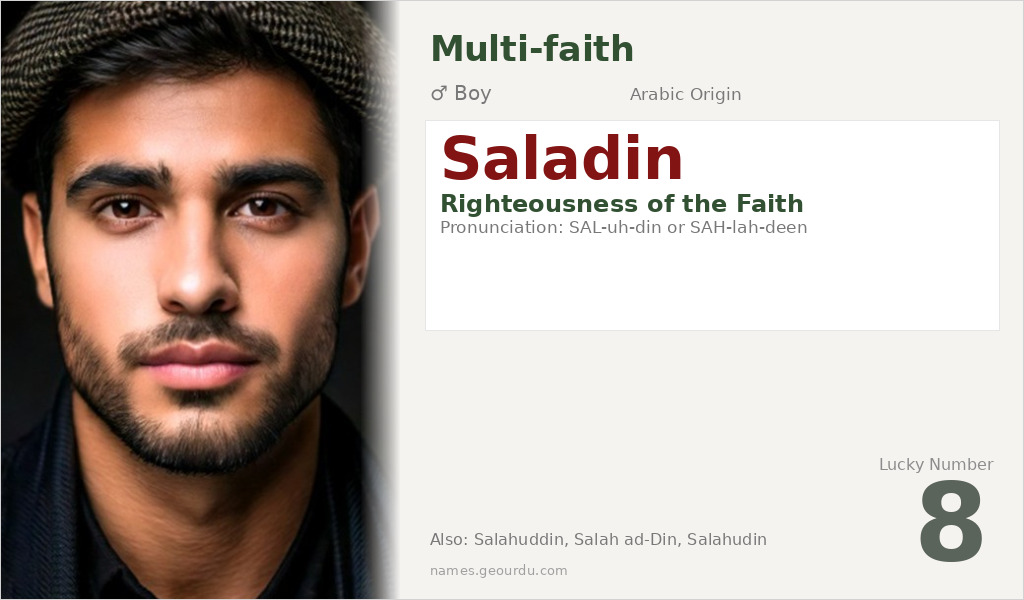
The name Saladin originates from the Arabic compound name صلاح الدين (Salah ad-Din), which literally translates to ‘righteousness of the faith’. This meaningful construction combines two important elements: صلاح (salah) meaning ‘righteousness, goodness, integrity, or correctness’ and الدين (ad-din) meaning ‘the faith’ or ‘the religion’. In Arabic naming traditions, ‘ad-Din’ (of the faith) is commonly used as a suffix in compound names to express religious devotion, similar to other names like Nur ad-Din (Light of the Faith) or Shams ad-Din (Sun of the Faith). The Westernized form ‘Saladin’ became popularized through European chronicles of the Crusades, particularly referring to Salah ad-Din Yusuf ibn Ayyub. The name’s meaning reflects core Islamic values of maintaining righteousness within religious practice.
| 📛 Name | Saladin |
| 💎 Meaning | Righteousness of the Faith |
| 👤 Gender | Boy |
| 🕌 Religion | Multi-faith |
| 🌍 Origin | Arabic |
| 🗣 Pronunciation | SAL-uh-din or SAH-lah-deen |
| ✍️ Urdu | صلاح الدین |
| ✍️ Arabic | صلاح الدين |
| 🔢 Numerology | 8 |
| ✨ Spellings | Salahuddin, Salah ad-Din, Salahudin, Salahaddin, Salah Eddin |
Origin & Cultural Significance
Saladin has its origins in medieval Arabic and Islamic culture, specifically emerging as an honorific title that later became a personal name. The most famous bearer, Salah ad-Din Yusuf ibn Ayyub (1137-1193), was a Kurdish Muslim military leader who founded the Ayyubid dynasty that ruled Egypt, Syria, Yemen, and other regions. His title ‘Salah ad-Din’ (Righteousness of the Faith) reflected his role as a defender of Islam during the Crusades. Following his historical prominence, the name spread throughout the Muslim world and eventually gained recognition in Western cultures through historical accounts and literature. While primarily used in Muslim communities, the name has been adopted by some Christians and others who admire its historical significance and meaning. In modern times, it remains particularly popular in Arabic-speaking countries, Turkey, and among Muslim communities worldwide.
Personality Traits
The name Saladin carries strong associations with leadership, integrity, and religious conviction due to its historical legacy. Those named Saladin are often perceived as principled individuals with a strong moral compass and the ability to lead others. The name suggests someone who values justice, demonstrates courage in challenging situations, and maintains faithfulness to their beliefs. While personality traits vary by individual, the name’s historical weight often inspires expectations of strength, strategic thinking, and devotion to causes greater than oneself.
Similar Names
If you like Saladin, consider: Salah, Yusuf, Ayyub, Nur ad-Din, Shams ad-Din
Famous People Named Saladin
- Saladin (Salah ad-Din Yusuf ibn Ayyub) — 12th-century Muslim military leader and founder of the Ayyubid dynasty, known for recapturing Jerusalem from the Crusaders
- Salahuddin of Selangor — Current Sultan of Selangor, Malaysia, born 1942
Frequently Asked Questions About Saladin
What does Saladin mean?
Saladin means 'Righteousness of the Faith' in Arabic. It comes from the compound name صلاح الدين (Salah ad-Din), combining 'salah' (righteousness) and 'ad-din' (of the faith).
Is Saladin a boy or girl name?
Saladin is exclusively a boy's name. It has masculine grammatical forms in Arabic and has only been used historically for males, most notably the 12th-century military leader Salah ad-Din.
What is the origin of Saladin?
Saladin originates from Arabic and Islamic culture. It began as the honorific title of Salah ad-Din Yusuf ibn Ayyub, the famous 12th-century Muslim leader, and later became used as a personal name throughout the Muslim world.





