
Table of Contents
Samad is a profound Arabic name with rich theological significance in Islam. Derived from the Quranic term for ‘Eternal’ and ‘Self-Sufficient’, it carries deep spiritual weight as one of the 99 Names of Allah. This name has been cherished across Muslim communities for centuries, symbolizing divine attributes of absolute dependability. Parents choosing Samad often seek to imbue their child with qualities of resilience and spiritual connection.
Meaning of Samad
Samad originates from the Arabic root ṣ-m-d (ص-م-د), which conveys meanings of ‘to aim at’, ‘to turn to’, or ‘to seek refuge’. In its perfected form, it describes something that is eternal, absolute, and entirely self-sufficient. The most significant usage is in Islamic theology as As-Samad (الصمد), one of the 99 Names of Allah mentioned in Surah Al-Ikhlas (112:2) of the Quran: ‘Allahuṣ-Ṣamad’ meaning ‘Allah, the Eternal, the Absolute’. Linguistically, it implies a being upon whom all others depend while needing nothing in return. This makes it distinct from simply ‘immortal’—it encompasses completeness, independence, and ultimate reliability.
| 📛 Name | Samad |
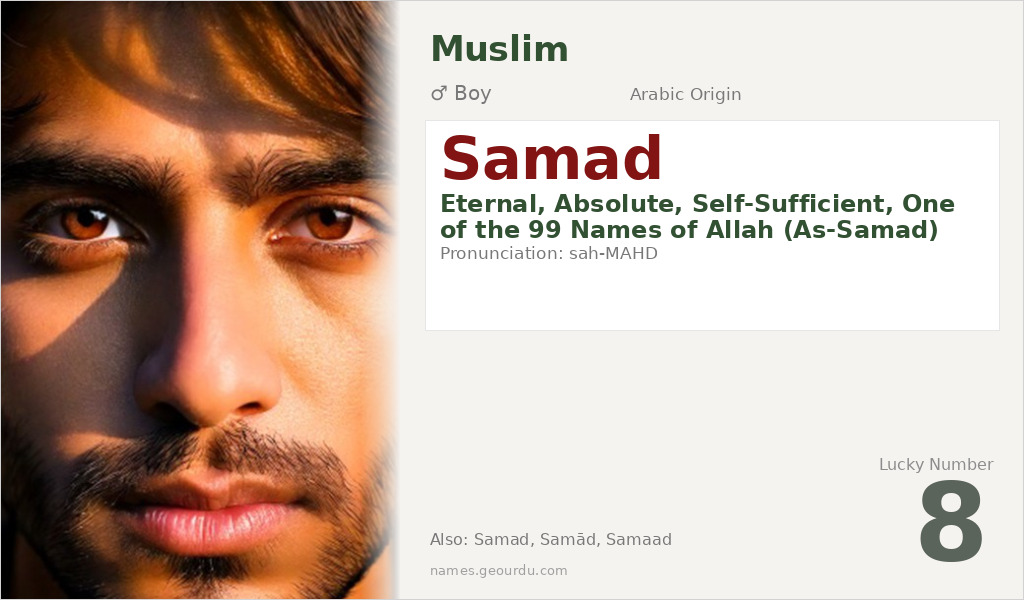
| 💎 Meaning | Eternal, Absolute, Self-Sufficient, One of the 99 Names of Allah (As-Samad) |
| 👤 Gender | Boy |
| 🕌 Religion | Muslim |
| 🌍 Origin | Arabic |
| 🗣 Pronunciation | sah-MAHD |
| ✍️ Urdu | صمد |
| ✍️ Arabic | صَمَد |
| 🔢 Numerology | 8 |
| ✨ Spellings | Samad, Samād, Samaad, Samat |
Origin & Cultural Significance
Samad has its origins in Classical Arabic and pre-Islamic poetry, where it was used to describe noble chiefs or leaders to whom people turned for needs. With the advent of Islam, it gained profound religious significance through its Quranic usage, becoming exclusively associated with divine attributes. The name spread across the Muslim world through Arabic, Persian, Turkish, and South Asian linguistic routes, maintaining its theological weight. While primarily an Arabic Islamic name, it’s also found in Persian and Urdu-speaking cultures with the same meaning. It’s not traditionally used in non-Arabic pre-Islamic contexts like Pashto, Balochi, or Sindhi as a native name, though it may appear due to Islamic influence.
Personality Traits
Those named Samad are often seen as pillars of strength in their communities, reflecting the name’s meaning of dependability and self-sufficiency. They may exhibit a calm, thoughtful demeanor and a natural inclination toward leadership or spiritual pursuits. The name’s association with divine attributes can inspire a sense of responsibility and integrity in personal and professional life.
Similar Names
If you like Samad, consider: Samir, Sami, Samar, Salam, Sadiq
Famous People Named Samad
- Samad Behrangi — Iranian teacher, author, and social critic known for children's literature
- Samad Vurgun — Azerbaijani poet and playwright, People's Poet of Azerbaijan
Frequently Asked Questions About Samad
What does Samad mean?
Samad means 'Eternal', 'Absolute', or 'Self-Sufficient' in Arabic. It is most famously one of the 99 Names of Allah (As-Samad) in Islam, denoting God as the Eternal Being upon whom all depend.
Is Samad a boy or girl name?
Samad is exclusively a boy's name in all cultures where it is used. It has no feminine variants in Arabic or other languages due to its grammatical structure and religious associations.
What is the origin of Samad?
Samad originates from Classical Arabic, specifically from the Quranic term As-Samad. It has been used for centuries in Muslim communities across Arabic, Persian, Turkish, and South Asian cultures with consistent meaning.





