
Table of Contents
Samata is a meaningful name rooted in ancient Sanskrit, symbolizing ‘equality’ and ‘balance.’ Popular in Hindu communities, it carries spiritual weight from texts like the Bhagavad Gita. While often chosen for girls, it is traditionally unisex, reflecting virtues of equanimity and fairness. This guide explores its etymology, cultural context, and modern usage.
Meaning of Samata
Samata originates from the Sanskrit word ‘समता’ (samatā), which translates to ‘equality,’ ‘balance,’ or ‘equilibrium.’ It is formed from the root ‘sama’ (सम), meaning ‘equal’ or ‘same,’ and the abstract suffix ‘-tā’ (ता), denoting a state or quality. In Hindu philosophy, particularly in Advaita Vedanta and Yoga traditions, ‘samatā’ emphasizes mental equanimity—maintaining composure in joy and sorrow. The term appears in classical texts like the Upanishads and the Bhagavad Gita, where Lord Krishna describes ‘samatvam’ as a key to spiritual wisdom. Linguistically, it shares roots with words in other Indo-Aryan languages, such as ‘samata’ in Hindi and Bengali, retaining similar meanings.
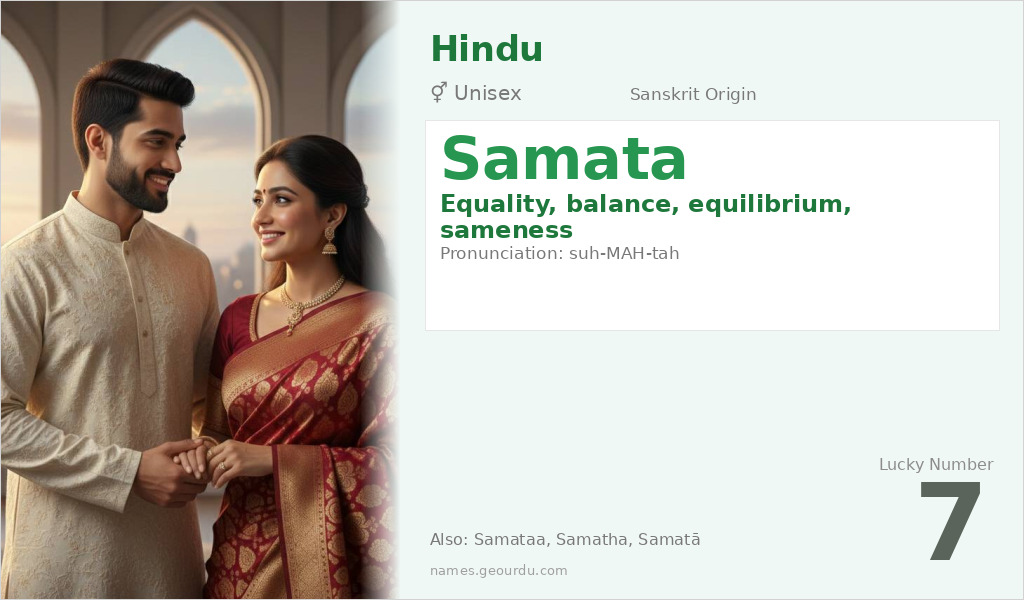
| 📛 Name | Samata |
| 💎 Meaning | Equality, balance, equilibrium, sameness |
| 👤 Gender | Unisex |
| 🕌 Religion | Hindu |
| 🌍 Origin | Sanskrit |
| 🗣 Pronunciation | suh-MAH-tah |
| ✍️ Urdu | سماٹا |
| ✍️ Arabic | ساماتا |
| 🔢 Numerology | 7 |
| ✨ Spellings | Samataa, Samatha, Samatā |
Origin & Cultural Significance
Samata has its origins in Sanskrit, an ancient Indo-Aryan language of India, and is deeply tied to Hindu culture and spirituality. It is commonly used in India, Nepal, and among Hindu diaspora communities worldwide. The name gained prominence through religious scriptures, where ‘samatā’ is praised as a virtue for achieving inner peace and social harmony. In modern times, it is more frequently given to girls but remains unisex, reflecting its philosophical roots. Regional variations exist, such as ‘Samatha’ in Pali Buddhist contexts, though ‘Samata’ is predominantly Hindu. Its usage extends beyond personal names to institutions and movements advocating equality, like the Samata Party in Indian politics.
Personality Traits
People named Samata are often perceived as balanced, just, and thoughtful individuals. They may exhibit a natural inclination toward fairness and diplomacy, making them effective mediators in conflicts. Their calm and philosophical outlook can inspire others, though they might sometimes be seen as overly idealistic. In social settings, they tend to promote harmony and inclusivity, aligning with the name’s meaning of equality.
Similar Names
If you like Samata, consider: Samataa, Samatha, Samatva, Samya, Samaira
Famous People Named Samata
- Samata Patil — Indian actress known for Marathi and Hindi films
- Samata Party — Indian political party founded in 1994, though not a person, it reflects the name's cultural use
Frequently Asked Questions About Samata
What does Samata mean?
Samata means 'equality,' 'balance,' or 'equilibrium' in Sanskrit, derived from the root 'sama' (equal) and suffix '-tā' (state).
Is Samata a boy or girl name?
Samata is a unisex name in Hindu tradition, though it is more commonly used for girls in modern times. It is not restricted by gender in its cultural origins.
What is the origin of Samata?
Samata originates from Sanskrit, an ancient Indian language, and is deeply embedded in Hindu philosophy and texts like the Bhagavad Gita.