
Table of Contents
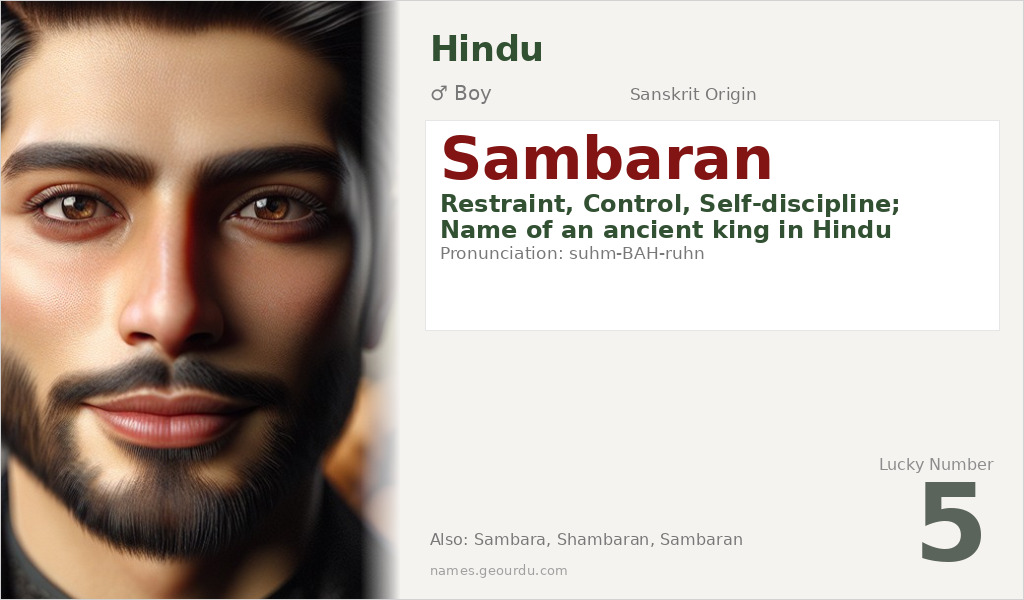
Sambaran is a distinctive Hindu boy name with deep roots in Sanskrit language and Hindu mythology. Meaning ‘restraint’ or ‘self-discipline’, this name carries both linguistic elegance and mythological significance. While not extremely common today, it represents traditional values of control and disciplined living. The name’s connection to an ancient mythological king adds historical depth to its modern usage.
Meaning of Sambaran
Sambaran derives from the Sanskrit word ‘sambara’ (संबर), which fundamentally means ‘restraint’, ‘control’, or ‘self-discipline’. In Sanskrit grammar, the suffix ‘-an’ typically indicates possession or association, making Sambaran mean ‘one who possesses restraint’ or ‘the restrained one’. This linguistic construction appears in classical Sanskrit texts where ‘sambara’ describes disciplined conduct or controlled behavior. The name’s meaning reflects important values in Hindu philosophy, particularly the concept of ‘samyama’ (self-restraint) as a spiritual practice. In mythological contexts, the name appears as ‘Sambara’, a powerful asura king known for his magical abilities but ultimately representing forces that must be controlled.
| 📛 Name | Sambaran |
| 💎 Meaning | Restraint, Control, Self-discipline; Name of an ancient king in Hindu mythology |
| 👤 Gender | Boy |
| 🕌 Religion | Hindu |
| 🌍 Origin | Sanskrit |
| 🗣 Pronunciation | suhm-BAH-ruhn |
| ✍️ Urdu | سمبارن |
| ✍️ Arabic | سامباران |
| 🔢 Numerology | 5 |
| ✨ Spellings | Sambara, Shambaran, Sambaran, Sambharan |
Origin & Cultural Significance
Sambaran originates from classical Sanskrit, the ancient liturgical language of Hinduism. The name appears in Hindu mythological texts, most notably in references to Sambara, a powerful asura (demon) king mentioned in the Rigveda (1.51.6, 1.54.4, 1.112.14) and later Puranas. According to mythology, Sambara possessed 99 or 100 fortresses and was eventually defeated by Lord Indra. The name’s usage reflects the Sanskrit tradition of naming children after mythological figures or desirable qualities. While primarily associated with Hindu culture, the name’s Sanskrit origin means it could theoretically appear in other Indian religious contexts, though it remains predominantly Hindu in contemporary usage.
Personality Traits
Those named Sambaran are often perceived as disciplined, thoughtful individuals who value self-control and careful consideration. Their name’s meaning of ‘restraint’ may influence their approach to life, making them methodical and analytical in decision-making. They tend to be reliable and structured, with a natural inclination toward order and discipline in both personal and professional spheres.
Similar Names
If you like Sambaran, consider: Samar, Sambhav, Samarth, Sambit, Samir
Famous People Named Sambaran
- Sambara (mythological figure) — Ancient asura king in Hindu mythology mentioned in the Rigveda and Puranas, known for his magical powers and battles with deities
- No widely known contemporary figures with this exact name, though variations appear in historical Indian texts
Frequently Asked Questions About Sambaran
What does Sambaran mean?
Sambaran means 'restraint', 'control', or 'self-discipline' in Sanskrit. It also refers to an ancient mythological king in Hindu texts.
Is Sambaran a boy or girl name?
Sambaran is exclusively a boy name in Hindu naming traditions, derived from masculine Sanskrit grammatical forms and associated with a male mythological figure.
What is the origin of Sambaran?
Sambaran originates from Sanskrit, the classical language of Hinduism. It appears in ancient Hindu texts like the Rigveda and Puranas as the name of a mythological asura king.





