Table of Contents
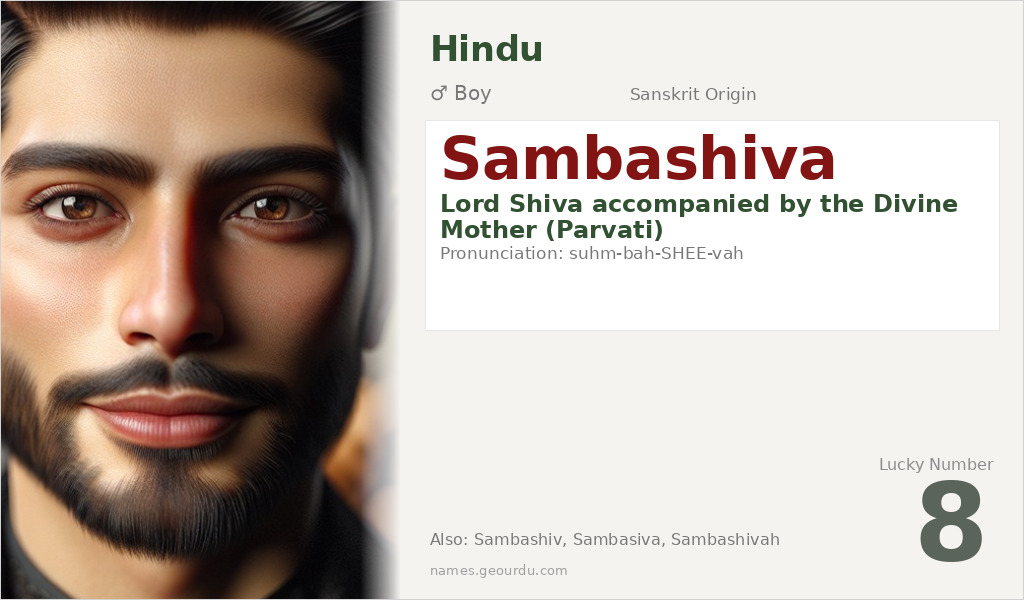
Sambashiva is a profound Sanskrit name with deep roots in Hindu spirituality and mythology. This name beautifully captures the essence of divine union, specifically referring to Lord Shiva in companionship with his consort Parvati. As a traditional Hindu boy’s name, Sambashiva carries significant religious and cultural weight, representing the harmonious balance between masculine and feminine divine energies. Parents choosing this name often seek to imbue their child with spiritual connection and the virtues associated with Shiva’s compassionate aspect.
Meaning of Sambashiva
Sambashiva derives from classical Sanskrit, combining the prefix ‘Sam’ (सम्) meaning ‘together with’, ‘accompanied by’, or ‘in union with’, and ‘Shiva’ (शिव), the name of one of Hinduism’s principal deities. The complete name therefore translates to ‘Shiva together with’ or ‘Shiva accompanied by’, specifically indicating Shiva in his aspect as part of the divine couple with Parvati. This linguistic construction appears in various Hindu texts where Shiva is worshipped alongside his consort, emphasizing their inseparable nature. The name represents not just Shiva alone, but Shiva as he exists in relationship with the Divine Mother, making it distinct from simple names meaning ‘Shiva’. This compound formation follows traditional Sanskrit naming patterns where prefixes modify the core deity name to indicate specific aspects or relationships.
| 📛 Name | Sambashiva |
| 💎 Meaning | Lord Shiva accompanied by the Divine Mother (Parvati) |
| 👤 Gender | Boy |
| 🕌 Religion | Hindu |
| 🌍 Origin | Sanskrit |
| 🗣 Pronunciation | suhm-bah-SHEE-vah |
| ✍️ Urdu | سمبشیو |
| ✍️ Arabic | سامباشيفا |
| 🔢 Numerology | 8 |
| ✨ Spellings | Sambashiv, Sambasiva, Sambashivah |
Origin & Cultural Significance
Sambashiva originates from Sanskrit, the ancient liturgical language of Hinduism, and has been used within Hindu communities for centuries, particularly in India and Nepal. The name emerges from Hindu theological traditions that emphasize the worship of Shiva and Parvati as a united divine pair, most notably in Shaivism and Shaktism traditions. While not among the most common Shiva-related names, Sambashiva appears in religious contexts, temple inscriptions, and traditional naming practices. The name reflects the cultural importance of divine couples in Hindu mythology, where deities are often worshipped in pairs representing complementary principles. Its usage has remained primarily within Hindu religious and cultural contexts rather than spreading to other linguistic or religious traditions.
Personality Traits
The name Sambashiva suggests personality traits aligned with spiritual harmony and balanced relationships. Those bearing this name are often thought to embody the complementary qualities of Shiva’s ascetic strength and Parvati’s nurturing compassion. This duality may manifest as someone who values both independence and partnership, capable of deep contemplation while maintaining meaningful connections. The name’s emphasis on divine union implies a personality that seeks integration and wholeness in various aspects of life.
Similar Names
If you like Sambashiva, consider: Shiva, Shivam, Shivansh, Shivendra, Shivang
Famous People Named Sambashiva
- No widely known contemporary public figures with this exact name found in records, though it appears in historical and religious contexts
Frequently Asked Questions About Sambashiva
What does Sambashiva mean?
Sambashiva means 'Lord Shiva together with' or 'Shiva accompanied by', specifically referring to Shiva in union with his consort Parvati (the Divine Mother). It is a Sanskrit compound name.
Is Sambashiva a boy or girl name?
Sambashiva is exclusively a boy's name in Hindu naming traditions, as it refers to the masculine deity Shiva, though it emphasizes his relationship with the feminine divine.
What is the origin of Sambashiva?
Sambashiva originates from Sanskrit, the classical language of Hinduism, and has been used within Hindu communities, particularly in contexts emphasizing the worship of Shiva and Parvati as a divine couple.