
Table of Contents
Sambuddha is a profound Sanskrit name carrying centuries of spiritual significance. Meaning ‘fully awakened’ or ‘completely enlightened,’ this name resonates deeply in Buddhist and Hindu philosophical traditions. Unlike common names, Sambuddha represents the highest state of consciousness and wisdom attainment. Its rich etymology and cultural weight make it a distinctive choice with deep philosophical roots.
Meaning of Sambuddha
Sambuddha derives from the Sanskrit language, combining ‘sam-‘ (a prefix meaning ‘completely,’ ‘perfectly,’ or ‘thoroughly’) with ‘buddha’ (the past participle of ‘budh,’ meaning ‘to awaken, to know, to perceive’). Literally translated, it means ‘fully awakened’ or ‘completely enlightened.’ In Buddhist contexts, this term specifically refers to one who has attained perfect enlightenment, like Siddhartha Gautama (the Buddha). In Hindu philosophical traditions, particularly Advaita Vedanta, it describes a jivanmukta—a liberated soul who has realized the ultimate truth. The name appears in ancient texts like the Pali Canon and Sanskrit scriptures, maintaining consistent meaning across millennia.
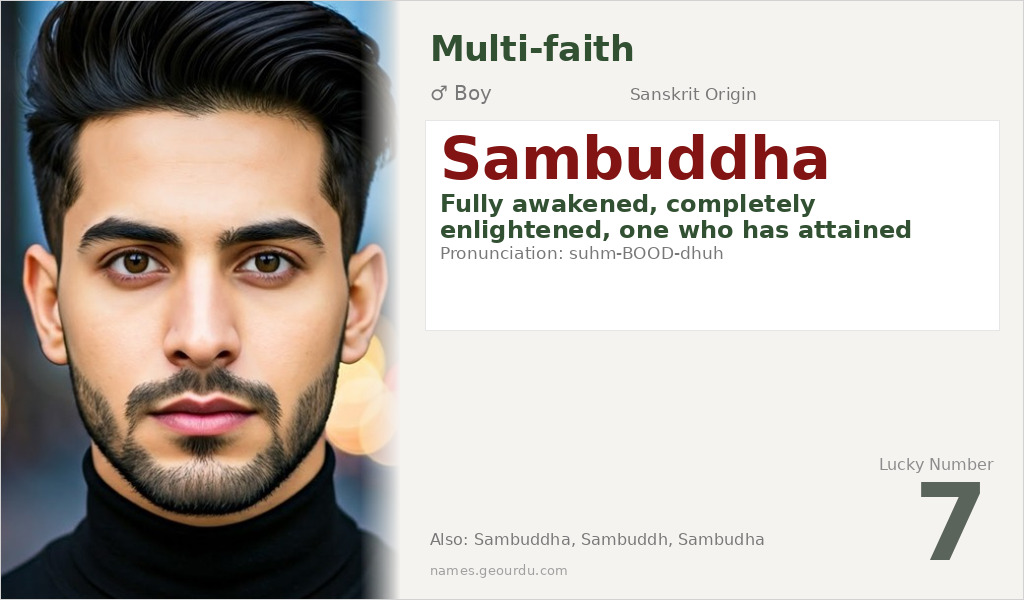
| 📛 Name | Sambuddha |
| 💎 Meaning | Fully awakened, completely enlightened, one who has attained perfect wisdom |
| 👤 Gender | Boy |
| 🕌 Religion | Multi-faith |
| 🌍 Origin | Sanskrit |
| 🗣 Pronunciation | suhm-BOOD-dhuh |
| ✍️ Urdu | سمبودھا |
| ✍️ Arabic | سامبودها |
| 🔢 Numerology | 7 |
| ✨ Spellings | Sambuddha, Sambuddh, Sambudha |
Origin & Cultural Significance
Sambuddha originates from classical Sanskrit, the liturgical language of Hinduism, Buddhism, and Jainism. While the name has Hindu philosophical usage, it is predominantly associated with Buddhism, where ‘Sammā-sambuddha’ (Pali) or ‘Samyak-sambuddha’ (Sanskrit) is a technical term for a fully enlightened being who discovers the Dharma without a teacher. The name spread through Buddhist texts and communities across South and Southeast Asia. In modern times, it’s used primarily in Buddhist-majority regions like Sri Lanka, Nepal, and parts of India, though it remains relatively rare as a personal name compared to its religious significance.
Personality Traits
Those named Sambuddha are often associated with qualities of deep introspection, spiritual seeking, and intellectual depth. The name’s meaning suggests someone who values truth, wisdom, and enlightenment above material pursuits. In cultural perception, such individuals might be seen as calm, thoughtful leaders who approach life with philosophical perspective. The name carries expectations of wisdom and insightfulness that can influence both self-perception and social interactions.
Similar Names
If you like Sambuddha, consider: Buddha, Bodhi, Siddhartha, Gautama, Bodhidharma
Famous People Named Sambuddha
- Sambuddha Mitra Mustafi — Indian historian and author specializing in South Asian history
- Sambuddha Chakrabarti — Indian film director and screenwriter known for Bengali cinema
Frequently Asked Questions About Sambuddha
What does Sambuddha mean?
Sambuddha means 'fully awakened' or 'completely enlightened' in Sanskrit. It's a compound of 'sam-' (completely) and 'buddha' (awakened), referring to one who has attained perfect wisdom or enlightenment.
Is Sambuddha a boy or girl name?
Sambuddha is traditionally a masculine name, used primarily for boys in cultures where it appears. There are no documented feminine variants in historical or contemporary usage.
What is the origin of Sambuddha?
Sambuddha originates from Sanskrit, the ancient Indian language. While it has Hindu philosophical usage, it is most prominently associated with Buddhism as a term for a fully enlightened being who discovers spiritual truth independently.





