
Table of Contents
Samindra is a powerful and historically rich name with deep roots in Hindu tradition and Sanskrit language. Meaning ‘Lord of War’ or ‘Commander of Battle,’ this name carries the strength and authority of ancient warrior ideals. Popular among Hindu families, Samindra represents both spiritual significance and martial excellence. Its classical origins make it a meaningful choice for parents seeking a name with cultural depth and heroic connotations.
Meaning of Samindra
Samindra derives from the Sanskrit language, combining ‘Sam’ (सं) meaning ‘battle’ or ‘war’ with ‘Indra’ (इन्द्र), the name of the Hindu god of thunder, rain, and warfare. This compound formation creates the meaning ‘Indra of battle’ or ‘supreme commander in conflict.’ In Hindu mythology, Indra is the king of the Devas (gods) and a symbol of martial power and leadership. The name thus signifies someone who embodies the qualities of Indra in wartime—strategic brilliance, courage, and authority. It appears in classical Sanskrit texts as an honorific for warriors and military leaders, maintaining its association with martial excellence through centuries of Hindu tradition.
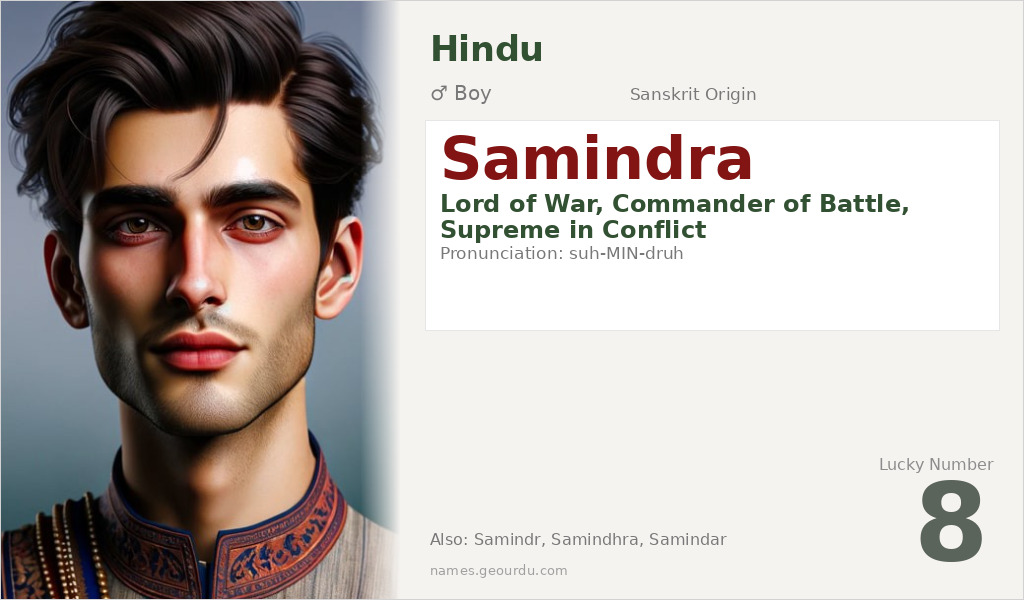
| 📛 Name | Samindra |
| 💎 Meaning | Lord of War, Commander of Battle, Supreme in Conflict |
| 👤 Gender | Boy |
| 🕌 Religion | Hindu |
| 🌍 Origin | Sanskrit |
| 🗣 Pronunciation | suh-MIN-druh |
| ✍️ Urdu | سامندر |
| ✍️ Arabic | ساميندرا |
| 🔢 Numerology | 8 |
| ✨ Spellings | Samindr, Samindhra, Samindar |
Origin & Cultural Significance
Samindra originates from classical Sanskrit, the ancient liturgical language of Hinduism. It emerged from Vedic and post-Vedic traditions where compound names honoring deities were common. The name reflects the cultural importance of Indra, one of the principal deities in the Rigveda and later Hindu texts, who symbolizes kingship, strength, and protection. Historically, such names were given to signify hoped-for qualities in children, particularly leadership and valor in Kshatriya (warrior) communities. While primarily used in Hindu communities across India and Nepal, the name has maintained its traditional character without significant adaptation in other religious or linguistic contexts.
Personality Traits
Those named Samindra are often perceived as natural leaders with strategic minds and strong determination. They tend to approach life’s battles with courage and resilience, much like their namesake deity Indra. Their personality often combines authority with protective instincts, making them reliable in challenging situations. While they can be competitive, they typically channel this energy into constructive problem-solving and inspiring others.
Similar Names
If you like Samindra, consider: Samir, Indrajit, Samarendra, Indraneel, Samarth
Famous People Named Samindra
- Samindra Singh — Indian historian and author specializing in military history
- Samindra Kumar — Nepali politician and former minister
Frequently Asked Questions About Samindra
What does Samindra mean?
Samindra means 'Lord of War' or 'Commander of Battle,' derived from Sanskrit 'Sam' (battle) and 'Indra' (the Hindu god of war).
Is Samindra a boy or girl name?
Samindra is exclusively a boy's name in Hindu naming tradition, reflecting masculine warrior qualities associated with the god Indra.
What is the origin of Samindra?
Samindra originates from Sanskrit, the classical language of Hinduism, and is composed of two Sanskrit elements meaning 'battle' and the god 'Indra.'





