
Table of Contents
Samuel is a timeless name with deep religious roots and enduring popularity across cultures. Derived from Hebrew origins meaning ‘God has heard’, this name carries significant Biblical weight as the name of an important prophet and judge. From ancient scriptures to modern celebrity circles, Samuel has maintained its dignified appeal for centuries. Let’s explore the rich history and meaning behind this classic name.
Meaning of Samuel
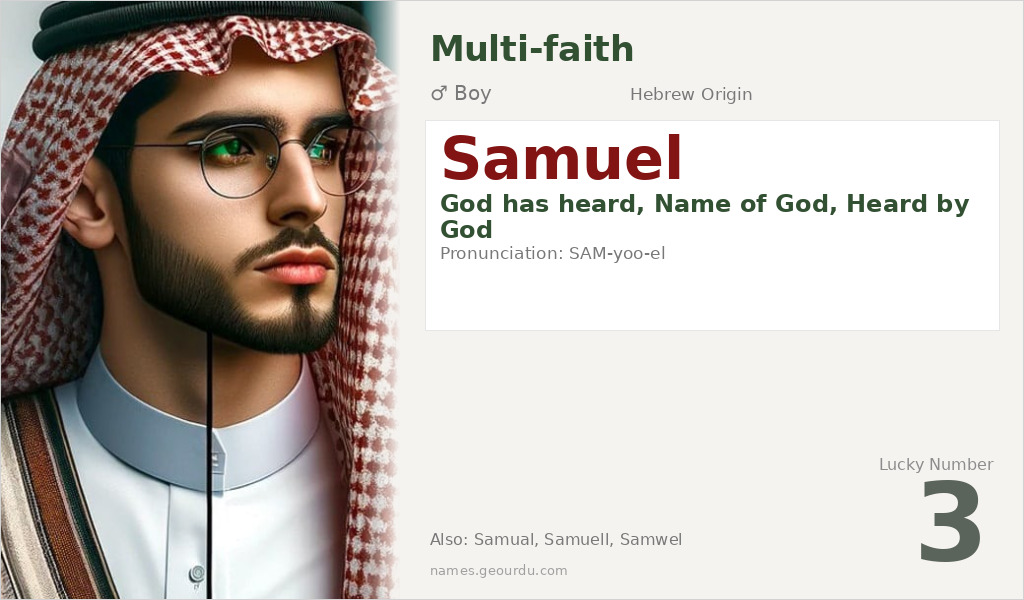
The name Samuel originates from the Hebrew שְׁמוּאֵל (Shemu’el), which is a combination of two Hebrew words: ‘shem’ (שֵׁם) meaning ‘name’ and ‘El’ (אֵל) meaning ‘God’. This gives the name the profound meaning of ‘name of God’ or more commonly interpreted as ‘God has heard’. In the Biblical context, this refers to Hannah’s prayer for a child being heard by God, resulting in the birth of the prophet Samuel. The name appears in the Tanakh (Hebrew Bible) and Old Testament as one of the most significant prophetic figures. Throughout history, the name has been transliterated into various languages while maintaining its core meaning and religious significance.
| 📛 Name | Samuel |
| 💎 Meaning | God has heard, Name of God, Heard by God |
| 👤 Gender | Boy |
| 🕌 Religion | Multi-faith |
| 🌍 Origin | Hebrew |
| 🗣 Pronunciation | SAM-yoo-el |
| ✍️ Urdu | سیموئیل |
| ✍️ Arabic | صموئيل |
| 🔢 Numerology | 3 |
| ✨ Spellings | Samual, Samuell, Samwel, Shemuel, Shmuel |
Origin & Cultural Significance
Samuel has its origins in ancient Hebrew culture and appears prominently in the Hebrew Bible as the prophet Samuel, who served as the last of the judges and the first of the major prophets. The name spread through Jewish communities and was adopted by Christians due to its appearance in the Old Testament. During the Protestant Reformation, Old Testament names like Samuel gained popularity in English-speaking countries. The name has since become widely used in Christian, Jewish, and secular contexts across Europe, the Americas, and other regions. While not originally a Hindu name, it has been adopted by some Indian Christians but does not have traditional Hindu religious significance.
Personality Traits
Those named Samuel are often associated with qualities of wisdom, spiritual depth, and strong moral character. The Biblical Samuel was known for his prophetic insight and leadership, traits that have become culturally associated with the name. Modern Samuels often exhibit good listening skills, thoughtful decision-making, and a natural authority that others respect. The name carries an expectation of integrity and reliability that many bearers seem to embody.
Similar Names
If you like Samuel, consider: Samson, Samir, Sam, Sami, Samuele, Samvel
Famous People Named Samuel
- Samuel L. Jackson — American actor known for roles in Pulp Fiction and Marvel films
- Samuel Morse — American inventor of the Morse code
- Samuel Beckett — Irish playwright and Nobel Prize winner
- Samuel Taylor Coleridge — English poet and philosopher
Frequently Asked Questions About Samuel
What does Samuel mean?
Samuel means 'God has heard' or 'name of God' in Hebrew, derived from the elements 'shem' (name) and 'El' (God).
Is Samuel a boy or girl name?
Samuel is traditionally and overwhelmingly a masculine name, though rare feminine variants like Samantha exist. In all major cultures and religions, Samuel is considered a boy's name.
What is the origin of Samuel?
Samuel originates from Hebrew and appears in the Hebrew Bible/Old Testament as the name of the prophet Samuel. It has Jewish and Christian religious origins dating back thousands of years.





