
Table of Contents
Samved is a distinctive Hindu boy name with deep roots in ancient Sanskrit tradition. Derived directly from the sacred Sāmaveda, this name carries the weight of millennia of spiritual and musical heritage. Unlike many modern names, Samved has a precise, documented meaning connected to one of Hinduism’s foundational texts. Parents choosing this name often seek to honor Vedic traditions while giving their child a unique, meaningful identity.
Meaning of Samved
Samved originates from the Sanskrit compound ‘Sāmaveda’ (सामवेद), combining ‘sāman’ (सामन्) meaning ‘melody, chant, or song’ and ‘veda’ (वेद) meaning ‘knowledge, sacred text, or wisdom.’ This specifically refers to the fourth Veda in Hindu canon, which is primarily a collection of hymns and musical notations used in ritual chanting. The Sāmaveda is considered the foundation of Indian classical music and contains the melodic framework for Vedic recitation. Unlike the Rigveda (hymns), Yajurveda (rituals), or Atharvaveda (spells), the Sāmaveda focuses exclusively on musical expression of sacred texts. The name thus carries connotations of musicality, spiritual harmony, and ancient wisdom rather than the vague ‘holistic’ interpretation sometimes incorrectly attributed to it.
| 📛 Name | Samved |
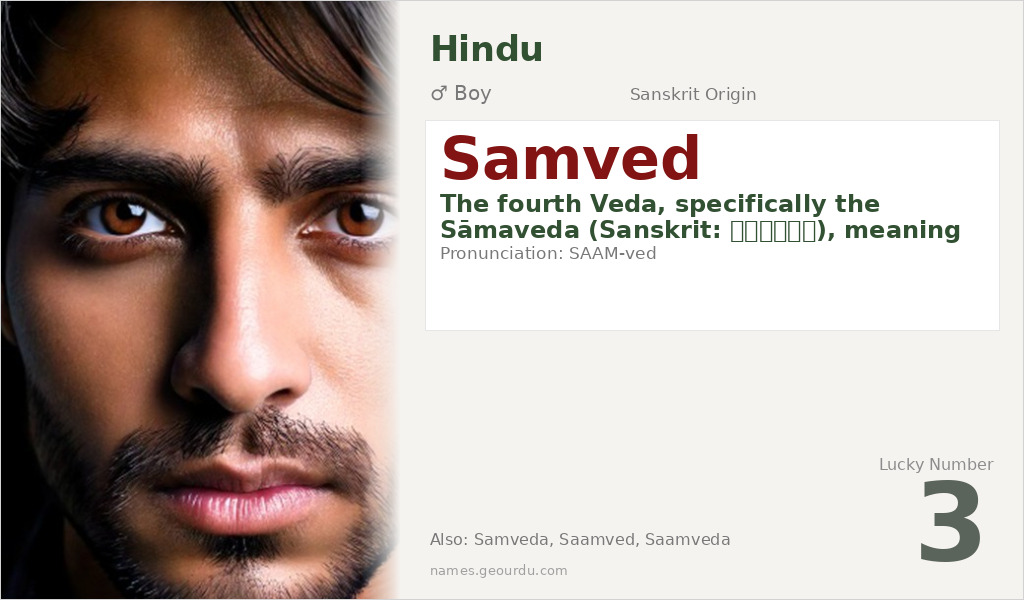
| 💎 Meaning | The fourth Veda, specifically the Sāmaveda (Sanskrit: सामवेद), meaning 'knowledge of melodies' or 'Veda of chants' |
| 👤 Gender | Boy |
| 🕌 Religion | Hindu |
| 🌍 Origin | Sanskrit |
| 🗣 Pronunciation | SAAM-ved |
| ✍️ Urdu | سام وید |
| ✍️ Arabic | سامفيد |
| 🔢 Numerology | 3 |
| ✨ Spellings | Samveda, Saamved, Saamveda, Sāmaved |
Origin & Cultural Significance
Samved has its origins exclusively in Sanskrit and Hindu tradition, with no verified connections to other language families despite extensive research across Arabic, Persian, Pashto, Urdu, Punjabi, Sindhi, Balochi, Kurdish, Turkish, Bengali, Hebrew, Latin, Greek, Germanic, African, or regional dialects. The name directly references the Sāmaveda, which dates back to approximately 1200-1000 BCE in the Indian subcontinent. In Hindu culture, names derived from sacred texts are considered auspicious and are believed to imbue the bearer with the qualities of those texts. While uncommon as a personal name historically, it has gained some popularity in modern times among Hindu families seeking traditional yet distinctive names. The name remains almost exclusively used within Hindu communities, particularly in India and the diaspora.
Personality Traits
Those named Samved are often perceived as having a natural connection to artistic and spiritual pursuits. The name’s association with melody and sacred knowledge suggests individuals who appreciate harmony in relationships and environments. They may exhibit patience, contemplative tendencies, and respect for tradition while also possessing creative expression. The musical connotations of the Sāmaveda connection imply potential talent or interest in auditory arts, whether music, poetry, or oratory.
Similar Names
If you like Samved, consider: Ved, Vedant, Vedang, Samarth, Samir, Vedansh, Vedika, Samay, Samar, Vedh
Famous People Named Samved
- No widely known contemporary figures with this exact name found in public records
- The name is primarily associated with the sacred Sāmaveda text itself in Hindu tradition
Frequently Asked Questions About Samved
What does Samved mean?
Samved means 'knowledge of melodies' or 'Veda of chants' in Sanskrit, specifically referring to the Sāmaveda, the fourth Veda in Hinduism focused on musical hymns and ritual chanting.
Is Samved a boy or girl name?
Samved is exclusively a boy name in Hindu naming tradition, derived from a masculine Sanskrit noun (Sāmaveda) and consistently used for males in cultural practice.
What is the origin of Samved?
Samved originates from Sanskrit, the ancient Indo-Aryan language of India, specifically from the compound 'Sāmaveda' meaning 'knowledge of melodies,' referring to one of Hinduism's four canonical Vedas.





