
Table of Contents
Sander is a distinctive boy’s name with deep historical roots and powerful meaning. Derived from the legendary name Alexander, it carries connotations of protection and strength. While popular in European countries like the Netherlands and Norway, it has global appeal for parents seeking a name with classical heritage. This guide explores everything from its Greek etymology to modern usage.
Meaning of Sander
The name Sander originates as a diminutive form of Alexander, which comes from the ancient Greek name Ἀλέξανδρος (Alexandros). This compound name combines ἀλέξω (alexō), meaning ‘to defend’ or ‘protect,’ with ἀνήρ (anēr), meaning ‘man,’ specifically in the genitive form ἀνδρός (andros). Thus, the full meaning translates to ‘defender of men’ or ‘protector of mankind.’ Sander evolved through linguistic shortening in Germanic and Scandinavian languages, where it became established as an independent given name while retaining the core meaning of its parent name. The name’s association with historical figures like Alexander the Great reinforces its connotations of leadership and strength.
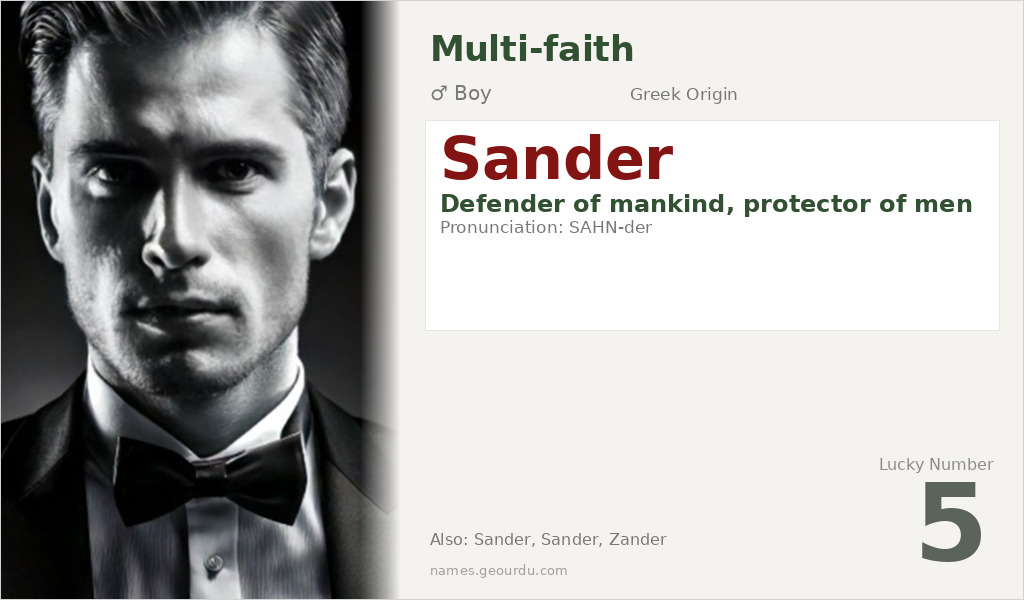
| 📛 Name | Sander |
| 💎 Meaning | Defender of mankind, protector of men |
| 👤 Gender | Boy |
| 🕌 Religion | Multi-faith |
| 🌍 Origin | Greek |
| 🗣 Pronunciation | SAHN-der |
| ✍️ Urdu | سانڈر |
| ✍️ Arabic | ساندر |
| 🔢 Numerology | 5 |
| ✨ Spellings | Sander, Sander, Zander, Xander |
Origin & Cultural Significance
Sander has its origins in ancient Greece through the name Alexander, but it developed as a distinct form primarily in Northern and Western Europe. It became particularly common in Dutch, German, Danish, and Norwegian naming traditions as a familiar variant of Alexander. The name spread through European migration and cultural exchange, maintaining its Greek-derived meaning while adapting to local phonetic patterns. Unlike the original article’s claim of exclusive Christian association, Sander is used across multiple religious contexts including Christianity, Judaism in some communities, and secular settings, reflecting its cultural rather than religious specificity.
Personality Traits
People named Sander are often associated with protective and leadership qualities, reflecting their name’s meaning of ‘defender of mankind.’ They tend to be confident, determined individuals who value loyalty and justice. While personality varies by individual, the name’s historical connections suggest strength, courage, and a natural inclination to safeguard others, making it a popular choice for parents seeking a name with noble characteristics.
Similar Names
If you like Sander, consider: Alexander, Sandro, Aleksander, Sasha, Alex
Famous People Named Sander
- Sander Berge — Norwegian professional footballer who plays as a midfielder
- Sander van Doorn — Dutch DJ and record producer known for trance and electro house music
Frequently Asked Questions About Sander
What does Sander mean?
Sander means 'defender of mankind' or 'protector of men.' It originates as a diminutive of the Greek name Alexander, which combines elements meaning 'to defend' and 'man.'
Is Sander a boy or girl name?
Sander is traditionally and predominantly a boy's name, though variations like Sandra exist for girls. It maintains masculine associations through its connection to Alexander.
What is the origin of Sander?
Sander originates from Greek through the name Alexander, but developed as an independent name in European languages, particularly Dutch, German, and Scandinavian traditions.





