
Table of Contents
Sankar is a profound Sanskrit name with deep spiritual roots in Hindu tradition. As one of the primary epithets of Lord Shiva, it carries centuries of cultural and religious significance. This name represents auspiciousness, benevolence, and the divine aspect of creation and destruction. Parents choosing Sankar often seek to imbue their child with spiritual strength and positive qualities.
Meaning of Sankar
The name Sankar originates from the Sanskrit word ‘Śaṅkara’, which is a compound of two elements: ‘śam’ meaning ‘auspicious, beneficent, or blissful’ and ‘kara’ meaning ‘maker, doer, or giver’. Thus, the complete meaning translates to ‘the one who makes auspiciousness’ or ‘giver of bliss’. In Hindu theology, this specifically refers to Lord Shiva’s benevolent aspect that brings happiness and prosperity. The name appears extensively in Vedic literature, Puranic texts, and classical Sanskrit poetry. Unlike many names that have evolved across languages, Sankar has remained remarkably consistent in its Sanskrit form and meaning throughout history.
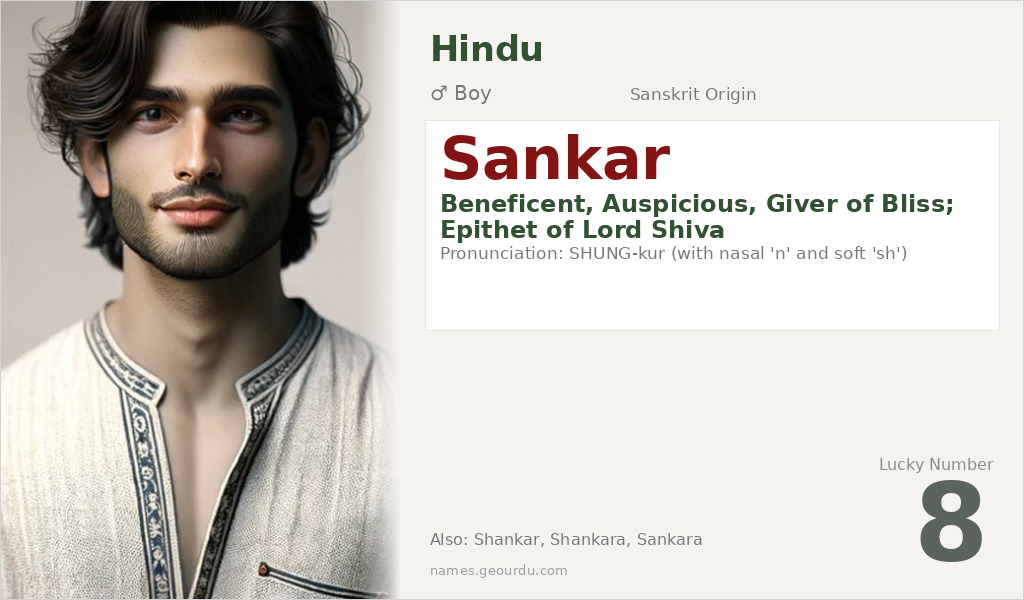
| 📛 Name | Sankar |
| 💎 Meaning | Beneficent, Auspicious, Giver of Bliss; Epithet of Lord Shiva |
| 👤 Gender | Boy |
| 🕌 Religion | Hindu |
| 🌍 Origin | Sanskrit |
| 🗣 Pronunciation | SHUNG-kur (with nasal 'n' and soft 'sh') |
| ✍️ Urdu | شنکر |
| ✍️ Arabic | شانكار |
| 🔢 Numerology | 8 |
| ✨ Spellings | Shankar, Shankara, Sankara, Shankhar |
Origin & Cultural Significance
Sankar has its origins in ancient Sanskrit, the classical language of India dating back over 3,500 years. As an epithet of Lord Shiva, it holds particular importance in Shaivism, one of the major traditions within Hinduism. The name gained prominence through sacred texts like the Shiva Purana and through the works of philosopher Adi Shankara in the 8th century. While primarily used in Hindu communities across India, Nepal, and the diaspora, the name has also been adopted in some Buddhist and Jain contexts due to cultural exchange. Its usage remains most common among Sanskrit-derived language speakers including Hindi, Bengali, Marathi, and Tamil communities.
Personality Traits
Those named Sankar are often associated with qualities of wisdom, stability, and spiritual depth. They may exhibit a natural inclination toward philosophical thinking and disciplined living. The name’s connection to Lord Shiva suggests potential traits of transformation, strength in adversity, and a balance between austerity and compassion. In social contexts, Sankars are frequently perceived as reliable, thoughtful individuals who approach life with both practicality and spiritual awareness.
Similar Names
If you like Sankar, consider: Shiva, Mahesh, Rudra, Bholenath, Mahadev
Famous People Named Sankar
- Adi Shankara — 8th century Indian philosopher and theologian who consolidated Advaita Vedanta
- Shankar Mahadevan — Indian playback singer and composer known for Bollywood music
Frequently Asked Questions About Sankar
What does Sankar mean?
Sankar means 'Beneficent', 'Auspicious', or 'Giver of Bliss' in Sanskrit. It is derived from 'śam' (auspicious) and 'kara' (maker), forming the epithet Śaṅkara for Lord Shiva.
Is Sankar a boy or girl name?
Sankar is exclusively a masculine name in Hindu tradition, as it refers to Lord Shiva who is male. There are no documented feminine variants in Sanskrit or regional languages.
What is the origin of Sankar?
Sankar originates from Sanskrit, the ancient Indo-Aryan language of India. It specifically comes from the word Śaṅkara, which has been used for millennia as an epithet for Lord Shiva in Hindu scriptures.





