
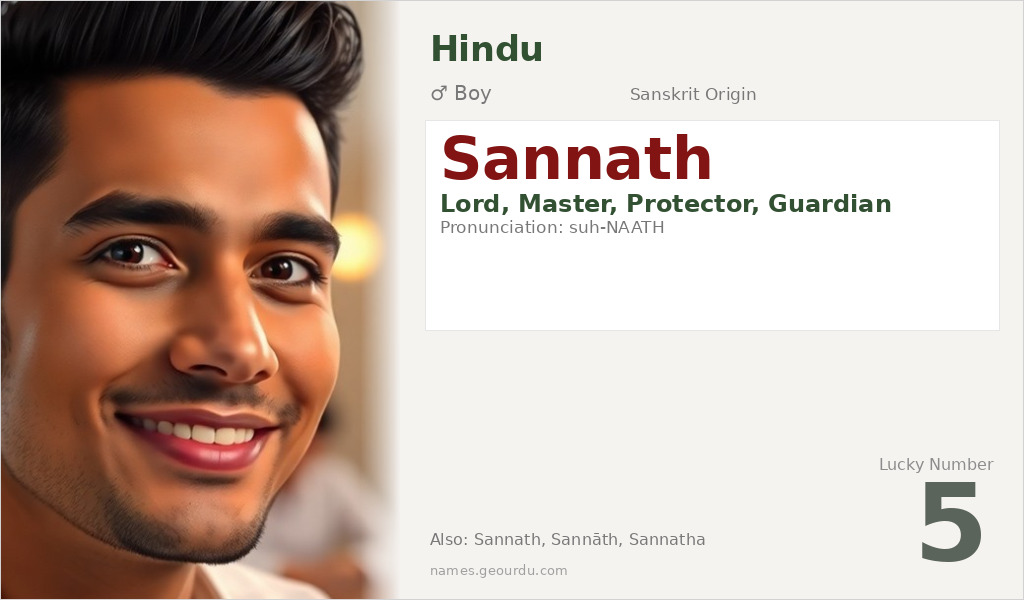
Table of Contents
Sannath is a distinctive and meaningful name rooted in ancient Sanskrit traditions, often chosen for boys in Hindu families. With a direct translation meaning ‘Lord’ or ‘Master,’ it embodies qualities of authority and guardianship. This name carries cultural depth and spiritual significance, making it a popular choice in regions like India and Nepal. In this guide, we explore the etymology, personality traits, and cultural context of the name Sannath.
Meaning of Sannath
Sannath originates from the Sanskrit word ‘Svāmī’ (स्वामी), which means ‘lord, master, owner, or protector.’ The linguistic evolution from Sanskrit to Prakrit and later Apabhraṃśa led to variations like ‘Sannāth’ in modern Indian languages. In Sanskrit, ‘sva’ refers to ‘self’ or ‘own,’ combined with ‘-āmī’ to denote possession or mastery, thus conveying a sense of authority and guardianship. Historically, this term was used in religious and royal contexts, signifying spiritual or temporal leadership. The name is well-documented in classical texts and inscriptions, affirming its established meaning without ambiguity.
| 📛 Name | Sannath |
| 💎 Meaning | Lord, Master, Protector, Guardian |
| 👤 Gender | Boy |
| 🕌 Religion | Hindu |
| 🌍 Origin | Sanskrit |
| 🗣 Pronunciation | suh-NAATH |
| ✍️ Urdu | سناتھ |
| ✍️ Arabic | ساناث |
| 🔢 Numerology | 5 |
| ✨ Spellings | Sannath, Sannāth, Sannatha, Sannathh |
Origin & Cultural Significance
The name Sannath has its origins in Sanskrit, an ancient Indo-Aryan language central to Hindu scriptures and culture. It is primarily used in Hindu communities across India, Nepal, and the diaspora, reflecting Sanskrit’s enduring influence on naming traditions. In historical contexts, similar derivatives of ‘Svāmī’ appear in medieval Indian literature and epigraphs, often associated with deities or respected figures. While not common in other language families like Arabic or Persian, it remains a culturally specific name within Sanskritic traditions, with regional variations in spelling and pronunciation.
Personality Traits
People named Sannath are often perceived as natural leaders, embodying the name’s meaning of ‘lord’ or ‘master’ through protective and authoritative traits. They tend to be responsible, analytical, and adventurous, aligning with the numerology number 5’s emphasis on freedom and curiosity. In social settings, they may exhibit a strong sense of duty and a knack for guiding others, making them reliable and influential figures in their communities.
Similar Names
If you like Sannath, consider: Sanath, Sanat, Sanathkumar, Sanathan, Sanathana
Famous People Named Sannath
- Sannath Reddy — Indian cricketer from Andhra Pradesh
- Sannath Jayaprakash — Indian classical musician and vocalist
Frequently Asked Questions About Sannath
What does Sannath mean?
Sannath means 'Lord,' 'Master,' 'Protector,' or 'Guardian,' derived from the Sanskrit word 'Svāmī' (स्वामी).
Is Sannath a boy or girl name?
Sannath is traditionally a boy's name in Hindu culture, reflecting masculine connotations of authority and protection.
What is the origin of Sannath?
Sannath originates from Sanskrit, an ancient Indian language, and is primarily used in Hindu naming traditions across South Asia.





