Table of Contents
Sara is a timeless name that has graced princesses, saints, and celebrities across centuries and continents. With roots in ancient Hebrew meaning ‘princess,’ this elegant name carries connotations of nobility, purity, and grace. From biblical matriarchs to modern icons, Sara remains one of the world’s most beloved feminine names, cherished in Muslim, Christian, Jewish, and secular communities alike.
Meaning of Sara
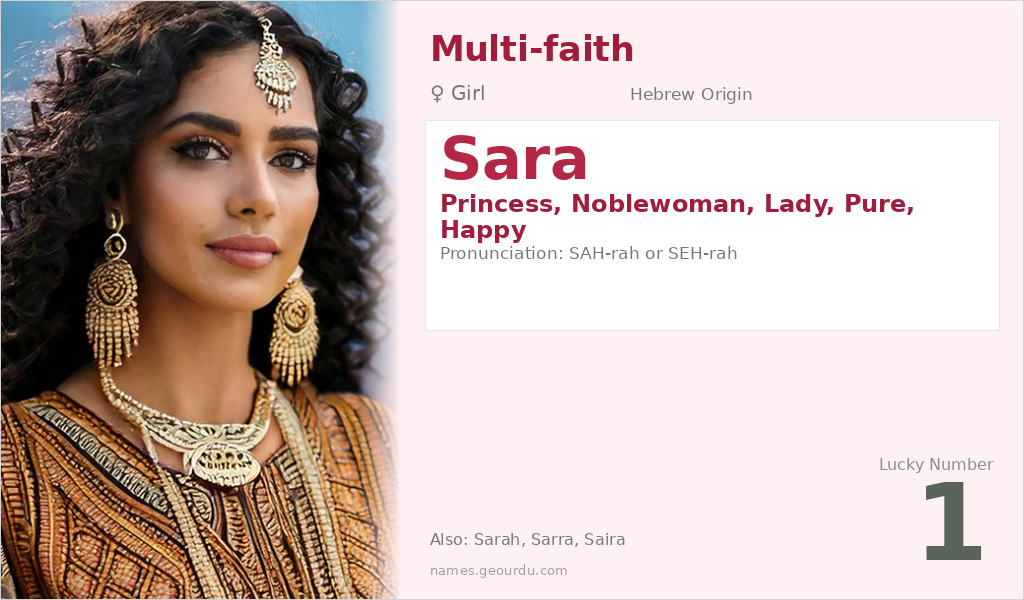
The name Sara originates from the Hebrew name Sarah (שָׂרָה), which literally means ‘princess,’ ‘noblewoman,’ or ‘lady.’ In Arabic, Sara (سارة) carries similar meanings of ‘pure’ and ‘happy.’ The name appears prominently in Abrahamic traditions as the wife of Prophet Abraham and mother of Isaac in both the Bible and Quran. While some regional variations might have different meanings (like ‘lake’ in certain contexts), the universally accepted meaning across most cultures is ‘princess.’ The name has been adapted into countless languages while retaining its core meaning of nobility and grace.
| 📛 Name | Sara |
| 💎 Meaning | Princess, Noblewoman, Lady, Pure, Happy |
| 👤 Gender | Girl |
| 🕌 Religion | Multi-faith |
| 🌍 Origin | Hebrew |
| 🗣 Pronunciation | SAH-rah or SEH-rah |
| ✍️ Urdu | سارہ |
| ✍️ Arabic | سارة |
| 🔢 Numerology | 1 |
| ✨ Spellings | Sarah, Sarra, Saira, Saraa |
Origin & Cultural Significance
Sara has its primary origin in ancient Hebrew, where it was borne by the matriarch Sarah in the Book of Genesis. The name spread through Jewish, Christian, and Islamic traditions, becoming particularly popular in the Middle East and Europe. During the Islamic Golden Age, the name gained prominence in Arabic-speaking regions as سارة. It entered Western cultures through biblical translations and became widely used in English-speaking countries by the 18th century. Today, Sara remains popular across diverse cultures from Latin America to Scandinavia, maintaining its cross-cultural appeal.
Personality Traits
Individuals named Sara are often perceived as natural leaders with a dignified presence. They typically exhibit qualities of reliability, intelligence, and emotional strength. Many Saras balance traditional values with modern adaptability, showing both grace under pressure and compassionate understanding toward others. Their name’s royal connotations often translate into confident, principled personalities who inspire trust and respect.
Similar Names
If you like Sara, consider: Sarah, Zara, Saira, Sarai, Sarina
Famous People Named Sara
- Sara Ali Khan — Indian actress
- Sara Bareilles — American singer-songwriter
- Sara Sampaio — Portuguese model
Frequently Asked Questions About Sara
What does Sara mean?
Sara means 'princess' or 'noblewoman' from its Hebrew origin. In Arabic, it also means 'pure' and 'happy.'
Is Sara a boy or girl name?
Sara is overwhelmingly a feminine name across all cultures where it's used. There are extremely rare masculine uses in some regions, but globally it's considered a girl's name.
What is the origin of Sara?
Sara originates from Hebrew, specifically from the name Sarah meaning 'princess.' It has been adopted into Arabic, Persian, Turkish, and numerous European languages through religious and cultural exchange.