
Table of Contents
Sardar is a powerful name with deep historical roots across multiple cultures. Originating from Persian, it carries connotations of leadership, authority, and nobility. While commonly used in South Asia and the Middle East, its appeal transcends religious boundaries. This name has been borne by political leaders, military figures, and community heads throughout history.
Meaning of Sardar
Sardar derives from the Persian compound word ‘sar-dār’ (سردار), where ‘sar’ means ‘head’ and ‘dār’ means ‘holder’ or ‘possessor’. Literally translating to ‘head-holder’, it metaphorically signifies ‘chief’, ‘leader’, or ‘commander’. The term entered numerous languages through Persian cultural and administrative influence, including Urdu, Punjabi, Pashto, Sindhi, Balochi, Kurdish, and Turkish. In Ottoman Turkish, it became ‘serdar’ as a military rank. The meaning has remained remarkably consistent across these linguistic adaptations, always retaining its core association with leadership and authority.
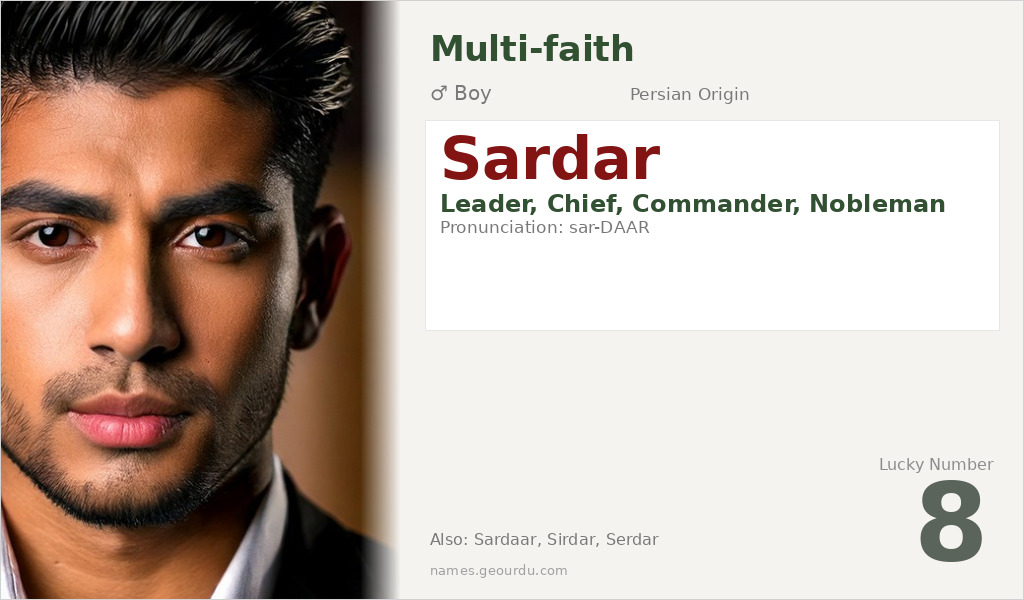
| 📛 Name | Sardar |
| 💎 Meaning | Leader, Chief, Commander, Nobleman |
| 👤 Gender | Boy |
| 🕌 Religion | Multi-faith |
| 🌍 Origin | Persian |
| 🗣 Pronunciation | sar-DAAR |
| ✍️ Urdu | سردار |
| ✍️ Arabic | سردار |
| 🔢 Numerology | 8 |
| ✨ Spellings | Sardaar, Sirdar, Serdar, Sardhar |
Origin & Cultural Significance
The name Sardar originated in Persia as an honorific title for military commanders and administrative leaders. During the Mughal Empire, it was adopted into South Asian languages as a title for nobility and military officers. Sikh tradition uses ‘Sardar’ as an honorific for baptized Sikh males, while in Baloch and Pashtun tribal structures, it denotes tribal chiefs. Today, it functions both as a given name and a respectful title across India, Pakistan, Afghanistan, Iran, Turkey, and diaspora communities. Its cross-cultural adoption makes it truly multi-faith rather than exclusively Islamic.
Personality Traits
Those named Sardar often embody leadership qualities from an early age. They tend to be natural decision-makers who others look to for guidance and direction. With a name meaning ‘chief’ or ‘leader’, they frequently develop strong organizational skills and a protective instinct toward their community or family. The historical weight of the name may inspire confidence and responsibility in its bearers.
Similar Names
If you like Sardar, consider: Sardar Ali, Sardar Khan, Sardar Singh, Serdar, Sardorbek
Famous People Named Sardar
- Sardar Vallabhbhai Patel — Indian independence leader and first Deputy Prime Minister of India
- Sardar Muhammad Abdul Qayyum Khan — Pakistani Kashmiri political leader
Frequently Asked Questions About Sardar
What does Sardar mean?
Sardar means 'leader', 'chief', 'commander', or 'nobleman'. It comes from Persian 'sar-dār' (head-holder).
Is Sardar a boy or girl name?
Sardar is exclusively a masculine name, used for boys and men across all cultures where it appears.
What is the origin of Sardar?
Sardar originates from Persian language and culture, spreading to Urdu, Punjabi, Pashto, Sindhi, Balochi, Kurdish, Turkish, and other languages through historical influence.





