Table of Contents
Sareeta is a beautiful and melodious name with deep roots in Sanskrit culture. Often chosen for girls, it evokes images of grace, virtue, and artistic expression. This name has transcended religious boundaries, becoming popular in various communities across South Asia. Discover the rich history and meaning behind Sareeta in this comprehensive guide.
Meaning of Sareeta
Sareeta originates from the Sanskrit word ‘Sārītā’, derived from ‘sāra’, meaning essence, substance, or excellence. In Sanskrit literature, it describes a woman of noble character, virtue, or high status, often translated as ‘princess’ or ‘excellent one’. Additionally, in Indian classical music, ‘Sareeta’ refers to a specific melodic composition, highlighting its artistic connotations. The name has been adapted into modern Indian languages like Hindi, Bengali, and Urdu, where it retains these core meanings. Unlike many names with Arabic origins, Sareeta’s etymology is firmly rooted in the ancient Indo-Aryan linguistic tradition.
| 📛 Name | Sareeta |
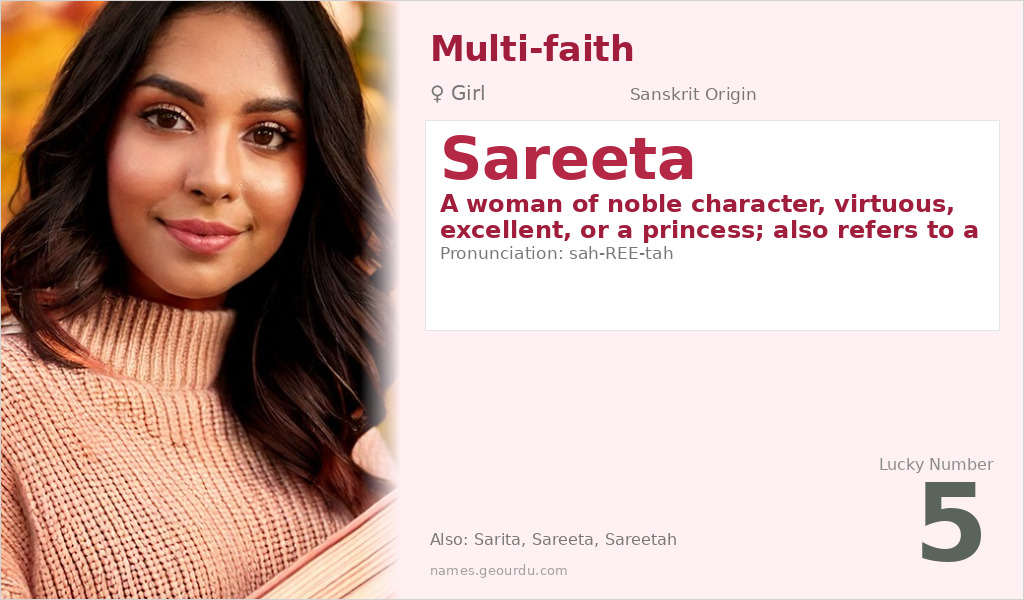
| 💎 Meaning | A woman of noble character, virtuous, excellent, or a princess; also refers to a type of musical composition in Indian classical music |
| 👤 Gender | Girl |
| 🕌 Religion | Multi-faith |
| 🌍 Origin | Sanskrit |
| 🗣 Pronunciation | sah-REE-tah |
| ✍️ Urdu | ساریتا |
| ✍️ Arabic | ساريتا |
| 🔢 Numerology | 5 |
| ✨ Spellings | Sarita, Sareeta, Sareetah, Saritha |
Origin & Cultural Significance
Sareeta has its origins in ancient Sanskrit, the classical language of India, dating back over 3,000 years. It emerged from Vedic and later Sanskrit texts, where it was used to denote feminine nobility and virtue. Over centuries, the name spread across South Asia through cultural exchange, becoming common in Hindu, Muslim, Sikh, and other communities, particularly in India, Pakistan, Bangladesh, and Nepal. Its usage in Muslim contexts is due to the syncretic cultural practices in regions like the Indian subcontinent, where Sanskrit-derived names are widely adopted regardless of religion. This cross-cultural adoption showcases the name’s enduring appeal beyond its original religious associations.
Personality Traits
People named Sareeta are often associated with traits of elegance, creativity, and integrity. The name’s meanings of ‘noble woman’ and connection to music suggest a personality that is both principled and artistically inclined. They may exhibit leadership qualities and a calming presence, inspiring trust and admiration in others. Their virtuous nature often makes them role models in their communities.
Similar Names
If you like Sareeta, consider: Sarika, Sarita, Sarina, Saira, Sara
Famous People Named Sareeta
- Sarita Choudhury — British-American actress known for roles in 'Mississippi Masala' and 'Homeland'
- Sarita Joshi — Indian actress in Hindi and Gujarati theatre and television
Frequently Asked Questions About Sareeta
What does Sareeta mean?
Sareeta means 'a woman of noble character', 'virtuous', 'excellent', or 'princess' in Sanskrit. It also refers to a type of musical composition in Indian classical music.
Is Sareeta a boy or girl name?
Sareeta is exclusively a girl's name, derived from feminine forms in Sanskrit and used for females across cultures.
What is the origin of Sareeta?
Sareeta originates from Sanskrit, an ancient Indo-Aryan language of India, and is used in various South Asian cultures including Hindu, Muslim, and Sikh communities.