
Table of Contents
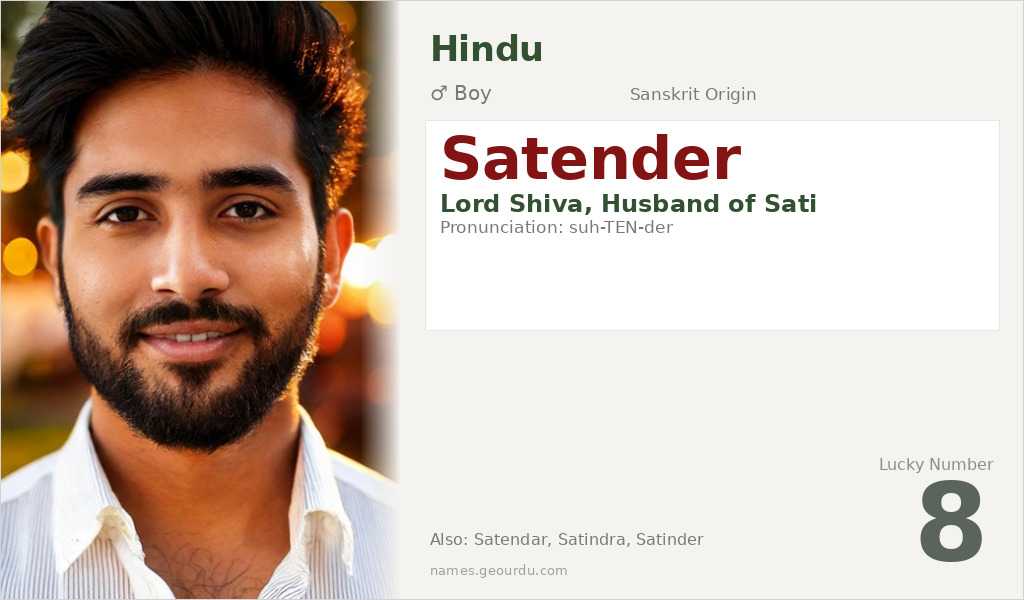
Satender is a powerful Hindu boy name with deep mythological roots in Sanskrit tradition. Meaning ‘Lord of Sati’ or ‘Husband of Sati,’ this name directly references Lord Shiva and his relationship with his first consort. Popular in Hindu communities across India, Satender carries spiritual significance and cultural heritage. Parents choosing this name often seek to imbue their child with the strength and devotion associated with Shiva.
Meaning of Satender
Satender is a Sanskrit compound name with two distinct components that together create a meaningful whole. The first part ‘Sati’ refers to the Hindu goddess Sati, daughter of Daksha and first wife of Shiva, known for her ultimate sacrifice. The second component ‘Indra’ means ‘lord,’ ‘king,’ or ‘ruler’ in Sanskrit, appearing in many Hindu names and titles. When combined, Satender literally translates to ‘Lord of Sati’ or ‘Husband of Sati,’ making it one of the many epithets of Lord Shiva. This name specifically highlights Shiva’s relationship with Sati before her rebirth as Parvati, emphasizing both marital devotion and divine connection. The name’s etymology is well-documented in Sanskrit texts and Hindu mythological traditions.
| 📛 Name | Satender |
| 💎 Meaning | Lord Shiva, Husband of Sati |
| 👤 Gender | Boy |
| 🕌 Religion | Hindu |
| 🌍 Origin | Sanskrit |
| 🗣 Pronunciation | suh-TEN-der |
| ✍️ Urdu | ستندر |
| ✍️ Arabic | ساتيندر |
| 🔢 Numerology | 8 |
| ✨ Spellings | Satendar, Satindra, Satinder |
Origin & Cultural Significance
Satender originates from classical Sanskrit, the ancient liturgical language of Hinduism. The name emerged from Hindu mythological traditions where various epithets were created to describe different aspects of deities. Specifically, Satender developed as a name honoring Lord Shiva’s relationship with his first wife Sati, whose self-immolation story is central to Shaivism. This name is primarily used in Hindu communities across North India, particularly in states like Haryana, Punjab, and Uttar Pradesh. While the name has Sanskrit roots, its modern usage reflects both religious devotion and cultural identity within Hindu naming practices.
Personality Traits
Those named Satender are often associated with qualities reminiscent of Lord Shiva – they may display a combination of intense focus and deep compassion. They tend to be determined individuals with strong principles and spiritual inclinations. Many exhibit protective instincts toward family and community, along with leadership capabilities that inspire respect from others.
Similar Names
If you like Satender, consider: Shiva, Mahadev, Rudra, Bholenath, Nataraj
Famous People Named Satender
- Satender Singh Dahiya — Indian wrestler who won gold at the 2022 Commonwealth Games
- Satender Kumar Antil — Indian politician and Member of Parliament from Haryana
Frequently Asked Questions About Satender
What does Satender mean?
Satender means 'Lord Shiva' or specifically 'Husband of Sati' in Sanskrit, referring to Shiva's relationship with his first consort in Hindu mythology.
Is Satender a boy or girl name?
Satender is exclusively a boy name in Hindu naming traditions, as it refers to the male deity Lord Shiva.
What is the origin of Satender?
Satender originates from Sanskrit, the classical language of Hinduism, and specifically derives from Hindu mythology where it serves as an epithet for Lord Shiva.





