
Table of Contents
Satinath is a profound Sanskrit name that carries deep spiritual significance in Hindu tradition. Meaning ‘Lord of Truth’ or ‘Master of Truth’, this name combines two powerful Sanskrit elements representing ultimate reality and divine protection. Traditionally given to boys, Satinath reflects values of honesty, wisdom, and spiritual authority that have been cherished across generations in Indian culture.
Meaning of Satinath
Satinath derives from classical Sanskrit, combining ‘Satya’ (सत्य) meaning ‘truth, reality, essence’ with ‘Nath’ (नाथ) meaning ‘lord, master, or protector’. The component ‘Satya’ comes from the root ‘sat’ (सत्), which in Vedic philosophy represents the eternal, unchanging reality—the absolute truth that underlies all existence. ‘Nath’ originates from the verb ‘nāth’ (नाथ्) meaning ‘to seek help or protection’, evolving to signify one who provides such protection. Together, they create a name that literally means ‘Lord of Truth’, suggesting mastery over spiritual truth and reality. This compound structure follows traditional Sanskrit naming patterns where ‘nath’ serves as a suffix indicating divinity or mastery, similar to names like Vishwanath (Lord of the Universe) or Gopinath (Lord of the Cowherds).
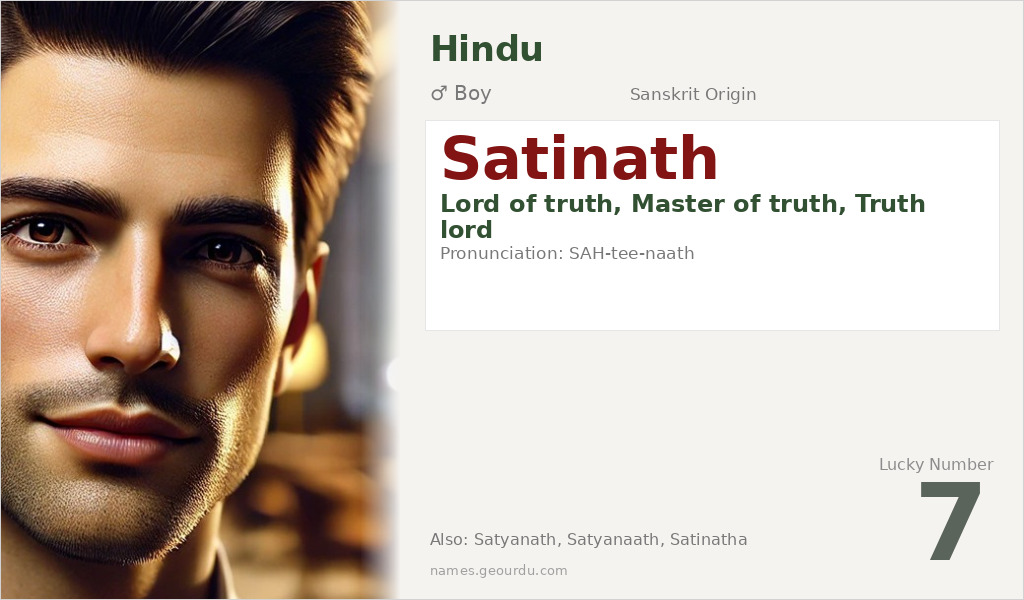
| 📛 Name | Satinath |
| 💎 Meaning | Lord of truth, Master of truth, Truth lord |
| 👤 Gender | Boy |
| 🕌 Religion | Hindu |
| 🌍 Origin | Sanskrit |
| 🗣 Pronunciation | SAH-tee-naath |
| ✍️ Urdu | ستیناتھ |
| ✍️ Arabic | ساتينات |
| 🔢 Numerology | 7 |
| ✨ Spellings | Satyanath, Satyanaath, Satinatha |
Origin & Cultural Significance
Satinath originates from Sanskrit, the classical language of ancient India and Hindu scriptures. As a compound name, it reflects the sophisticated naming traditions of Hindu culture where meaningful elements are combined to create names with spiritual depth. The name appears in various Hindu contexts, sometimes as an epithet for Lord Shiva who is considered the embodiment of ultimate truth (Satya). Historically, such names were particularly popular among Brahmin communities and those with strong ties to Hindu philosophical traditions. The name’s usage spans across India, with notable prevalence in Bengali, Hindi, and Marathi speaking regions, maintaining its classical roots while adapting to modern naming practices.
Personality Traits
Those named Satinath are often perceived as individuals of strong character and intellectual depth. Their connection to ‘truth’ in their name’s meaning tends to manifest as honesty, reliability, and a quest for understanding life’s deeper meanings. They may naturally gravitate toward leadership roles where integrity is valued, and often display a balanced combination of practical wisdom and spiritual insight. The name suggests someone who values principles over convenience and seeks to live authentically according to their convictions.
Similar Names
If you like Satinath, consider: Satyanarayan, Satyanand, Satyendra, Satyajit, Satyaprakash
Famous People Named Satinath
- Satinath Bhaduri — Renowned Bengali novelist and freedom fighter, author of 'Dhorai Charit Manas'
- Satinath Mukherjee — Indian classical vocalist and musicologist
Frequently Asked Questions About Satinath
What does Satinath mean?
Satinath means 'Lord of Truth' or 'Master of Truth'. It is a compound Sanskrit name combining 'Satya' (truth) and 'Nath' (lord/master).
Is Satinath a boy or girl name?
Satinath is traditionally a masculine name given to boys in Hindu culture. The '-nath' suffix is typically masculine in Sanskrit naming conventions.
What is the origin of Satinath?
Satinath originates from Sanskrit, the classical language of ancient India. It follows Hindu naming traditions where meaningful elements are combined to create spiritually significant names.





