
Table of Contents
Sattar is a profound Arabic name for boys, deeply rooted in Islamic tradition as one of the 99 Names of Allah. Meaning ‘The Veiler’ or ‘The Protector,’ it symbolizes divine mercy in concealing human imperfections. This name carries spiritual weight and is cherished across Muslim communities for its association with God’s attribute of covering faults. Explore the rich etymology and cultural significance of Sattar in this detailed guide.
Meaning of Sattar
Sattar originates from the Arabic root س-ت-ر (s-t-r), which conveys concepts of covering, veiling, concealing, and protecting. As a proper name, it is derived from ‘As-Sattar’ (الستار), one of the 99 Names of Allah in Islam, meaning ‘The Veiler of Sins’ or ‘The One who covers and protects.’ This divine attribute emphasizes God’s mercy in hiding human shortcomings from others, encouraging humility and compassion. In linguistic context, the root appears in words like ‘sitr’ (cover) and ‘yastur’ (he covers), highlighting its thematic consistency. The name is exclusively used in Muslim cultures to invoke this protective quality, with no verified meanings in other languages like Pashto or Balochi.
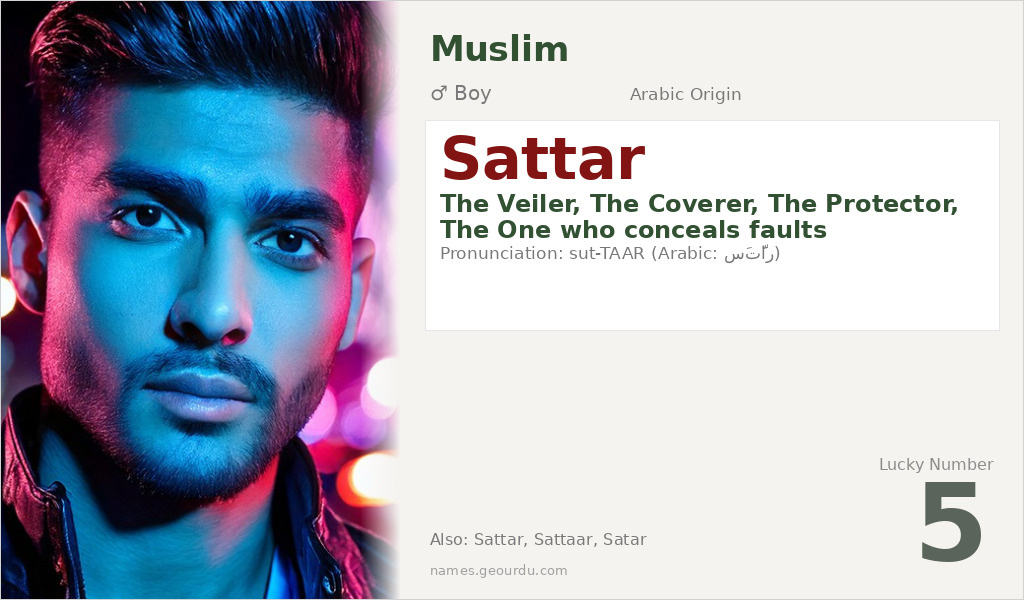
| 📛 Name | Sattar |
| 💎 Meaning | The Veiler, The Coverer, The Protector, The One who conceals faults |
| 👤 Gender | Boy |
| 🕌 Religion | Muslim |
| 🌍 Origin | Arabic |
| 🗣 Pronunciation | sut-TAAR (Arabic: سَتَّار) |
| ✍️ Urdu | ستار |
| ✍️ Arabic | ستار |
| 🔢 Numerology | 5 |
| ✨ Spellings | Sattar, Sattaar, Satar, Sattaar |
Origin & Cultural Significance
Sattar has its origins in Classical Arabic and Islamic theology, dating back to the Quran and Hadith where God’s attributes are detailed. It is primarily used in Muslim-majority regions such as the Middle East, South Asia (e.g., Pakistan, Bangladesh, India), and among diaspora communities. Culturally, the name is given to boys to embody the virtue of protection and discretion, reflecting a hope for the child to exhibit merciful traits. Historically, it has been borne by figures like Abdus Sattar, highlighting its enduring relevance. Unlike some names with cross-cultural variants, Sattar remains firmly within Arabic-Islamic tradition without significant adaptation in other linguistic families.
Personality Traits
Those named Sattar are often associated with traits of discretion, protection, and empathy, mirroring the name’s meaning of veiling faults. They may be seen as trustworthy confidants who value privacy and offer non-judgmental support. This personality aligns with the Islamic ideal of showing mercy and covering others’ mistakes, fostering a compassionate demeanor in social interactions.
Similar Names
If you like Sattar, consider: Sattar Ali, Abdus Sattar, Sattar Khan, Sattar Bahlulzada
Famous People Named Sattar
- Abdus Sattar — former President of Bangladesh (1981-1982)
- Sattar Bahlulzada — Azerbaijani painter known for landscape art
Frequently Asked Questions About Sattar
What does Sattar mean?
Sattar means 'The Veiler,' 'The Coverer,' or 'The Protector' in Arabic, derived from the root s-t-r. It is one of the 99 Names of Allah, emphasizing divine mercy in concealing human faults.
Is Sattar a boy or girl name?
Sattar is exclusively a boy's name in Muslim cultures, reflecting its use as a masculine given name tied to Islamic theology and tradition.
What is the origin of Sattar?
Sattar originates from Arabic and Islamic tradition, specifically from the Quranic concept of God's attributes. It is not found with verified meanings in other languages like Pashto or Balochi.





