
Table of Contents
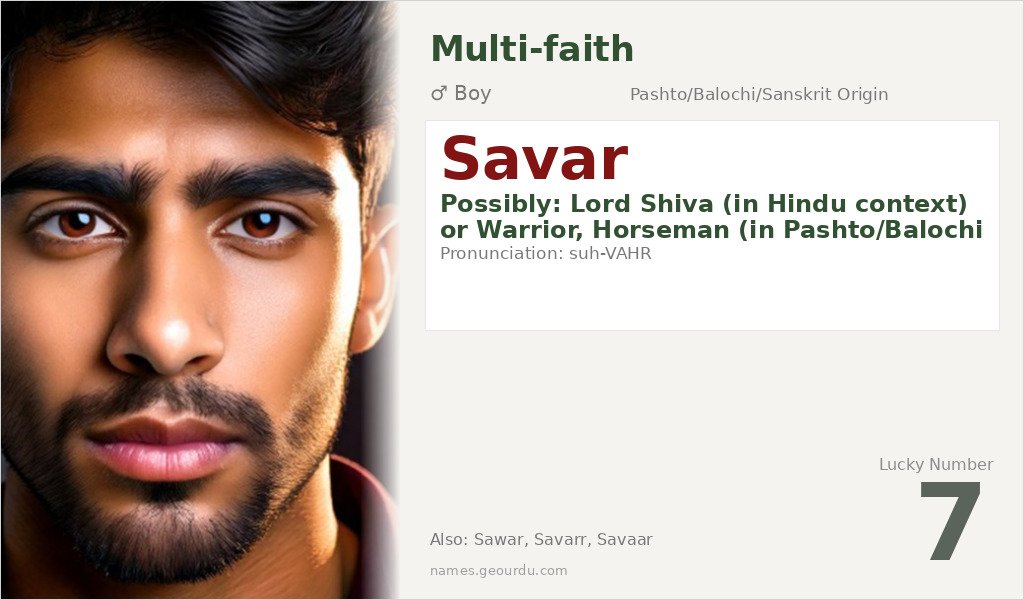
Savar is a distinctive name with intriguing cross-cultural significance. While commonly associated with Hindu traditions in some regions, it also carries important meaning in Pashto and Balochi cultures as ‘horseman’ or ‘warrior.’ This name bridges spiritual and martial traditions, offering rich historical depth for parents considering meaningful names.
Meaning of Savar
The name Savar has multiple potential meanings across different linguistic traditions. In Pashto and Balochi languages, ‘savar’ (سوار) directly translates to ‘horseman,’ ‘rider,’ or ‘cavalryman,’ derived from the Persian root ‘savār.’ This reflects the nomadic and warrior traditions of these cultures. In Hindu contexts, some sources suggest a connection to Lord Shiva, possibly as a regional variant or derivative, though this is not well-documented in classical Sanskrit literature. The name may also relate to the Sanskrit word ‘savara’ meaning ‘forest dweller’ or ‘hunter,’ though this connection is speculative. Without definitive etymological records, the name’s meaning remains culturally contextual.
| 📛 Name | Savar |
| 💎 Meaning | Possibly: Lord Shiva (in Hindu context) or Warrior, Horseman (in Pashto/Balochi context) |
| 👤 Gender | Boy |
| 🕌 Religion | Multi-faith |
| 🌍 Origin | Pashto/Balochi/Sanskrit |
| 🗣 Pronunciation | suh-VAHR |
| ✍️ Urdu | سوار |
| ✍️ Arabic | سوار |
| 🔢 Numerology | 7 |
| ✨ Spellings | Sawar, Savarr, Savaar |
Origin & Cultural Significance
Savar originates from multiple cultural streams. Its strongest documented origin is from Persian ‘savār,’ which entered Pashto and Balochi languages, where it became a common term for horsemen and warriors, often used as a title or name among tribal leaders. In South Asia, the name appears in Hindu communities, particularly in regions with historical Pashtun/Baloch influence. The name’s presence in India may represent cultural exchange along historical trade and migration routes. Historical records show several Pashtun and Baloch leaders bearing variations of this name, particularly in the 17th-19th centuries across modern Pakistan and Afghanistan.
Personality Traits
Those named Savar often embody qualities associated with both meanings of their name. From the warrior tradition comes strength, courage, and leadership—traits valued in pastoral and tribal societies. From the potential spiritual connection comes depth, introspection, and protective instincts. This combination creates individuals who are both practical and principled, capable of both action and contemplation.
Similar Names
If you like Savar, consider: Shiva, Sawar, Savarion, Sava, Savir
Famous People Named Savar
- Savar (historical figure) — Pashtun tribal leader in the 18th century
- Savar Khan — Baloch chieftain in Pakistani history
Frequently Asked Questions About Savar
What does Savar mean?
Savar has multiple possible meanings: in Pashto/Balochi it means 'horseman' or 'warrior,' while in some Hindu contexts it may relate to Lord Shiva, though this connection is less documented.
Is Savar a boy or girl name?
Savar is primarily a masculine name across all cultural contexts where it appears, reflecting warrior and leadership traditions.
What is the origin of Savar?
The name has documented origins in Persian 'savār,' which entered Pashto and Balochi languages, with additional appearances in Hindu naming traditions in South Asia.





