
Table of Contents
Sawant is a distinctive name with deep roots in Indian history and culture, particularly within the Marathi-speaking community of Maharashtra. While often encountered as a surname, it also serves as a meaningful given name carrying connotations of authority and land stewardship. This name connects modern bearers to a rich feudal heritage and regional identity that has persisted for centuries. Understanding Sawant’s true meaning reveals a fascinating journey from ancient Sanskrit to contemporary usage.
Meaning of Sawant
The name Sawant originates from the Sanskrit word ‘Sāmanta’ (सामन्त), which historically referred to a feudal lord, regional ruler, or landowner in ancient Indian society. Through linguistic evolution via Prakrit and into Marathi, ‘Sāmanta’ transformed into ‘Sawant’, specifically within the Maratha community where it denoted individuals of the landowning or warrior classes. Unlike the incorrect solar association in some sources, Sawant’s meaning is firmly terrestrial—connected to land, authority, and governance. This etymology reflects the socio-political structures of medieval India, where samantas were vassals or subordinate rulers who controlled territories under larger empires.
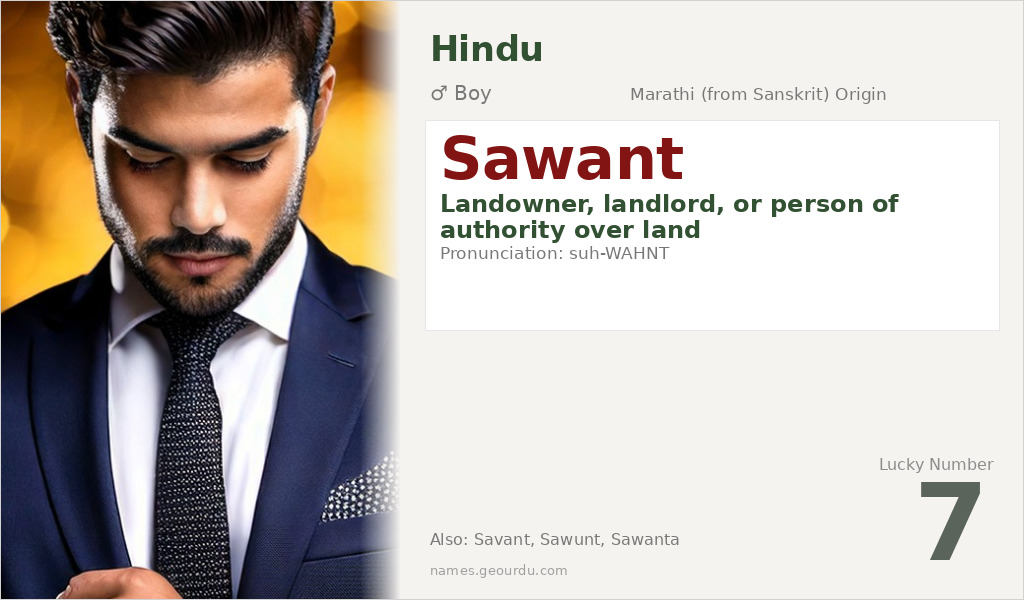
| 📛 Name | Sawant |
| 💎 Meaning | Landowner, landlord, or person of authority over land |
| 👤 Gender | Boy |
| 🕌 Religion | Hindu |
| 🌍 Origin | Marathi (from Sanskrit) |
| 🗣 Pronunciation | suh-WAHNT |
| ✍️ Urdu | ساونٹ |
| ✍️ Arabic | ساونت |
| 🔢 Numerology | 7 |
| ✨ Spellings | Savant, Sawunt, Sawanta |
Origin & Cultural Significance
Sawant has its origins in the Marathi language and culture of Maharashtra, western India, with linguistic roots tracing back to Sanskrit. Historically, it emerged as a title and surname among the Maratha community, particularly associated with families who held land or regional authority during the Maratha Empire period (17th-19th centuries). The name spread through migration and remains prevalent in Maharashtra and among Marathi diaspora communities worldwide. While primarily Hindu in association, its usage is more cultural and regional than strictly religious, reflecting Marathi identity and historical social structures.
Personality Traits
Those named Sawant are often associated with qualities of leadership, responsibility, and practicality, reflecting the name’s meaning of landownership and authority. They may exhibit strong organizational skills, a grounded approach to life, and a protective nature toward their responsibilities and community. The historical connection to feudal stewardship suggests traits of reliability, tradition-mindedness, and a capacity for management and oversight in various aspects of life.
Similar Names
If you like Sawant, consider: Samant, Samanta, Samantha, Sawan, Savant
Famous People Named Sawant
- Shivaji Sawant — Indian Marathi language novelist known for 'Mrityunjay'
- Vijay Sawant — Indian politician from Maharashtra
Frequently Asked Questions About Sawant
What does Sawant mean?
Sawant means 'landowner', 'landlord', or 'feudal lord' in Marathi, derived from the Sanskrit word 'Sāmanta'. It does not mean 'Sun' as sometimes incorrectly stated.
Is Sawant a boy or girl name?
Sawant is primarily a masculine name, though it originated as a surname that can be used by any gender. As a given name, it is almost exclusively used for boys within Marathi culture.
What is the origin of Sawant?
Sawant originates from the Marathi language of Maharashtra, India, with etymological roots in Sanskrit. It specifically developed within the Maratha community as a title for landowners and regional authorities.





