Table of Contents
Seetha is a beautiful and profound name with deep roots in Hindu mythology and Sanskrit language. Most famously borne by the goddess Sita from the epic Ramayana, this name carries connotations of fertility, purity, and earthly connection. Its literal meaning—’furrow’—evokes imagery of agriculture and creation, making it both humble and divine. Today, Seetha remains a popular choice for girls in Hindu communities worldwide.
Meaning of Seetha
The name Seetha derives directly from the Sanskrit word ‘sītā’ (सीता), which means ‘furrow’—specifically the line or trench created when plowing earth for agriculture. This literal meaning is central to Hindu mythology, as Sita, the wife of Lord Rama, is said to have emerged from a furrow in a field, symbolizing her connection to the earth and fertility. Etymologically, the Sanskrit root is linked to the act of sowing and cultivation, reflecting ancient agrarian values. Over time, the meaning has extended metaphorically to concepts like boundaries, lines, and foundations, but the core remains agricultural. The name is exclusively feminine in usage and has no verified meanings in other languages like Arabic or Persian, despite some modern adaptations.
| 📛 Name | Seetha |
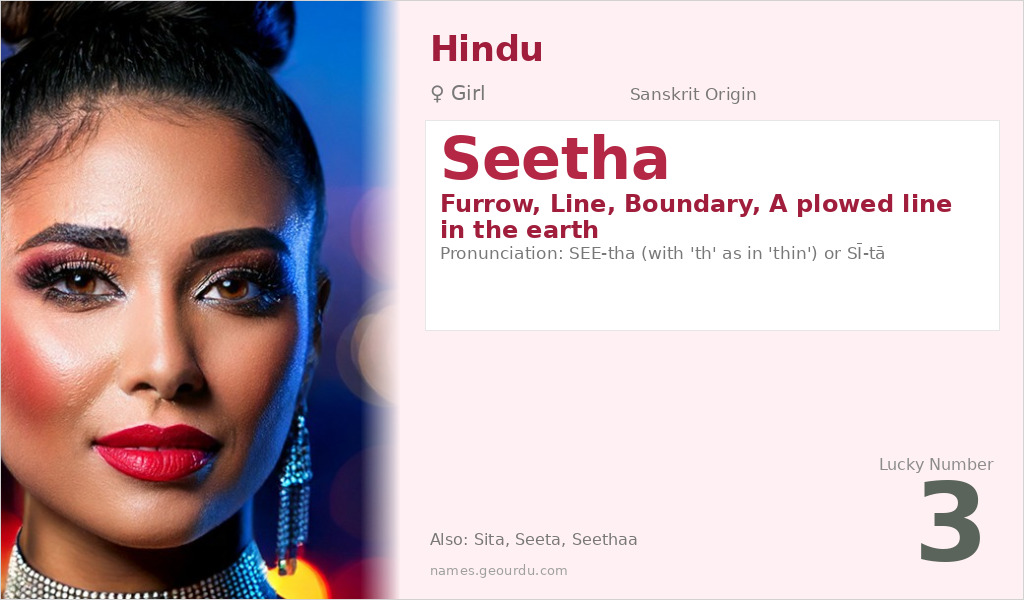
| 💎 Meaning | Furrow, Line, Boundary, A plowed line in the earth |
| 👤 Gender | Girl |
| 🕌 Religion | Hindu |
| 🌍 Origin | Sanskrit |
| 🗣 Pronunciation | SEE-tha (with 'th' as in 'thin') or SĪ-tā |
| ✍️ Urdu | سیتا |
| ✍️ Arabic | سيتا |
| 🔢 Numerology | 3 |
| ✨ Spellings | Sita, Seeta, Seethaa, Sītā |
Origin & Cultural Significance
Seetha originates from classical Sanskrit, the ancient language of Hindu scriptures in India. Its most significant cultural context comes from the Ramayana, one of Hinduism’s major epics, where Sita is a central character revered as an avatar of the goddess Lakshmi. The name has been used for millennia in Indian subcontinent, particularly among Hindu communities, and spread globally through diaspora. While variations exist (like Sita), the spelling ‘Seetha’ is common in South Indian languages and transliterations. It is not traditionally used in other religious contexts like Islam or Christianity, though its recognition extends due to the Ramayana’s influence across Asia.
Personality Traits
Named after a goddess of virtue, Seetha often embodies traits of strength, patience, and integrity. Like the earth from which the name derives, those named Seetha may be seen as stable, nurturing, and resilient, capable of weathering challenges with grace. They often value family, tradition, and moral clarity, reflecting the enduring legacy of their mythological namesake.
Similar Names
If you like Seetha, consider: Sita, Rama, Lakshmi, Radha, Parvati
Famous People Named Seetha
- Sita (Hindu goddess) — Central figure in the Ramayana, revered as an avatar of Lakshmi and embodiment of purity, devotion, and wifely virtue
- Sita White — British socialite and television personality known for her appearances on reality TV
Frequently Asked Questions About Seetha
What does Seetha mean?
Seetha means 'furrow' or 'plowed line' in Sanskrit, referring to an agricultural trench. It is most famous as the name of the Hindu goddess Sita from the Ramayana.
Is Seetha a boy or girl name?
Seetha is exclusively a girl's name in Hindu tradition, derived from the feminine Sanskrit noun 'sītā' and associated with the goddess Sita.
What is the origin of Seetha?
Seetha originates from Sanskrit, an ancient Indian language, and is deeply rooted in Hindu mythology from the Ramayana epic, with no verified origins in other languages like Arabic or Persian.