
Table of Contents
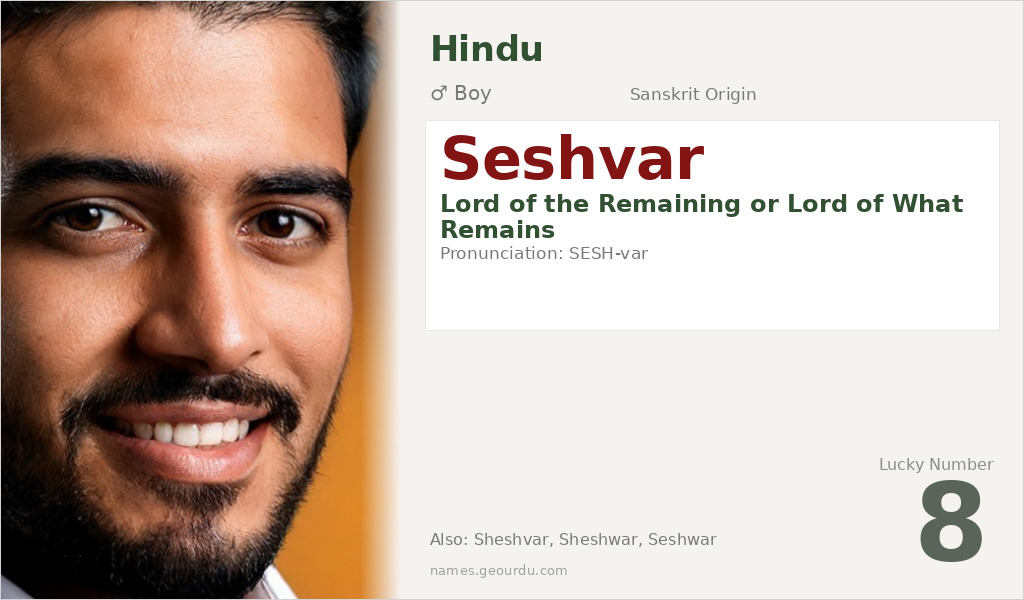
Seshvar is a profound Sanskrit name with deep roots in Hindu cosmology and philosophy. Meaning ‘Lord of the Remaining’ or ‘Lord of What Remains’, this name carries associations with eternal permanence and divine order. Traditionally given to boys, Seshvar connects to the concept of Shesha, the cosmic serpent in Hindu mythology. Discover the rich etymology and cultural significance of this distinctive name.
Meaning of Seshvar
Seshvar derives from two Sanskrit components: ‘Shesha’ (शेष) meaning ‘the remainder, what remains, the eternal residue’ and ‘Ishvara’ (ईश्वर) meaning ‘lord, master, or god’. In Hindu tradition, Shesha refers specifically to the thousand-headed serpent upon whom Lord Vishnu rests between cycles of creation, representing that which remains when all else is dissolved. The compound Seshvar thus literally translates to ‘Lord of Shesha’ or more broadly ‘Lord of What Remains’. This name embodies concepts of cosmic permanence, divine sustenance, and the eternal foundation of existence. Unlike more common Hindu names, Seshvar carries specific philosophical weight related to the cyclical nature of creation and preservation.
| 📛 Name | Seshvar |
| 💎 Meaning | Lord of the Remaining or Lord of What Remains |
| 👤 Gender | Boy |
| 🕌 Religion | Hindu |
| 🌍 Origin | Sanskrit |
| 🗣 Pronunciation | SESH-var |
| ✍️ Urdu | شیسور |
| ✍️ Arabic | سشوار |
| 🔢 Numerology | 8 |
| ✨ Spellings | Sheshvar, Sheshwar, Seshwar |
Origin & Cultural Significance
Seshvar originates from classical Sanskrit, the ancient liturgical language of Hinduism. The name emerges from Hindu cosmological texts where Shesha (also called Ananta) represents the eternal serpent that supports the universe. As a given name, Seshvar appears in Hindu communities, particularly in India and among diaspora populations, though it remains relatively uncommon compared to other Sanskrit-derived names. The name reflects the sophisticated compound word formation characteristic of Sanskrit, where meaningful elements combine to create nuanced philosophical concepts. While not among the most popular contemporary names, Seshvar maintains cultural resonance for those seeking names with specific mythological and philosophical connotations.
Personality Traits
Those named Seshvar are often associated with qualities of stability, endurance, and spiritual depth. The name’s connection to cosmic permanence suggests individuals who value tradition, exhibit reliability, and possess a philosophical outlook on life. They may demonstrate leadership tempered with wisdom, reflecting the balance between authority and cosmic order inherent in the name’s meaning. These traits make Seshvar a name that conveys both strength and spiritual contemplation.
Similar Names
If you like Seshvar, consider: Shesha, Ishvara, Vishnu, Ananta, Narayana
Famous People Named Seshvar
- Seshvar — Not widely documented as a contemporary famous figure, but appears in historical Hindu contexts as an epithet or name
- Sheshvar Sharma — Indian classical musician and scholar
Frequently Asked Questions About Seshvar
What does Seshvar mean?
Seshvar means 'Lord of the Remaining' or 'Lord of What Remains' in Sanskrit, derived from 'Shesha' (remainder) and 'Ishvara' (lord).
Is Seshvar a boy or girl name?
Seshvar is traditionally a masculine name in Hindu culture, given to boys with its roots in Sanskrit masculine noun formations.
What is the origin of Seshvar?
Seshvar originates from Sanskrit, the classical language of Hinduism, with specific connections to Hindu cosmology and the concept of Shesha, the cosmic serpent.





