
Table of Contents
Seth is a timeless name with profound biblical roots that has transcended its ancient origins to become popular worldwide. As the name of Adam and Eve’s third son in the Hebrew Bible, Seth carries weighty significance about divine appointment and legacy. This name has maintained consistent popularity across English-speaking countries and beyond, appealing to parents seeking a strong, historically rich name. Whether chosen for religious reasons or its classic sound, Seth remains a meaningful choice with deep historical resonance.
Meaning of Seth
The name Seth derives from the Hebrew שֵׁת (Shet), directly connected to the Hebrew verb ‘shith’ meaning ‘to place, to appoint, to set.’ This etymology is explicitly referenced in Genesis 4:25, where Eve declares after Seth’s birth: ‘For God has appointed me another seed instead of Abel.’ The name therefore carries meanings of divine appointment, substitution, and compensation. In the biblical narrative, Seth represents hope and continuity after tragedy, being appointed to continue the human lineage. The name’s meaning has remained consistent through translations into Greek (Σήθ), Latin (Seth), and eventually English, preserving its core significance across millennia.
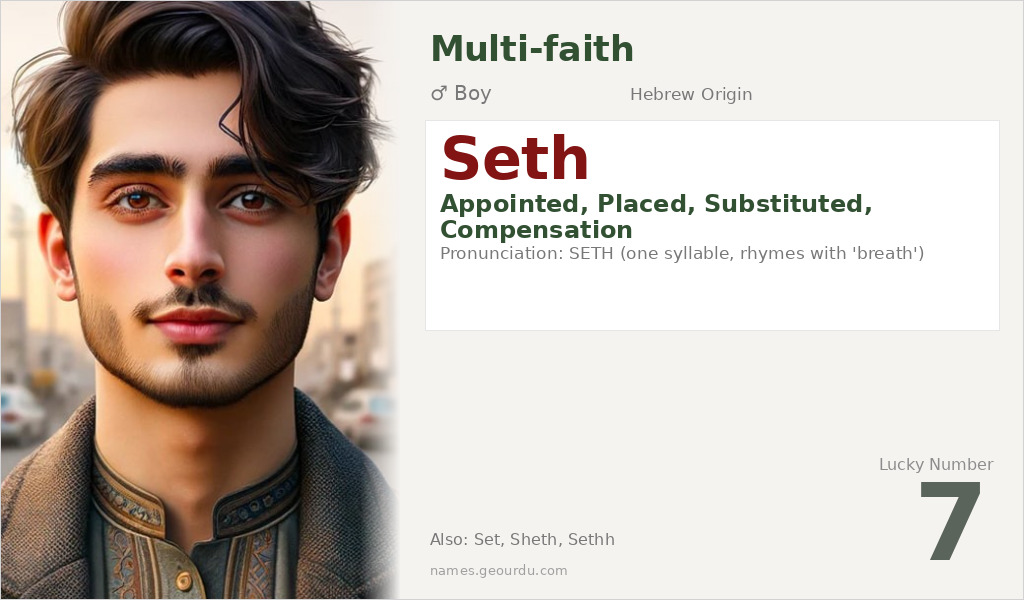
| 📛 Name | Seth |
| 💎 Meaning | Appointed, Placed, Substituted, Compensation |
| 👤 Gender | Boy |
| 🕌 Religion | Multi-faith |
| 🌍 Origin | Hebrew |
| 🗣 Pronunciation | SETH (one syllable, rhymes with 'breath') |
| ✍️ Urdu | سیتھ |
| ✍️ Arabic | شيث |
| 🔢 Numerology | 7 |
| ✨ Spellings | Set, Sheth, Sethh |
Origin & Cultural Significance
Seth originates from ancient Hebrew culture and appears in the Torah/Hebrew Bible as the third son of Adam and Eve, born after Cain killed Abel. According to biblical tradition, Seth became the ancestor of Noah and thus all humanity after the flood. The name entered Western usage through Greek and Latin translations of the Bible and became established in Christian communities. While the name has been adopted across cultures and religions due to biblical influence, its primary origin remains Hebrew/Judeo-Christian. The name gained particular popularity in English-speaking countries during the Protestant Reformation when Old Testament names became fashionable.
Personality Traits
Those named Seth often exhibit characteristics associated with their biblical namesake—thoughtfulness, resilience, and a sense of purpose. They tend to be analytical thinkers who approach life with quiet determination rather than flashy displays. The name’s meaning of ‘appointed’ suggests individuals who may feel destined for meaningful roles or who approach responsibilities with seriousness. Many Seths display a blend of traditional values with modern adaptability, making them reliable yet contemporary individuals.
Similar Names
If you like Seth, consider: Adam, Abel, Cain, Enoch, Noah
Famous People Named Seth
- Seth MacFarlane — American animator, creator of Family Guy
- Seth Rogen — Canadian-American actor and comedian
- Seth Godin — American author and marketing expert
- Seth Rollins — American professional wrestler
Frequently Asked Questions About Seth
What does Seth mean?
Seth means 'appointed,' 'placed,' or 'substituted' in Hebrew. It comes from the Hebrew verb 'shith' meaning to set or appoint, referencing the biblical Seth who was appointed by God to replace Abel.
Is Seth a boy or girl name?
Seth is almost exclusively a masculine name. While names can sometimes cross gender boundaries, Seth has remained consistently male throughout its history from biblical times to modern usage across cultures.
What is the origin of Seth?
Seth originates from ancient Hebrew culture and appears in the Hebrew Bible as the name of Adam and Eve's third son. It's fundamentally a Judeo-Christian name that has spread globally through biblical influence.





