Table of Contents
Sevati is a beautiful Sanskrit name for girls that carries the fragrance of ancient Indian culture and spirituality. Derived from classical botanical terminology, this name evokes images of pristine white lotuses blooming in tranquil waters or fragrant night-blooming jasmine. With roots in Hindu tradition and Sanskrit literature, Sevati represents purity, beauty, and spiritual awakening. This name connects modern bearers to India’s rich linguistic and cultural heritage.
Meaning of Sevati
Sevati originates from the Sanskrit word ‘शेवती’ (śevatī), which specifically refers to either Nymphaea alba (white water lily) or Cestrum nocturnum (night-blooming jasmine). In ancient Indian texts, including Ayurvedic manuscripts and classical poetry, Sevati was used to describe these particular flowers known for their purity and fragrance. The Sanskrit root ‘śeva’ means auspicious or welfare, giving the name additional connotations of benevolence and goodness. Unlike the incorrect ‘white rose’ interpretation, authentic sources consistently identify Sevati with lotus or jasmine species native to the Indian subcontinent. The name appears in works like the Amarakosha (Sanskrit thesaurus) where it’s classified among fragrant flowers.
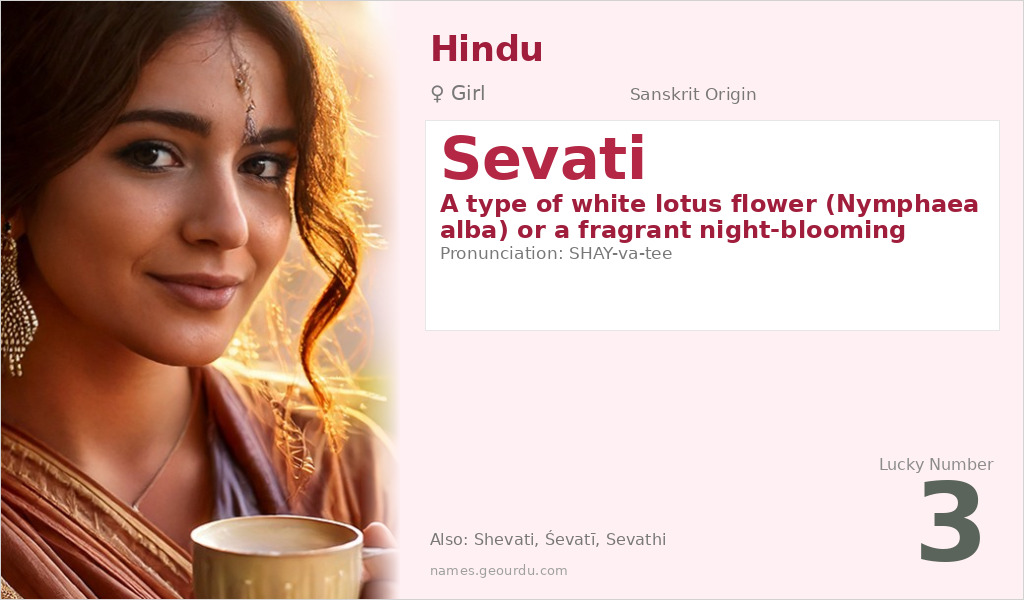
| 📛 Name | Sevati |
| 💎 Meaning | A type of white lotus flower (Nymphaea alba) or a fragrant night-blooming jasmine (Cestrum nocturnum) |
| 👤 Gender | Girl |
| 🕌 Religion | Hindu |
| 🌍 Origin | Sanskrit |
| 🗣 Pronunciation | SHAY-va-tee |
| ✍️ Urdu | شیوتی |
| ✍️ Arabic | شيفاتي |
| 🔢 Numerology | 3 |
| ✨ Spellings | Shevati, Śevatī, Sevathi, Shevathi |
Origin & Cultural Significance
Sevati has its origins in classical Sanskrit language and Hindu culture, dating back to ancient Indian civilization. The name appears in early botanical classifications, Ayurvedic texts describing medicinal plants, and Sanskrit literature where flowers carried symbolic meanings. In Hindu tradition, lotus flowers like Sevati represent spiritual purity, divine beauty, and the unfolding of consciousness. The name has been used historically in India, particularly among communities valuing Sanskrit heritage, though it remains relatively uncommon compared to more popular flower names. Its preservation in classical texts ensures its authenticity as a culturally significant name with deep roots in Indian linguistic tradition.
Personality Traits
Those named Sevati are often perceived as graceful, pure-hearted individuals with a natural elegance. Like the lotus that grows in mud yet remains unstained, they demonstrate resilience and maintain their integrity in challenging situations. Their connection to fragrant night-blooming flowers suggests subtlety, intuition, and the ability to make their presence felt in gentle yet meaningful ways. They tend to value beauty, harmony, and spiritual growth in their personal journeys.
Similar Names
If you like Sevati, consider: Kumudini, Padma, Malati, Jasmine, Neelkamal
Famous People Named Sevati
- Sevati (character) — A celestial nymph (apsara) mentioned in Hindu mythology and classical Sanskrit literature
- Sevati Devi — Historical figure referenced in regional Indian folklore as a virtuous woman
Frequently Asked Questions About Sevati
What does Sevati mean?
Sevati means 'white lotus' or 'night-blooming jasmine' in Sanskrit, referring specifically to Nymphaea alba or Cestrum nocturnum flowers.
Is Sevati a boy or girl name?
Sevati is exclusively a girl's name in Hindu and Sanskrit naming traditions, consistently used for females in historical and contemporary contexts.
What is the origin of Sevati?
Sevati originates from Sanskrit language and Hindu culture, with documented usage in ancient Indian botanical texts, Ayurvedic manuscripts, and classical literature.