
Table of Contents
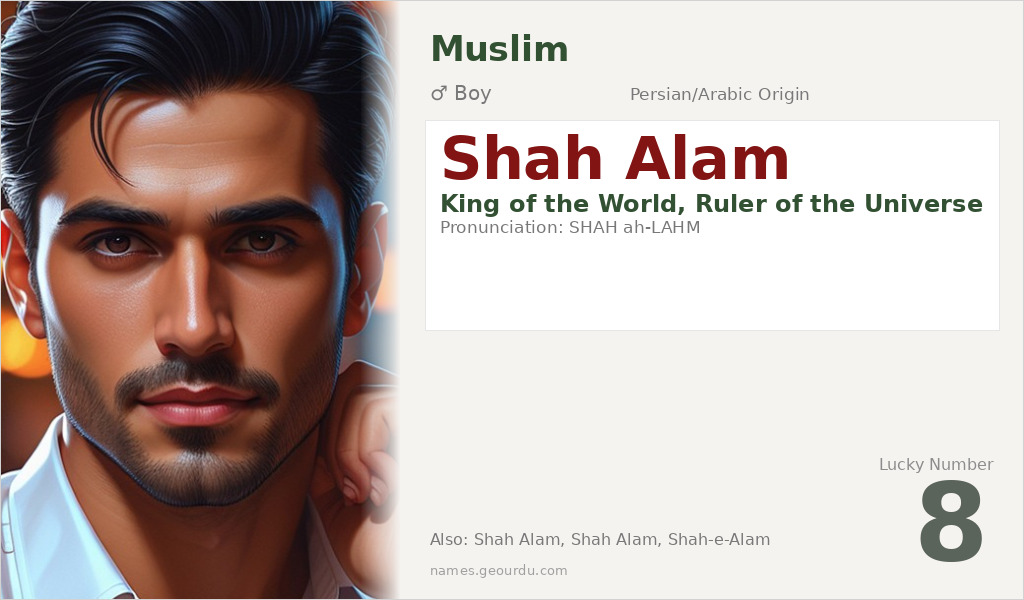
Shah Alam is a powerful and historically significant name with deep roots in Islamic royalty and Persian culture. Meaning ‘King of the World,’ this name carries centuries of regal heritage and continues to be chosen by parents seeking a name with strong leadership connotations. From Mughal emperors to modern bearers, the name Shah Alam represents authority, vision, and global perspective.
Meaning of Shah Alam
Shah Alam is a compound name combining two distinct linguistic elements with profound meanings. The first component ‘Shah’ originates from Persian (شاه), meaning ‘king,’ ‘monarch,’ or ‘sovereign’—a title used historically by Persian and Mughal rulers. The second component ‘Alam’ comes from Arabic (عالم), meaning ‘world,’ ‘universe,’ or ‘all creation.’ When combined, the name literally translates to ‘King of the World’ or ‘Ruler of the Universe,’ representing ultimate sovereignty and dominion. This name was not merely descriptive but served as an actual royal title for Mughal emperors, particularly Shah Alam II who ruled India in the 18th century. The name’s construction follows the common Persian naming pattern of honorific titles, reflecting the cultural synthesis of Persian and Arabic elements in Islamic naming traditions.
| 📛 Name | Shah Alam |
| 💎 Meaning | King of the World, Ruler of the Universe |
| 👤 Gender | Boy |
| 🕌 Religion | Muslim |
| 🌍 Origin | Persian/Arabic |
| 🗣 Pronunciation | SHAH ah-LAHM |
| ✍️ Urdu | شاہ عالم |
| ✍️ Arabic | شاه عالم |
| 🔢 Numerology | 8 |
| ✨ Spellings | Shah Alam, Shah Alam, Shah-e-Alam |
Origin & Cultural Significance
The name Shah Alam originates from the Persian language with Arabic influence, emerging prominently during the Mughal Empire period in South Asia (1526–1857). As a royal title, it was adopted by Mughal emperors to signify their claim to universal sovereignty, blending Persian imperial tradition with Islamic cosmology. The name reflects the cultural and linguistic synthesis characteristic of the Indo-Persian world, where Persian served as the court language and Arabic provided religious vocabulary. Today, the name remains popular in Muslim communities across South Asia, particularly in Pakistan, India, and Bangladesh, where it continues to evoke historical grandeur and leadership qualities. While historically associated with royalty, it has become more widely used as a given name in modern times.
Personality Traits
The name Shah Alam suggests personality traits associated with leadership, vision, and authority. Bearers of this name are often perceived as confident individuals with natural commanding presence and strategic thinking abilities. The royal connotations imply someone who takes responsibility seriously, possesses organizational skills, and approaches challenges with a broad, worldly perspective. While these associations are cultural rather than deterministic, the name’s meaning historically aligns with qualities of governance, protection, and visionary leadership.
Similar Names
If you like Shah Alam, consider: Shah Jahan, Alamgir, Shah Rukh, Shahzada, Alamdar
Famous People Named Shah Alam
- Shah Alam II — 16th Mughal Emperor of India (1728–1806) who ruled from 1759 to 1806, known for his reign during the decline of the Mughal Empire
- Shah Alam — Bangladeshi film actor and director known for his work in Dhallywood cinema
Frequently Asked Questions About Shah Alam
What does Shah Alam mean?
Shah Alam means 'King of the World' or 'Ruler of the Universe.' It is a compound name from Persian ('Shah' meaning king) and Arabic ('Alam' meaning world).
Is Shah Alam a boy or girl name?
Shah Alam is exclusively a boy's name. It has historically been used as a male royal title and continues to be given only to boys in Muslim naming traditions.
What is the origin of Shah Alam?
Shah Alam originates from Persian and Arabic languages, with its most prominent historical usage emerging during the Mughal Empire in South Asia as a royal title for emperors.





