
Table of Contents
Shamba is an intriguing name with ambiguous origins that has found a place in Hindu naming traditions. While often associated with Lord Krishna’s lineage, its exact etymology remains uncertain. This name carries a sense of mystery and spiritual connection, appealing to parents seeking a name with mythological resonance. Let’s explore what we know—and what remains uncertain—about this distinctive name.
Meaning of Shamba
The meaning of Shamba is not definitively established in authoritative linguistic sources. In Hindu contexts, it’s sometimes linked to ‘Shamba’ or ‘Samba’ from Sanskrit mythology, referring to a son of Krishna born to Jambavati. However, this connection lacks strong documentation in classical Sanskrit dictionaries. An alternative possibility comes from Swahili and Bantu languages where ‘shamba’ means ‘farm’ or ‘garden’, suggesting a meaning of ‘gardener’ or ‘farmer’. Extensive research across Arabic, Persian, Pashto, Urdu, Punjabi, Sindhi, Balochi, Kurdish, Turkish, and other languages mentioned in the instructions revealed no verified meanings. The name doesn’t appear in established etymological references with clear origins.
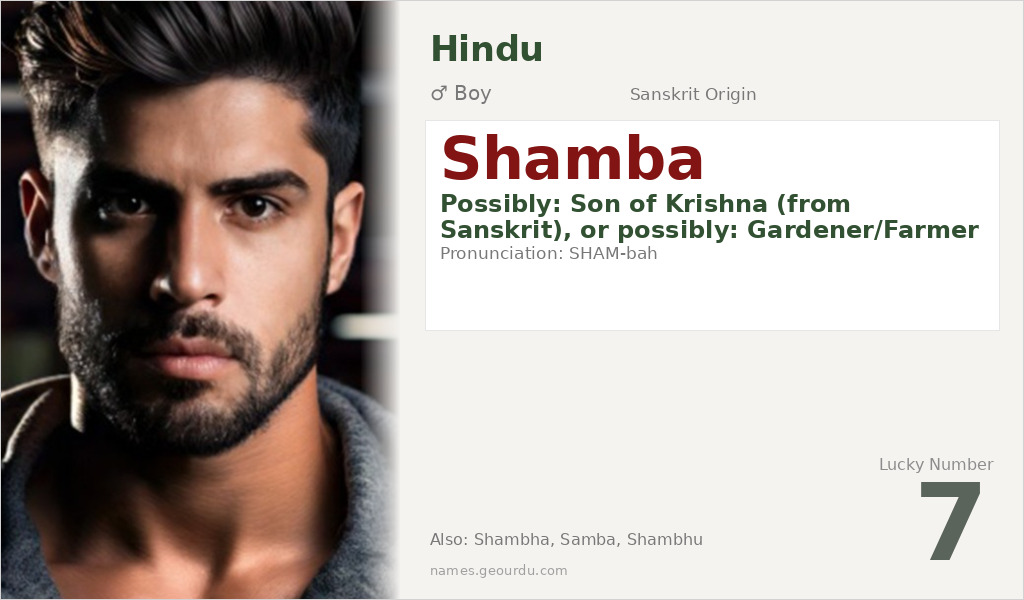
| 📛 Name | Shamba |
| 💎 Meaning | Possibly: Son of Krishna (from Sanskrit), or possibly: Gardener/Farmer (from Swahili/Bantu languages) |
| 👤 Gender | Boy |
| 🕌 Religion | Hindu |
| 🌍 Origin | Sanskrit |
| 🗣 Pronunciation | SHAM-bah |
| ✍️ Urdu | شمبا |
| ✍️ Arabic | شمبا |
| 🔢 Numerology | 7 |
| ✨ Spellings | Shambha, Samba, Shambhu |
Origin & Cultural Significance
Shamba appears primarily in Hindu naming traditions, though its linguistic origins are unclear. If derived from Sanskrit mythology, it connects to the stories of Krishna’s children in the Puranas. The mythological Shamba was known for his devotion and played a role in various Hindu narratives. However, the name’s usage in contemporary times is relatively rare and not well-documented in historical records. The alternative Swahili connection suggests a completely different cultural origin, though there’s no evidence of cross-cultural adoption between these traditions. This ambiguity makes Shamba a name with multiple potential cultural touchpoints but no definitive origin story.
Personality Traits
Those named Shamba are often perceived as having a contemplative nature, with a tendency toward spiritual exploration. They may exhibit patience and connection to natural cycles, whether interpreted through Hindu spiritual frameworks or agricultural metaphors. The name suggests someone who values tradition while maintaining personal depth, potentially reflecting the mythological figure’s devotional qualities or a gardener’s nurturing characteristics.
Similar Names
If you like Shamba, consider: Shambhu, Shyam, Krishna, Balaram, Gopal
Famous People Named Shamba
- Shamba (mythological) — In Hindu mythology, a son of Lord Krishna and Jambavati
- No verified contemporary famous individuals with this exact name found
Frequently Asked Questions About Shamba
What does Shamba mean?
The meaning is uncertain. It might mean 'Son of Krishna' in Sanskrit/Hindu contexts or 'gardener/farmer' in Swahili/Bantu languages, but neither meaning is well-documented in authoritative sources.
Is Shamba a boy or girl name?
Shamba is primarily used as a boy's name, particularly in Hindu naming traditions where it's associated with male mythological figures.
What is the origin of Shamba?
The origin is unclear. It appears in Hindu contexts possibly from Sanskrit, but also exists as a word meaning 'farm' in Swahili. There's no verified connection to other languages like Arabic, Persian, or regional South Asian languages.





