
Table of Contents
Shantinath is a profound Sanskrit name that carries the beautiful meaning ‘Lord of Peace’ or ‘Master of Peace’. This name has deep spiritual roots in both Jainism and Hinduism, representing ideals of tranquility, non-violence, and spiritual mastery. Parents choosing this name often seek to imbue their child with qualities of calm leadership and inner harmony. With its rich historical and religious significance, Shantinath remains a meaningful choice across cultures.
Meaning of Shantinath
The name Shantinath is a classical Sanskrit compound formed from two distinct elements with deep linguistic roots. ‘Shanti’ (शान्ति) originates from the Sanskrit verbal root √शम् (śam), which means ‘to be calm, to cease, to pacify’. This gives us the noun ‘shanti’ meaning peace, tranquility, or calmness. The second component ‘Nath’ (नाथ) comes from √नाथ् (nāth), meaning ‘to seek help’ or ‘to protect’, evolving to mean lord, master, protector, or refuge. When combined, Shantinath literally translates to ‘Lord of Peace’ or ‘Protector of Peace’. This construction follows standard Sanskrit compounding rules where two nouns combine to create a new meaningful unit, similar to other names like Krishnanath (‘Lord Krishna’) or Gopinath (‘Lord of the Cowherds’).
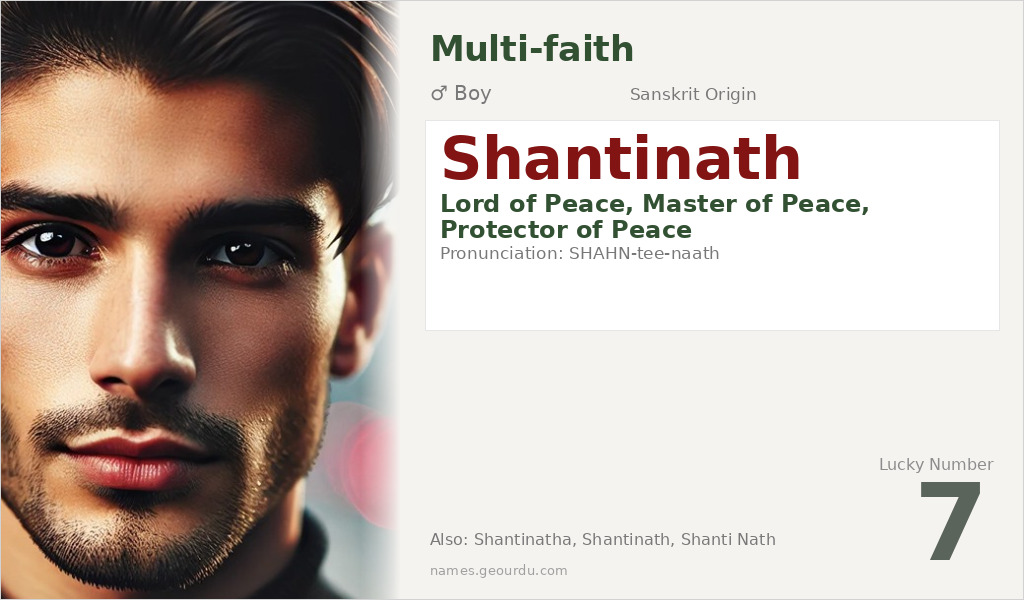
| 📛 Name | Shantinath |
| 💎 Meaning | Lord of Peace, Master of Peace, Protector of Peace |
| 👤 Gender | Boy |
| 🕌 Religion | Multi-faith |
| 🌍 Origin | Sanskrit |
| 🗣 Pronunciation | SHAHN-tee-naath |
| ✍️ Urdu | شانتی ناتھ |
| ✍️ Arabic | شانتيناث |
| 🔢 Numerology | 7 |
| ✨ Spellings | Shantinatha, Shantinath, Shanti Nath |
Origin & Cultural Significance
Shantinath originates from classical Sanskrit, the ancient liturgical language of India that has influenced numerous modern South Asian languages. The name holds particular importance in Jainism as the 16th Tirthankara (ford-maker or spiritual teacher) in the current time cycle. According to Jain tradition, Shantinath was born as Prince Shreyans and later renounced worldly life to attain enlightenment. In Hinduism, the name appears as an epithet for various deities associated with peace and protection. The name’s usage spans multiple Indian languages including Hindi, Marathi, Gujarati, and Kannada, though it remains most closely associated with religious and spiritual contexts rather than common secular usage.
Personality Traits
Those named Shantinath are often associated with serene and contemplative personalities. The name suggests an individual who values harmony in relationships and environments, potentially making them natural mediators in conflicts. Their spiritual name may indicate a tendency toward introspection, wisdom-seeking, and guiding others toward peaceful resolutions. While personality traits vary individually, the name’s meaning often creates expectations of calm leadership and emotional stability.
Similar Names
If you like Shantinath, consider: Shantanu, Shantideva, Shantipriya, Shantaram, Shantilal
Famous People Named Shantinath
- Shantinath — 16th Tirthankara in Jainism, born as Prince Shreyans, who attained enlightenment and taught non-violence and peace
- Shantinath Desai — Renowned Indian Kannada writer and novelist known for his literary contributions
Frequently Asked Questions About Shantinath
What does Shantinath mean?
Shantinath means 'Lord of Peace' or 'Master of Peace' in Sanskrit, combining 'Shanti' (peace) and 'Nath' (lord/protector).
Is Shantinath a boy or girl name?
Shantinath is traditionally a masculine name used for boys, particularly in Jain and Hindu religious contexts where it refers to male spiritual figures.
What is the origin of Shantinath?
Shantinath originates from Sanskrit, the ancient Indian language, with significant religious importance in both Jainism (as the 16th Tirthankara) and Hinduism.





