Table of Contents
Shaqaaiq is a beautiful and poetic Arabic name that carries the fragrance of desert wildflowers and centuries of literary tradition. Unlike common floral names, Shaqaaiq specifically refers to the vibrant anemone flowers that dot Middle Eastern landscapes. This name embodies both delicate beauty and remarkable resilience, making it a meaningful choice for parents seeking a name with natural elegance and cultural depth. With roots in classical Arabic poetry, Shaqaaiq connects its bearer to a rich linguistic heritage.
Meaning of Shaqaaiq
Shaqaaiq (شَقَائِق) is an Arabic noun that specifically means ‘anemones’, referring to the wildflower species Anemone coronaria, commonly known as the poppy anemone or windflower. The word derives from the Arabic root ‘sh-q-q’ (ش ق ق), which carries meanings of splitting, cleaving, or dividing. This likely references the divided appearance of the anemone’s petals or the way the flower seems to split open as it blooms. In botanical Arabic, the full term is often ‘shaqā’iq al-nu’mān’ (شقائق النعمان), literally ‘anemones of Nu’man’, though the shortened form Shaqaaiq is used as a given name. The name has been used metaphorically in Arabic poetry since pre-Islamic times to describe beautiful women, particularly referencing rosy cheeks that resemble the flower’s vivid red petals.
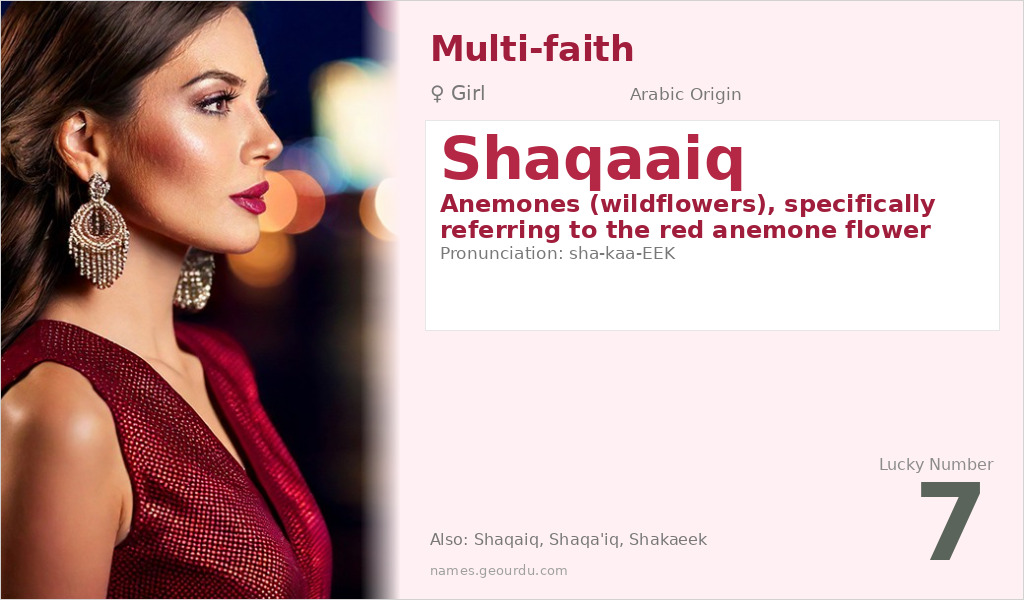
| 📛 Name | Shaqaaiq |
| 💎 Meaning | Anemones (wildflowers), specifically referring to the red anemone flower species |
| 👤 Gender | Girl |
| 🕌 Religion | Multi-faith |
| 🌍 Origin | Arabic |
| 🗣 Pronunciation | sha-kaa-EEK |
| ✍️ Urdu | شقائق |
| ✍️ Arabic | شَقَائِق |
| 🔢 Numerology | 7 |
| ✨ Spellings | Shaqaiq, Shaqa'iq, Shakaeek, Shakaa'iq |
Origin & Cultural Significance
Shaqaaiq originates from classical Arabic language and literature, with its usage as a personal name emerging from the poetic tradition of comparing feminine beauty to natural elements. The name is particularly associated with Arabic-speaking cultures across the Middle East and North Africa, where the red anemone is a native wildflower. While the name appears in Muslim communities due to Arabic’s religious significance in Islam, it is fundamentally a cultural rather than religious name, used by Arabic speakers of various faiths. Historical records show the name appearing in early Islamic period literature, though it remains relatively uncommon as a given name compared to its frequent appearance in poetry and descriptive texts.
Personality Traits
Those named Shaqaaiq are often perceived as having qualities reminiscent of the anemone flower: beautiful yet resilient, delicate yet strong. They tend to possess artistic sensibilities and an appreciation for natural beauty, often expressing themselves creatively. Like the wildflower that blooms in challenging environments, individuals with this name typically demonstrate adaptability and inner strength. Their personality often combines aesthetic refinement with practical resilience, making them both graceful and determined in their pursuits.
Similar Names
If you like Shaqaaiq, consider: Shakira, Shahd, Yasmin, Warda, Nargis
Famous People Named Shaqaaiq
- Shaqaaiq bint Abdullah — Historical figure mentioned in early Islamic sources as a woman known for her beauty and poetic references
- Shaqaaiq al-Nu'man — Not a person but the full Arabic name for the red anemone flower, frequently referenced in classical Arabic poetry
Frequently Asked Questions About Shaqaaiq
What does Shaqaaiq mean?
Shaqaaiq means 'anemones' in Arabic, specifically referring to the red anemone wildflower (Anemone coronaria). It comes from the Arabic root meaning 'to split', likely describing the flower's divided petals.
Is Shaqaaiq a boy or girl name?
Shaqaaiq is exclusively a feminine name in Arabic naming traditions. It has been used for girls for centuries, derived from poetic descriptions of feminine beauty comparing women to delicate flowers.
What is the origin of Shaqaaiq?
Shaqaaiq originates from classical Arabic language and literature. It's a botanical term that became used as a feminine given name through poetic tradition in Arabic-speaking cultures across the Middle East and North Africa.