
Table of Contents
Sheng is a powerful and evocative name of Chinese origin, carrying the profound meaning of ‘victory’ or ‘triumph.’ Often chosen for boys, it reflects aspirations for success and resilience. This name has deep roots in Chinese language and culture, symbolizing overcoming obstacles and achieving greatness. Its simplicity and strong phonetic presence make it a memorable choice across various regions.
Meaning of Sheng
Sheng (胜/勝) is a Chinese name derived from the Mandarin word for ‘victory’ or ‘triumph.’ The character 胜 combines the radical 月 (meat/flesh, suggesting physical strength) with 生 (shēng, meaning ‘life’ or ‘birth’), historically implying vitality in conquest. In linguistic context, it is distinct from homophones like 生 (life) or 声 (sound), emphasizing its association with winning and superiority. The name is commonly used in compound names, such as Shengli (胜利, ‘victory’), enhancing its thematic depth. Its etymology is well-documented in Chinese dictionaries and classical texts, often linked to military or personal achievements.
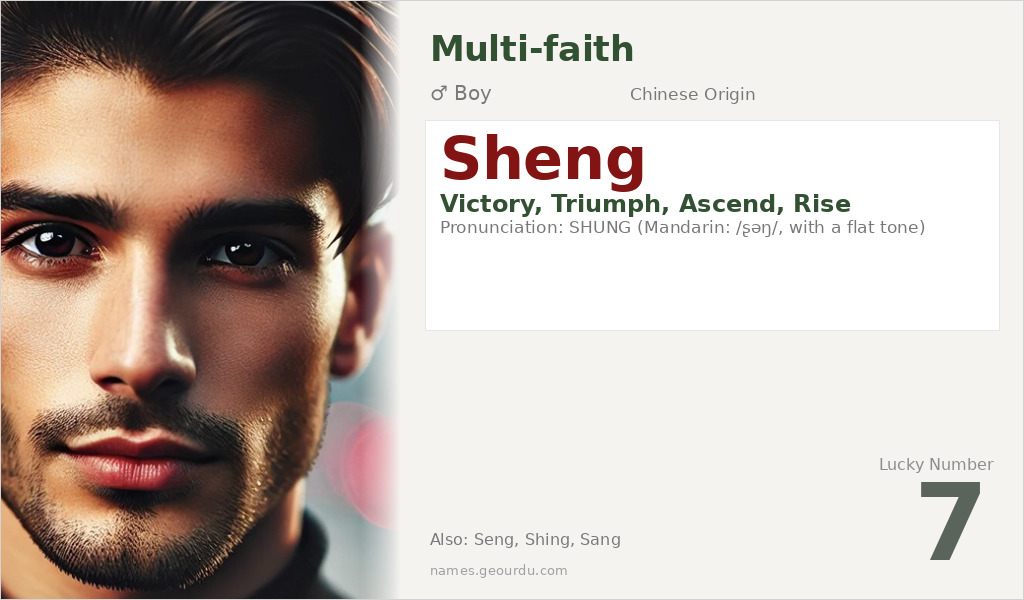
| 📛 Name | Sheng |
| 💎 Meaning | Victory, Triumph, Ascend, Rise |
| 👤 Gender | Boy |
| 🕌 Religion | Multi-faith |
| 🌍 Origin | Chinese |
| 🗣 Pronunciation | SHUNG (Mandarin: /ʂəŋ/, with a flat tone) |
| ✍️ Urdu | شینگ |
| ✍️ Arabic | شينغ |
| 🔢 Numerology | 7 |
| ✨ Spellings | Seng, Shing, Sang |
Origin & Cultural Significance
Sheng originates from Chinese, specifically Mandarin and other Sinitic languages like Hokkien and Teochew, where it can also mean ‘ascend’ (升). It has been used historically in China for centuries, appearing in names of scholars, warriors, and leaders to denote success. Culturally, it is not tied to any single religion but is prevalent in Chinese-speaking communities worldwide, including those with Buddhist, Taoist, or Christian backgrounds. The name’s usage extends to diaspora communities, maintaining its core meaning while adapting to global contexts. It reflects traditional values of perseverance and honor in Chinese naming conventions.
Personality Traits
People named Sheng are often seen as determined and goal-oriented, with a natural inclination toward leadership and achievement. They may exhibit resilience in facing challenges, living up to the ‘victorious’ essence of their name. Their personality tends to blend ambition with practicality, making them effective in competitive environments. This name inspires a sense of strength and purpose, influencing how they navigate personal and professional spheres.
Similar Names
If you like Sheng, consider: Shengli (胜利 — Victory), Shengjun (胜军 — Victorious Army), Shengyu (胜宇 — Victorious Universe), Shengkai (胜凯 — Victorious Triumph), Victor (Latin equivalent)
Famous People Named Sheng
- Sheng Biao (盛彪) — Chinese actor known for roles in wuxia films
- Sheng Guangzu (盛光祖) — Former Chinese Minister of Railways
Frequently Asked Questions About Sheng
What does Sheng mean?
Sheng means 'victory' or 'triumph' in Chinese, derived from the character 胜/勝. It can also imply 'ascend' in some dialects like Hokkien.
Is Sheng a boy or girl name?
Sheng is primarily a boy's name in Chinese culture, though names can be unisex; it is overwhelmingly used for males due to its strong, victorious connotations.
What is the origin of Sheng?
Sheng originates from Chinese languages, specifically Mandarin, with roots in characters meaning victory. It is not inherently religious and is used across various Chinese-speaking cultures.





