
Table of Contents
Shrinath is a profound Sanskrit name with deep roots in Hindu tradition and devotion. Meaning ‘Lord of Shri’ or specifically referring to Lord Vishnu as the consort of Goddess Lakshmi, this name carries both spiritual significance and cultural heritage. Popular among Hindu families, particularly those devoted to Vaishnavism, Shrinath represents divine protection and prosperity. The name gained particular prominence through the worship of Shrinathji, the deity form of Krishna in Nathdwara.
Meaning of Shrinath
Shrinath is a compound Sanskrit name with two distinct elements that together create its profound meaning. The first component ‘Shri’ (श्री) represents prosperity, beauty, radiance, and is specifically associated with Goddess Lakshmi, the Hindu deity of wealth and fortune. The second component ‘Nath’ (नाथ) means lord, master, or protector. When combined, Shrinath literally translates to ‘Lord of Shri’ or ‘Husband of Lakshmi’, which in Hindu theology refers to Lord Vishnu. This name is linguistically significant as it follows classical Sanskrit compounding rules (samāsa) and appears in various Hindu texts and traditions. The specific form Shrinathji refers to the deity Krishna worshipped in Nathdwara, representing his form as a seven-year-old child lifting Govardhan Hill.
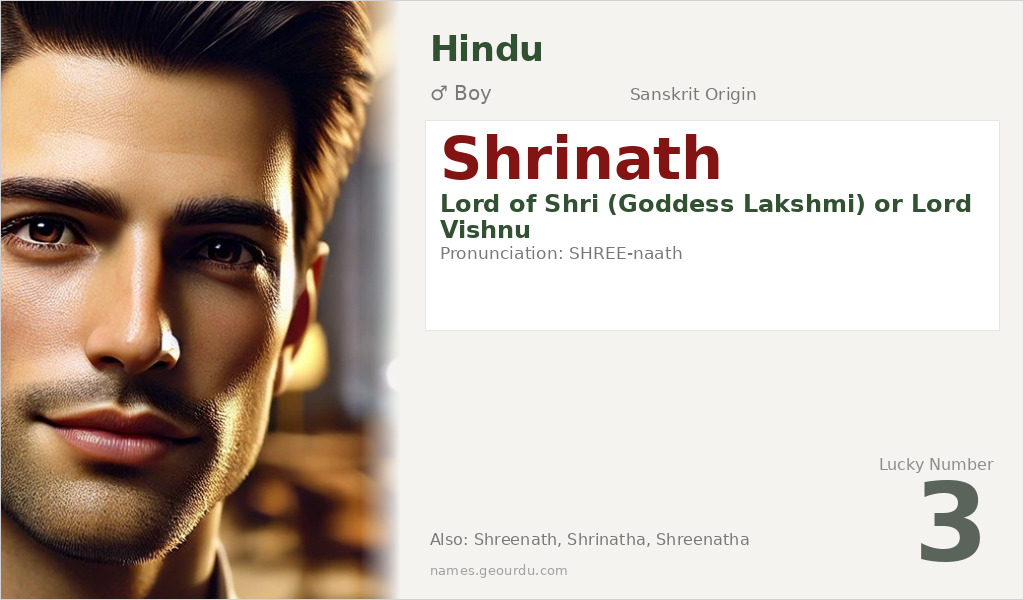
| 📛 Name | Shrinath |
| 💎 Meaning | Lord of Shri (Goddess Lakshmi) or Lord Vishnu |
| 👤 Gender | Boy |
| 🕌 Religion | Hindu |
| 🌍 Origin | Sanskrit |
| 🗣 Pronunciation | SHREE-naath |
| ✍️ Urdu | شریناتھ |
| ✍️ Arabic | شرينات |
| 🔢 Numerology | 3 |
| ✨ Spellings | Shreenath, Shrinatha, Shreenatha |
Origin & Cultural Significance
Shrinath originates from classical Sanskrit, the ancient liturgical language of Hinduism. The name has been used for centuries within Hindu religious contexts, particularly in Vaishnavism traditions that worship Vishnu and his avatars. Its most famous association is with Shrinathji, the deity installed in Nathdwara, Rajasthan in the 17th century by followers of Vallabhacharya’s Pushtimarg tradition. This form of Krishna is depicted as lifting Govardhan Hill with his left hand, and the temple in Nathdwara remains one of the most important pilgrimage sites for Krishna devotees. The name spread through religious devotion and continues to be used by Hindu families, especially in regions with strong Vaishnavite traditions like Gujarat, Rajasthan, and parts of North India.
Personality Traits
Those named Shrinath are often associated with qualities of protection, prosperity, and spiritual leadership. The name suggests someone who balances material success with spiritual values, reflecting the dual nature of Shri (wealth) and Nath (protection). They may be perceived as natural caretakers who bring stability and abundance to their communities. The divine association with Vishnu/Krishna adds a dimension of compassion and righteousness to the personality traits connected with this name.
Similar Names
If you like Shrinath, consider: Shrikant, Shrinivas, Shridhar, Nath, Shriram
Famous People Named Shrinath
- Shrinathji — The deity form of Krishna worshipped in Nathdwara, Rajasthan, central to the Pushtimarg tradition
- Shrinath Singh — Indian poet and literary critic known for his contributions to Hindi literature
Frequently Asked Questions About Shrinath
What does Shrinath mean?
Shrinath means 'Lord of Shri' or 'Lord Vishnu' in Sanskrit. It's a compound name where 'Shri' refers to Goddess Lakshmi (prosperity) and 'Nath' means lord or protector, so it literally means the lord or husband of Lakshmi, which is Vishnu.
Is Shrinath a boy or girl name?
Shrinath is exclusively a boy's name in Hindu tradition. It refers to male deities (Vishnu/Krishna) and follows masculine Sanskrit grammatical forms. There is no feminine equivalent in common usage.
What is the origin of Shrinath?
Shrinath originates from Sanskrit, the classical language of Hinduism. It has been used for centuries in Hindu religious contexts, most famously associated with Shrinathji, the form of Krishna worshipped in Nathdwara, Rajasthan since the 17th century.





