
Table of Contents
Shyamantak is a profound Sanskrit name with rich mythological heritage, directly connected to Lord Krishna’s divine persona. This traditional Hindu name carries the beautiful meaning of ‘one who possesses dark complexion’, reflecting Krishna’s iconic appearance. With roots in ancient scriptures like the Bhagavata Purana, Shyamantak represents both physical attributes and spiritual depth. Parents choosing this name often seek to imbue their child with Krishna’s virtues of wisdom, protection, and divine love.
Meaning of Shyamantak
Shyamantak is a classical Sanskrit compound name with precise etymological components. The first element ‘Shyama’ (श्याम) originates from the Sanskrit root ‘śyāma’ meaning ‘dark, black, or dark-complexioned’, specifically referring to the beautiful dark skin tone associated with Lord Krishna and other deities. The suffix ‘-antak’ (अन्तक) means ‘possessor of’ or ‘one who has’, creating the complete meaning ‘one who has dark complexion’. In Hindu theological context, this isn’t merely descriptive but carries spiritual symbolism—darkness representing the infinite cosmic reality, mystery, and divine protection. The name appears in sacred texts as an epithet for Krishna, emphasizing his all-encompassing, dark-hued divine form that absorbs all light and illusions.
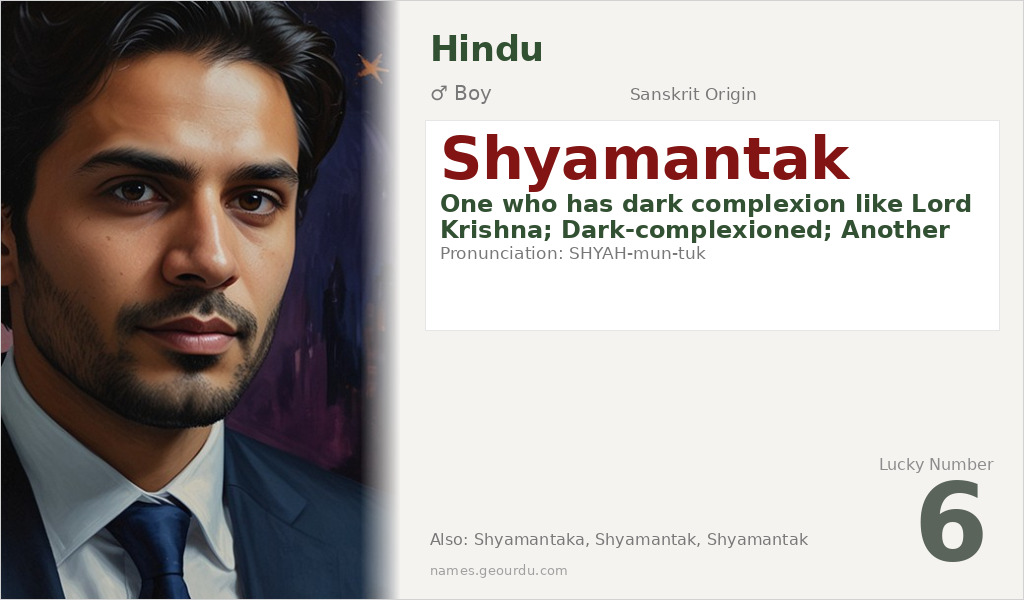
| 📛 Name | Shyamantak |
| 💎 Meaning | One who has dark complexion like Lord Krishna; Dark-complexioned; Another name for Lord Krishna |
| 👤 Gender | Boy |
| 🕌 Religion | Hindu |
| 🌍 Origin | Sanskrit |
| 🗣 Pronunciation | SHYAH-mun-tuk |
| ✍️ Urdu | شیامنتک |
| ✍️ Arabic | شيامانتاك |
| 🔢 Numerology | 6 |
| ✨ Spellings | Shyamantaka, Shyamantak, Shyamantak |
Origin & Cultural Significance
Shyamantak originates from ancient Sanskrit, the liturgical language of Hinduism, with its earliest documented usage in Vedic and Puranic literature. The name gained prominence through the Bhagavata Purana where it appears as one of Krishna’s many names, specifically highlighting his dark complexion that mesmerized devotees. Culturally, the name reflects the Indian aesthetic appreciation for dark skin tones in divine imagery, contrasting with Western beauty standards. Historically, names containing ‘Shyama’ have been popular across Indian subcontinent for millennia, with Shyamantak representing a more formal, compound variation. The name maintains particular significance in Vaishnavism traditions that worship Krishna as the supreme deity.
Personality Traits
Those named Shyamantak are often believed to inherit qualities associated with Lord Krishna—charm, intelligence, and protective instincts. They may exhibit natural leadership abilities combined with artistic sensibilities and deep emotional intelligence. The name’s connection to darkness symbolism suggests individuals who are comfortable with life’s mysteries, possessing intuitive understanding and spiritual depth. These personalities typically balance playful energy with serious philosophical inclinations, much like Krishna’s dual aspects as divine lover and supreme philosopher.
Similar Names
If you like Shyamantak, consider: Shyam, Shyamal, Shyamak, Krishna, Shyamsundar, Shyambihari, Shyamcharan, Shyamaprasad
Famous People Named Shyamantak
- Shyamantak — Character in Hindu scriptures as another name for Lord Krishna
- Shyamantak Mishra — Contemporary Indian scholar and writer
Frequently Asked Questions About Shyamantak
What does Shyamantak mean?
Shyamantak means 'one who has dark complexion' or 'dark-complexioned' in Sanskrit, specifically referring to Lord Krishna's appearance. It's a compound of 'Shyama' (dark) and '-antak' (possessor of).
Is Shyamantak a boy or girl name?
Shyamantak is exclusively a masculine name in Hindu tradition, given to boys. It's derived from masculine Sanskrit grammar and associated with male deity Krishna.
What is the origin of Shyamantak?
Shyamantak originates from Sanskrit, the ancient Indian language of Hindu scriptures. It appears in texts like the Bhagavata Purana as another name for Lord Krishna, with specific cultural significance in Hindu mythology.





