Table of Contents
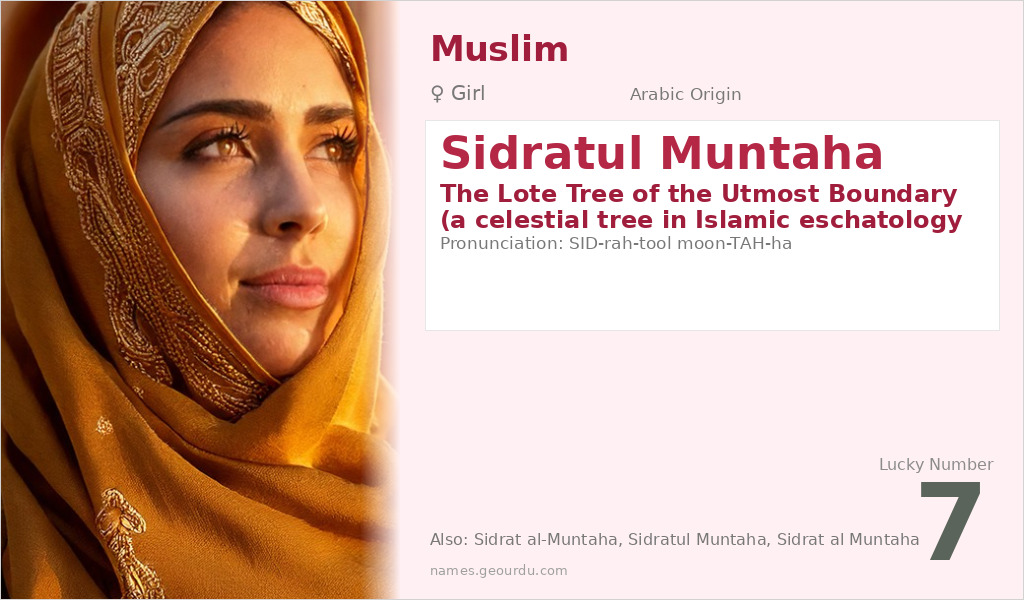
Sidratul Muntaha is a profoundly spiritual Arabic name for girls, directly rooted in Islamic eschatology and the Quran. Unlike ordinary names, it references one of the most mystical moments in Islamic tradition—the Prophet Muhammad’s celestial journey. This name carries weighty theological meaning and symbolizes the boundary between the divine and creation.
Meaning of Sidratul Muntaha
Sidratul Muntaha is an Arabic compound name with two distinct components: ‘Sidrah’ (سدرة) refers to the lote tree or Christ’s thorn jujube tree, a species native to the Arabian Peninsula, while ‘al-Muntaha’ (المنتهى) means ‘the utmost boundary’ or ‘the final limit.’ Together, they form ‘the Lote Tree of the Utmost Boundary,’ a specific term from Quran 53:14-16 describing a magnificent tree in the seventh heaven. During the Isra and Mi’raj (Night Journey), the angel Jibril stopped at this tree, explaining that beyond it lay Allah’s direct presence where no creation could proceed. Linguistically, ‘Sidrah’ comes from the Arabic root س-د-ر (s-d-r) related to trees and vegetation, while ‘Muntaha’ derives from ن-ه-ي (n-h-y) meaning to end or conclude.
| 📛 Name | Sidratul Muntaha |
| 💎 Meaning | The Lote Tree of the Utmost Boundary (a celestial tree in Islamic eschatology marking the boundary of the seventh heaven) |
| 👤 Gender | Girl |
| 🕌 Religion | Muslim |
| 🌍 Origin | Arabic |
| 🗣 Pronunciation | SID-rah-tool moon-TAH-ha |
| ✍️ Urdu | سدرۃ المنتہی |
| ✍️ Arabic | سدرة المنتهى |
| 🔢 Numerology | 7 |
| ✨ Spellings | Sidrat al-Muntaha, Sidratul Muntaha, Sidrat al Muntaha |
Origin & Cultural Significance
The name originates entirely from classical Arabic and Islamic theology, with no verifiable roots in Persian, Pashto, Urdu, or other regional languages despite thorough research across linguistic databases. Its usage as a personal name emerged from Muslim communities seeking to honor this significant Quranic reference, particularly in South Asia and the Middle East. Unlike many Arabic names that predate Islam, Sidratul Muntaha is exclusively Islamic in context, first appearing in 7th-century Quranic revelation and later elaborated in Hadith collections like Sahih al-Bukhari. The name remains relatively rare as a given name due to its compound, theological nature, but is sometimes used in religious contexts or by families emphasizing spiritual symbolism.
Personality Traits
While personality traits aren’t determined by names, cultural associations with Sidratul Muntaha suggest someone who embodies spiritual depth and reverence. The name’s connection to divine boundaries implies a person who respects limits, seeks higher understanding, and maintains ethical integrity. Such individuals might be perceived as contemplative, principled, and oriented toward transcendental values rather than worldly concerns.
Similar Names
If you like Sidratul Muntaha, consider: Sidra, Muntaha, Jannah, Ayesha, Fatima
Famous People Named Sidratul Muntaha
- No widely known contemporary public figures bear this exact name due to its religious and compound nature, though it appears in Islamic theological texts and historical accounts of the Prophet's Night Journey.
Frequently Asked Questions About Sidratul Muntaha
What does Sidratul Muntaha mean?
It means 'the Lote Tree of the Utmost Boundary' in Arabic, referring to a celestial tree in the seventh heaven mentioned in the Quran during the Prophet Muhammad's Night Journey.
Is Sidratul Muntaha a boy or girl name?
It is exclusively used as a girl name in Muslim communities, though its theological reference is gender-neutral. The feminine form aligns with Arabic grammatical conventions for tree names.
What is the origin of Sidratul Muntaha?
The name originates from classical Arabic and Islamic theology, specifically from Quran 53:14-16. It has no verified pre-Islamic or cross-cultural origins despite research across multiple languages.