Table of Contents
Sitr is a beautiful and meaningful Arabic name for girls, deeply rooted in Islamic culture and language. Derived from the root meaning ‘to cover’ or ‘conceal,’ it evokes themes of modesty, protection, and dignity. While not extremely common as a personal name, it carries significant linguistic and ethical weight. Explore the rich layers of this name’s origin, meaning, and cultural resonance.
Meaning of Sitr
Sitr (ستِر) comes directly from classical Arabic, originating from the triliteral root س-ت-ر (s-t-r). This root conveys the core ideas of covering, veiling, screening, or protecting. As a noun, ‘sitr’ refers to a physical or metaphorical veil—anything that provides concealment or privacy. In Islamic tradition, the concept of ‘sitr’ is crucial in discussions of modesty (haya), referring to the covering of one’s awrah (private parts) and maintaining decency. The name thus embodies values of protection, dignity, and respectful seclusion. Linguistically, it is distinct from names meaning ‘intelligence’ (like Aqil) or general ‘modesty’ (like Haya), focusing specifically on the act of covering.
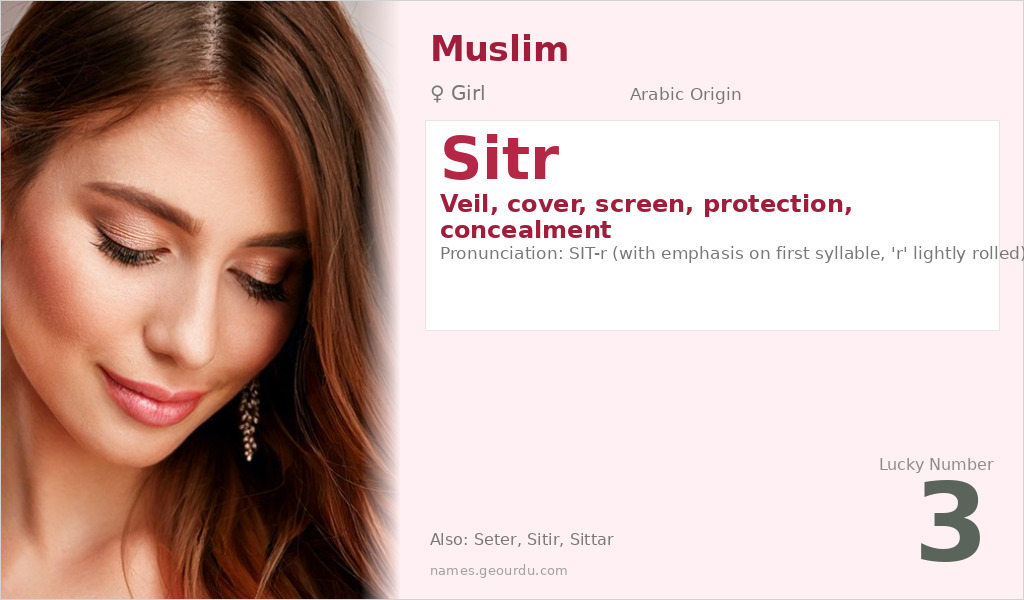
| 📛 Name | Sitr |
| 💎 Meaning | Veil, cover, screen, protection, concealment |
| 👤 Gender | Girl |
| 🕌 Religion | Muslim |
| 🌍 Origin | Arabic |
| 🗣 Pronunciation | SIT-r (with emphasis on first syllable, 'r' lightly rolled) |
| ✍️ Urdu | ستِر |
| ✍️ Arabic | ستِر |
| 🔢 Numerology | 3 |
| ✨ Spellings | Seter, Sitir, Sittar, Sitr |
Origin & Cultural Significance
Sitr originates from the Arabic language and is deeply embedded in Islamic culture and religious discourse. It is not a traditional personal name in most Arab communities but appears as a meaningful word in Islamic texts, ethics, and jurisprudence—particularly in contexts discussing modesty, privacy, and hijab. The name is more conceptual than commonly used for individuals, though it may be chosen for its profound ethical connotations. It is not found as a native name in Persian, Pashto, Urdu, or other regional languages, though the Arabic root is understood across the Muslim world. Its usage as a given name is rare but reflects a desire to instill values of modesty and protection.
Personality Traits
A person named Sitr might be seen as reserved, thoughtful, and protective. The name’s meaning suggests someone who values privacy, creates boundaries, and acts with dignity. They could be perceived as calm, introspective, and loyal—often serving as a ‘veil’ or protector for those they care about. While personality varies, the name carries an aura of modesty and strength in discretion.
Similar Names
If you like Sitr, consider: Satr, Sattar, Sitara, Sajida, Hijab
Famous People Named Sitr
- None widely documented — Sitr is primarily a meaningful word/concept rather than a common personal name in modern usage
Frequently Asked Questions About Sitr
What does Sitr mean?
Sitr is an Arabic word meaning 'veil,' 'cover,' 'screen,' or 'protection.' It derives from the root s-t-r, relating to concealing or veiling.
Is Sitr a boy or girl name?
Sitr is primarily used as a girl name in Muslim communities, reflecting feminine qualities of modesty and protection, though it is grammatically gender-neutral in Arabic.
What is the origin of Sitr?
Sitr originates from classical Arabic and is deeply connected to Islamic culture, where it signifies modesty and covering in both literal and ethical senses.