
Table of Contents
Solomon is a timeless name with deep historical and religious significance across multiple faith traditions. Originating from Hebrew, this name carries the beautiful meaning of ‘peace’ and is forever linked to one of the most famous biblical kings. From ancient scriptures to modern usage, Solomon represents wisdom, leadership, and harmony. This comprehensive guide explores the rich etymology, cultural contexts, and contemporary relevance of this distinguished name.
Meaning of Solomon
The name Solomon derives from the Hebrew שְׁלֹמֹה (Shelomoh), which comes from the root שָׁלוֹם (shalom) meaning ‘peace, completeness, wholeness’. In Hebrew, Shelomoh literally translates to ‘his peace’ or ‘peaceful one’. This etymology reflects the biblical narrative where King Solomon’s reign was characterized by peace and prosperity. The name appears in the Tanakh (Hebrew Bible) as the son of King David and Bathsheba, who succeeded his father as king of Israel. Through Greek (Σολομών) and Latin (Solomonus) adaptations, the name entered European languages while maintaining its core meaning.
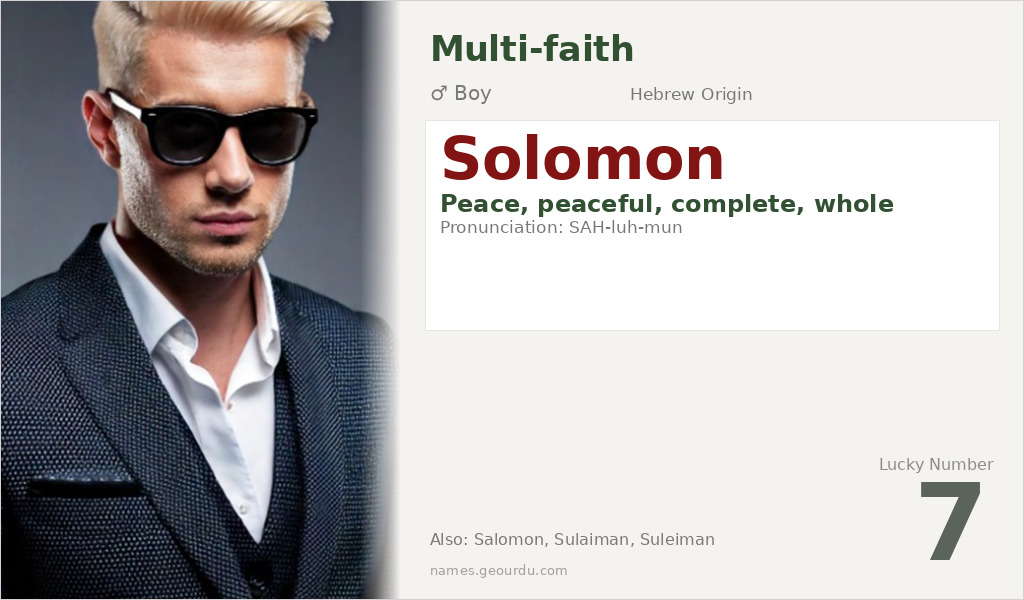
| 📛 Name | Solomon |
| 💎 Meaning | Peace, peaceful, complete, whole |
| 👤 Gender | Boy |
| 🕌 Religion | Multi-faith |
| 🌍 Origin | Hebrew |
| 🗣 Pronunciation | SAH-luh-mun |
| ✍️ Urdu | سلیمان |
| ✍️ Arabic | سليمان |
| 🔢 Numerology | 7 |
| ✨ Spellings | Salomon, Sulaiman, Suleiman, Shlomo, Salomone |
Origin & Cultural Significance
Solomon originates from ancient Hebrew culture and appears prominently in the Hebrew Bible as the third king of the United Kingdom of Israel. The name gained significance in Judaism as King Solomon built the First Temple in Jerusalem and was renowned for his wisdom. In Christianity, Solomon is recognized as an important figure in the Old Testament, while in Islam, he is known as Prophet Sulaiman (سليمان), mentioned in the Quran as a wise ruler who could communicate with animals and jinn. The name spread through Jewish, Christian, and Muslim communities worldwide, with variations like Suleiman in Arabic, Salomon in Spanish and French, and Shlomo in modern Hebrew.
Personality Traits
Those named Solomon often embody characteristics associated with the biblical king: wisdom, judgment, and diplomatic skill. They tend to be thoughtful problem-solvers who value knowledge and understanding. With a natural inclination toward peacemaking, Solomons frequently excel in roles requiring mediation and balanced decision-making. Their analytical minds combined with a desire for harmony make them effective leaders and trusted advisors.
Similar Names
If you like Solomon, consider: Shalom, Salman, Solon, Silas, Samuel
Famous People Named Solomon
- King Solomon — Biblical king of Israel known for wisdom and building the First Temple
- Solomon Northup — American abolitionist and author of 'Twelve Years a Slave'
Frequently Asked Questions About Solomon
What does Solomon mean?
Solomon means 'peace' or 'peaceful one' originating from the Hebrew word 'shalom' (שָׁלוֹם).
Is Solomon a boy or girl name?
Solomon is traditionally and almost exclusively a masculine name across all cultures where it is used.
What is the origin of Solomon?
Solomon originates from Hebrew, specifically from the biblical name שְׁלֹמֹה (Shelomoh), and is significant in Jewish, Christian, and Islamic traditions.





