
Table of Contents
Stanford is a distinguished name with roots deep in English geography and history. Originally denoting someone who lived near a stone river crossing, it evolved from surname to given name with particular popularity in the 19th and early 20th centuries. Today, it carries connotations of stability, tradition, and intellectual prestige, largely due to its association with Stanford University.
Meaning of Stanford
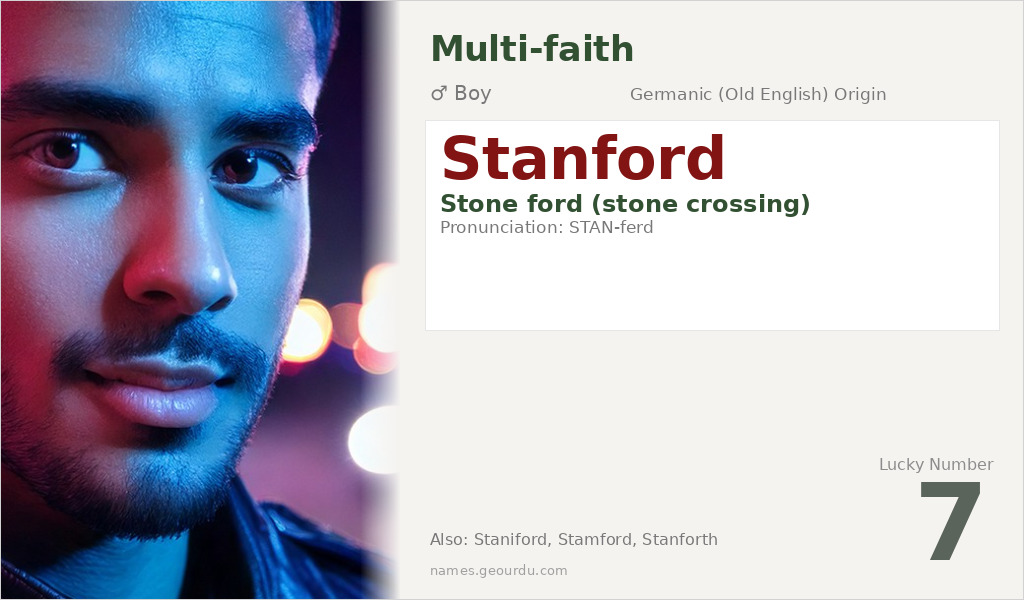
The name Stanford has a transparent and well-documented meaning from Old English, the Germanic language spoken in England from the 5th to 12th centuries. It is a compound of two elements: ‘stan’ meaning ‘stone’ and ‘ford’ meaning ‘a shallow place in a river or stream where one can cross’. Thus, Stanford literally translates to ‘stone ford’ or ‘stony crossing’. This toponymic origin reflects how many English surnames developed from geographical features or locations. The name appears in numerous English place names like Stanford-le-Hope, Stanford in the Vale, and Stanford upon Soar, indicating its widespread use to describe settlements near stone-paved river crossings.
| 📛 Name | Stanford |
| 💎 Meaning | Stone ford (stone crossing) |
| 👤 Gender | Boy |
| 🕌 Religion | Multi-faith |
| 🌍 Origin | Germanic (Old English) |
| 🗣 Pronunciation | STAN-ferd |
| ✍️ Urdu | سٹینفورڈ |
| ✍️ Arabic | ستانفورد |
| 🔢 Numerology | 7 |
| ✨ Spellings | Staniford, Stamford, Stanforth |
Origin & Cultural Significance
Stanford originated as a locational surname in medieval England, derived from various places named Stanford across the country. As a given name, it gained popularity in the 19th century during the Victorian era when surname names became fashionable. The name’s prestige increased significantly with Leland Stanford (1824-1893), the American railroad magnate, philanthropist, and founder of Stanford University. While the name has English origins, it has been adopted in various English-speaking countries without specific religious or cultural restrictions. Its usage spans multiple faiths and cultures where English names are used.
Personality Traits
Those named Stanford are often associated with qualities of solidity, intelligence, and tradition. The ‘stone’ element suggests steadfastness and reliability, while the ‘ford’ element implies an ability to navigate challenges. Historically borne by influential figures in education and the arts, the name carries an air of academic and cultural sophistication. Parents choosing this name often value its historical depth and distinguished sound.
Similar Names
If you like Stanford, consider: Stanley, Stan, Stafford, Clifford
Famous People Named Stanford
- Leland Stanford — American industrialist, founder of Stanford University
- Charles Villiers Stanford — Irish composer and conductor
Frequently Asked Questions About Stanford
What does Stanford mean?
Stanford means 'stone ford' or 'stony crossing,' originating from Old English where 'stan' means stone and 'ford' means a shallow river crossing.
Is Stanford a boy or girl name?
Stanford is traditionally and almost exclusively a masculine name, though like many surname names, it could theoretically be used for any gender.
What is the origin of Stanford?
Stanford originates from Old English as a toponymic surname referring to stone river crossings, later adopted as a given name in English-speaking countries.





