
Table of Contents
Subhas is a distinguished Sanskrit name for boys that carries profound linguistic and cultural significance. Meaning ‘well-spoken’ or ‘eloquent’, this name reflects qualities of articulate communication and intellectual expression. Historically associated with leadership and diplomacy, Subhas has been borne by notable figures in Indian history and literature. This guide explores the name’s authentic meaning, origin, and cultural context beyond common misconceptions.
Meaning of Subhas
The name Subhas originates from classical Sanskrit, composed of two elements: ‘Su’ (सु), meaning ‘good, excellent, or well’, and ‘bhāṣ’ (भाष्), meaning ‘to speak, to talk, or to express’. Together, they form ‘Subhas’, which literally translates to ‘one who speaks well’ or ‘eloquent speaker’. This etymology is well-documented in Sanskrit lexicons like the Amarakosha and Monier-Williams’ Sanskrit-English Dictionary. The name emphasizes qualities of effective communication, rhetorical skill, and articulate expression, distinguishing it from similar-sounding names that might mean ‘shining’ or ‘radiant’. In linguistic context, the root ‘bhāṣ’ is cognate with words across Indo-European languages, including Persian ‘goftan’ (to speak) and Greek ‘phēmi’ (I say), though Subhas remains distinctly Sanskrit in formation.
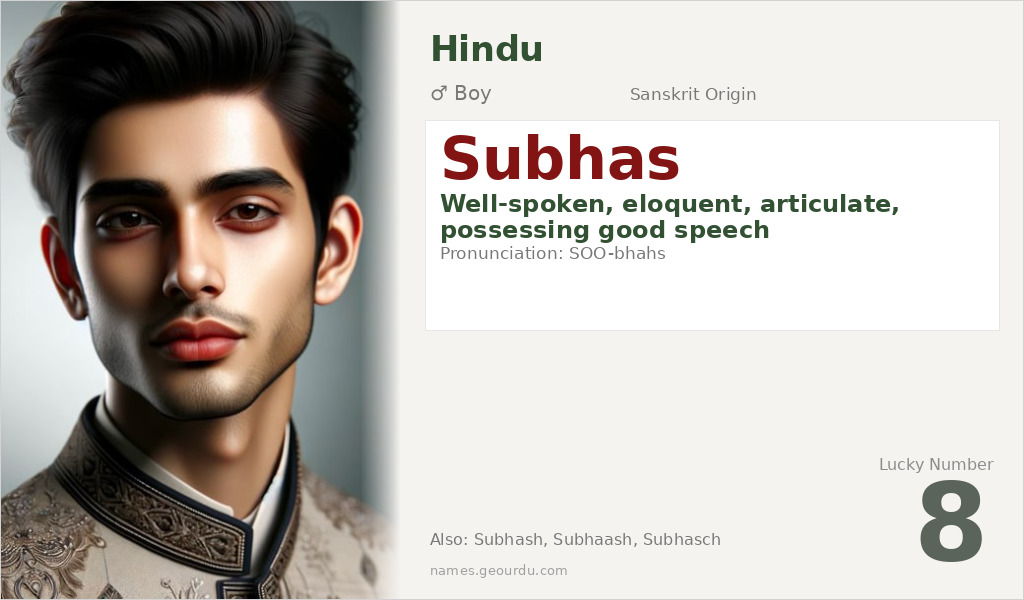
| 📛 Name | Subhas |
| 💎 Meaning | Well-spoken, eloquent, articulate, possessing good speech |
| 👤 Gender | Boy |
| 🕌 Religion | Hindu |
| 🌍 Origin | Sanskrit |
| 🗣 Pronunciation | SOO-bhahs |
| ✍️ Urdu | سبھاش |
| ✍️ Arabic | سوبهاش |
| 🔢 Numerology | 8 |
| ✨ Spellings | Subhash, Subhaash, Subhasch, Soubhās |
Origin & Cultural Significance
Subhas has its roots in ancient Sanskrit, the classical language of India, and is primarily associated with Hindu culture and traditions. The name appears in historical and literary contexts, often denoting individuals with diplomatic or oratorical abilities. While predominantly used in Hindu communities, the name transcends strict religious boundaries and is found among various Indian linguistic groups, including Bengali, Hindi, and Marathi speakers. Its most famous bearer, Subhas Chandra Bose, elevated the name’s prominence in the 20th century through his role in India’s independence movement. The name continues to be used in modern India and among diaspora communities, maintaining its connection to Sanskrit heritage while adapting to contemporary naming practices.
Personality Traits
Those named Subhas are often characterized by their communicative prowess and intellectual clarity. They tend to be persuasive speakers who can articulate complex ideas with ease, making them effective in roles requiring negotiation, teaching, or leadership. Their eloquence is frequently complemented by a thoughtful demeanor and a tendency toward diplomatic problem-solving. In social settings, they may be seen as articulate and insightful, with a natural ability to connect with others through meaningful conversation.
Similar Names
If you like Subhas, consider: Subhash, Subodh, Suvrat, Sumedh, Sukumar
Famous People Named Subhas
- Subhas Chandra Bose — Indian nationalist leader and freedom fighter who led the Indian National Army against British rule
- Subhas Mukhopadhyay — Bengali poet and writer, recipient of the Sahitya Akademi Award
Frequently Asked Questions About Subhas
What does Subhas mean?
Subhas means 'well-spoken', 'eloquent', or 'articulate' in Sanskrit, derived from 'Su' (good) and 'bhāṣ' (to speak).
Is Subhas a boy or girl name?
Subhas is traditionally a masculine name in Sanskrit and Indian naming conventions, though modern usage occasionally sees creative adaptations.
What is the origin of Subhas?
Subhas originates from Sanskrit, the classical language of ancient India, and is primarily associated with Hindu culture and Indian linguistic traditions.





